Wednesday, March 6, 2013
Some interesting thoughts about Essence vs Energies
As seen from the book Deification in the Eastern Orthodox Tradition: A Biblical Perspective (Gorgias Eastern Christian Studies)
"We do therefore have in Jewish theology something which corresponds to the essence-energies distinction of Orthodox Christianity. While on the one hand "face" panim is like the incomprehensible essence, on the other hand the Goodness of God which passes Moses by in the cleft of the rock has affinities with the Orthodox idea of the uncreated energies.
The glory or kabod is partly knowable and partly unkowable. One might describe it as an uncreated energy, in that it is the manifestation of God to his people in the world, rather than God as he is in himself. Its menacing, or transfiguring, quality, depending upon the state of the recipient, reminds one of the Uncreated Light of God, which becomes a fire to sinners.
There is also, however, a big difference between the Jewish theology of God's presence and that of the Orthodox uncreated energies. Judaism stresses the uniqueness of Moses. Only Elijah had a comparable experience, repeating the sight of God's glory from the cleft in the rock and finding God, not in the thunder and fire nor by seeing God's glory, but by hearing a gentle voice, in which the Lord was found (1 kgs 19:12). The New Testament perspective is that all human beings may experience the divine glory, through faith in Jesus Christ and the operation of the Holy Spirit. In the Old Testament, Moses acts as an intermediary between God and his people, standing between them and God. Christ's mediation is different. In the Incarnation, the human nature has been brought into union with the divine nature. If we are "in Christ," then we come into union ourselves with the divinity through our union with the Union27 of God and Man in Christ. Biblical Judaism had a different idea of deification, that is, the imitation of God by following his commandments, commandments that reveal something of God's nature." [1]
"The Jewish theology of revelation is very similar to that of Eastern Orthodoxy. In both, the nature is unknown but God is known by his energies. Moses Maimonides (1135-1204) summarizes the knowledge that can be had of God:
That first and greatest of all thinkers, out teacher Moses, of blessed memory, made two requests and both his requests were granted. His first request was when he asked God to let him know His essence and nature; the second, which was the first in point of time, was when he asked Him to let him know His attributes. God's reply was to promise that He would let him know all His attributes, telling him at the same time that they were His actions. Thereby He told him that His essence could not be apprehended in itself. But also pointed out to him a starting point from which he could set out to apprehend as much of Him as man can apprehend. And indeed Moses apprehended more than anyone ever did before him or after him..29
In imitating God, the Jew imitates the divine energies and so becomes like God in behaving as God does. As Moses Maimonides epitomizes his tradition:
"The highest virtue to which man can aspire is to become similar to God as far as this is possible; that means that we must imitate His actions by our own. 30
God's Holiness is itself an energy, since it describes God's priestly activity of setting apart a people and giving them the means of becoming holy themselves:
"You shall be holy to me, for I the Lord am holy and have separated you from the peoples that you should be mine."(Lev 20:26)
The difference between Christianity and Judaism is often described as Jewish legalism versus Christian freedom. However, this is a distorted perspective. Legalism is possible in all religions, including Eastern Orthodox Christianity, ........etc" [2]
Deification in the Eastern Orthodox Tradition: A Biblical Perspective (Gorgias Eastern Christian Studies)

[1] page 119, [2] pages 121-122 by Stephen Thomas from the book "Deification in the Eastern Orthodox Tradition: A Biblical Perspective"
Tuesday, February 5, 2013
Will Everyone Eventually Be Saved (Universalism)?
Perry Robinson will talk about this issue with Kevin Allen on February 10th at 8pm (EST) on Ancient Faith Today.
Play Audio
Don't miss it!
Wednesday, October 31, 2012
The Condemnation of Arianism at Nicea (325)
The Arian heresy was decisively fought at the First Ecumenical Synod, which was summoned at Nicea in Bithynia in the summer of 325, at which Athanasius was present, accompanying his spiritual master Alexander of Alexandria. Although he was merely a deacon, Athanasius was active in the deliberations of the Synod.(16) His later successor, the resourceful Patriarch Cyril, relates that: Athanasius was so brilliant and celebrated and was admired by all even in that holy and great Synod, the one of Nicea, which was summoned in critical times. He did not yet hold the office of the bishop, but rather belonged to the class of the clerics, and yet, because of his sagacity and gentleness besides, and because of his exceedingly subtle and incomparable mind, he was at that time, taken as his companion by Alexander, the bishop of blessed memory. He was as close to the old man as a son is to his father, leader in everything helpful, and the one who showed the way right well in all things, which were to be done.(17)
Athanasius himself explains the argumentation of the Arians in his letter on the Synod of Nicea and the objections of the Fathers. The Arians put forward biblical words and phrases in order to cover up their particular viewpoint. The Fathers, however, stressed the meaning of the biblical data and did not hesitate to make use of literally non-biblical terms, just as the Arians did, in order to clear up the orthodox meaning of the former. Thus, the fathers clarified the biblical statement that The Son was From the Father, saying that, He was from the essence (being) of the Father, over against the Arian claim that, The Son was out of nothing and, therefore, a creature; and in order that the phrase From the essence might not imply division, the Fathers also added the term Co-essential (Homoousios) to the Father in order to specify the unity of the one and undivided Essence of the Father and the Son. The Great Athanasius was, through his writings, the defender and supporter, par excellence, of these dogmatic decrees of the Synod of Nicea, i.e. of the From the Essence and Co-essential.
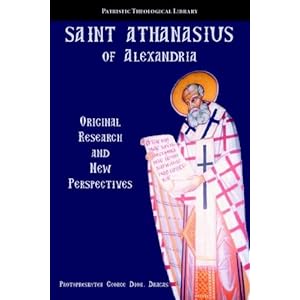
Pages 196 - 197 from the book Saint Athanasius of Alexandria: Original Research and New Perspectives (Patristic Theological Library) by ProtoPresbyter George Dion. Dragas
Friday, October 19, 2012
St. Alexander’s Letter to Alexander of Constantinople
Patriarch/Pope Alexander of Alexandria from 313 A.D. to 328 A.D.
Most of the Theology of the original Nicene Creed can be seen in the works of Saint Alexander of Alexandria(most of which was probably written by Saint Athanasius on his behalf). Also, a form of numeric unity as seen in the Nicene-Constantinople-1 Creed can also be seen in his works when he stresses how the Father and Son are inseparable. In another work before the time of the council of Nicea, Saint Athanasius wrote on his behalf a letter that stressed the doctrine of perichoresis between Father and Son. Also, the idea of Will being a function of Nature can also be seen in some of his letters.
The link:
http://www.fourthcentury.com/index.php/urkunde-14
The hypothesis that the Son came into being “out of nothing” is clearly impious: the Father must always be a father. He is always Father of a Son who is present, on account of whom he is called Father. Only if the Son is always present with him is he always a completed Father, lacking in nothing good. He could not, therefore beget his only Son in time, or in any interval of time, nor out of that which had no previous existence. (27.) Is it not then impious to say, “There was a time when the wisdom of God was not?” The very Wisdom who says, “I was by him as one brought up with him: I was daily his delight?” [Prov 8:30] Is it not also impious to say that at one time the power of God was not, or his Word, or anything else by which the Son is known, or the Father designated? To assert that the brightness of the Father’s glory [Heb 1:3] “once did not exist,” destroys also the original light of which it is the brightness. If there ever was a time in which the image of God [2 Cor 4:4] was not, it is plain that God, whose image he is, is not always. (28.) No, if the express image of God’s Person did not exist, then he was separated from the one of whom he is ever the express image. Hence it may be seen, that the sonship of our Savior has not even anything in common with the sonship of men. (29.) It has been shown that the nature of his existence cannot be expressed by language, and infinitely surpasses in excellence all things to which he has given being. So also his sonship, naturally partaking in his Father’s Divinity, is unspeakably different from the sonship of those who, by his appointment, have been adopted as sons. He is by nature unchangeable, perfect, and all-sufficient, whereas men are liable to change, and need his help. (30.) What further advance can be made by the wisdom of God [1 Cor 1:24]? What can the very Truth, or God the Word, add to itself? How can the Life or the True Light [John 14:6; 1:4, 9] be bettered in any way? And is it not still more contrary to nature to suppose that wisdom can be susceptible to folly? That the power of God can be united with weakness? That reason itself can be dimmed by unreasonableness, or that darkness can be mixed with the true light? Does not the Apostle say, “What communion has light with darkness? And what harmony has Christ with Belial?” [2 Cor 6:14-15] and Solomon, that “the way of a serpent upon a rock” [Prov 30:19] was “too wonderful” for the human mind to comprehend, which “rock,” according to St. Paul, is Christ [1 Cor 10:4]. Men and angels, however, who are his creatures, have received his blessing, enabling them to exercise themselves in virtue and in obedience to his commands, that thus they may avoid sin.
To read the rest please visit the link!
Subscribe to:
Posts (Atom)

LORD JESUS CHRIST,
SON OF GOD,
HAVE MERCY ON US,
THE SINNERS.

Subscribe To


 Posts
All Comments
Posts
All Comments