Will Everyone Eventually Be Saved (Universalism)?
Perry Robinson will talk about this issue with Kevin Allen on February 10th at 8pm (EST) on Ancient Faith Today.
Play Audio
Don't miss it!
Second Sunday of Lent: Saint Gregory Palamas, Apophatic Theology, and the Essence vs. Energies Distinction
Metropolitan Kallistos Ware talks about Saint Gregory Palamas, Apophatic Theology,
and the Essence vs. Energies Distinction
Apophatic Theology
Audio:
St. Gregory Palamas - 2nd Sunday of Lent, by Fr. Thomas Hopko
God: Essence and Energies, by Kevin Allen, Steve McMeans, and Dr. David Bradshaw, professor of Philosophy and the Philosophy of Religion at the University of Kentucky.
Articles:
The Bradshaw Papers, by Dr. David Bradshaw
The Concept of Divine Energies, by Dr. David Bradshaw
The Distinction Between Essence and Energies and its Importance for Theology, by Christos Yannaras
Chapters 68-76 from the One Hundred and Fifty Chapters, by St. Gregory Palamas
Notes on the Palamite Controversy, by John S. Romanides
Holy Scripture and the Church
"Christ founded the Church. The Church existed even when there was not yet a single book of New Testament Scripture. The books of the New Testament were written by the Apostles later, over the course of more than half a century after the beginning of the historical existence of the Church. In the books written by them, the Apostles left behind testimony of their oral preaching of the Gospel. They wrote for a Church already in existence, and entrusted their books to the Church to serve as perpetual edification. It is evident that the books of Holy Scripture do not constitute the essence of Christianity, since Christianity itself is not a teaching but a new life, established in mankind by the Holy Spirit on the basis of the Incarnation of the Son of God. Thus, it would not be impertinent to say that it is not by Holy Scripture, as a book, that man is saved, but by the grace of the Holy Spirit, Who lives in the Church. The Church guides people to perfection. In the Church there are also other ways, other means to that effect, besides the books of Holy Scripture. St. Irenaeus of Lyons writes: “Many nations of those barbarians who believe in Christ” have “salvation written in their hearts by the Spirit, without paper or ink, carefully preserving the ancient tradition... Those who, in the absence of written documents, have believed this faith, are barbarians, so far as regards our language; but as regards doctrine, manner, and tenor of life, they are, because of faith, very wise indeed; and they do please God, ordering their conversation in all righteousness, chastity, and wisdom.” In order to become a follower of a particular philosophical school it is necessary to assimilate the philosophical works by the father of that school. But is it sufficient to know the New Testament in order to become a Christian? Would this knowledge be enough for salvation? Certainly not. It is possible to know the entire New Testament by heart, it is possible to know perfectly the entire teaching of the New Testament, and still be very, very far from salvation. For salvation it is necessary to be added to the Church, just as it is said in the Book of Acts that those who were being saved were added to the Church (cf. Acts 2:47; 5:13–14). This was when there were no Scriptures, but there was the Church, and there were those who were being saved. Why was it essential to be added to the Church? It is because special grace-bearing power is needed for salvation, and this power can only be possessed by those who participate in the life of the Church, in the life of the single and indivisible Body of Christ. The grace-filled power of the Holy Spirit acts in the Church in many different ways: in the Mysteries and rites of the Church, in common prayer and mutual love, in church services; and, as the divinely inspired Word of God, it also operates through the books of Holy Scripture. Here we are coming close to the definition of Holy Scripture. The books of Holy Scripture are one of the means in the Church through which the grace-filled power of God acts upon people. The Spirit of God gives life only to the body of the Church, and therefore Holy Scripture can have meaning and significance only within the Church. “Flee to the Church, and be brought up in her bosom, and be nourished with the Lord’s Scriptures. For the Church has been planted [like a Paradise] in this world; therefore says the Spirit of God, Of every tree of the garden thou mayest freely eat (Gen. 2:16), that is, Eat ye from every Scripture of the Lord.” Thus, Holy Scripture is one of the manifestations of the common grace-filled life of the Church. Holy Scripture is the property of the Church, precious and priceless, but precisely the Church’s property. Holy Scripture cannot be torn away from the overall life of the Church. Only the Church gives meaning to the existence of Scripture. Holy Scripture is not an independent quantity; it cannot be considered a law given to the Church that she can fulfill and from which she can deviate. Holy Scripture arose in the midst of the Church and for the sake of the Church. The Church possesses Holy Scripture and uses it for the benefit of her members."
Holy Scripture and the Church
Why Orthodoxy is the True Faith (Extended Version)
These are the three marks of truth, according to Saint Vincent of Lerins, and -among all Christian denominations- only Orthodoxy possesses all three of them, as we shall easily show in the following paragraphs:
Protestantism lacks all three of them, primarily antiquity, the first Protestant denominations dating back to no sooner than the 16th century, or -more precisely- to 1517 AD. Even the so-called Pre-Reformers did not exist prior to the 12th, 14th, or 15th centuries.
Among the remaining four1 ancient and apostolic churches, only Orthodoxy possesses universality, as we shall now demonstrate:
Catholicism is distinguished by its unique, local belief in the Filioque, completely unknown to all other ancient and apostolic churches.
Monophysitism or Miaphysitism is distinguished by its unique, local belief in the one nature of Jesus Christ, completely unknown to all other ancient and apostolic churches.
Nestorianism is distinguished by its unique, local belief in the two persons of Jesus Christ (Jesus the man, and Christ our God), completely unknown to all other ancient and apostolic churches.
Therefore –among all the ancient and apostolic churches– Orthodoxy is the only one that possesses catholicity, being thus "the one holy catholic and apostolic church" of the Nicene creed.
1 I did not take into account artificial hybrids, or unification movements, such as Eastern Catholicism (between Catholicism and Eastern Orthodoxy), Oriental Catholicism (between Catholicism and Oriental Orthodoxy), and Monothelitism or Monoenergism (the Maronites of Lebanon: between Eastern and Oriental Orthodoxy), all of which lack both antiquity, as well as universality.
Apostolic Succession: The Pre-Augustinian View

"In Augustine’s mind, therefore, the Donatists were within the apostolic succession. Their bishops had been consecrated by bishops who had been validly consecrated, and because the sacrament confers an indelible grace, they retain valid orders. Further, the Donatist bishops retained the ability to pass on valid orders to those they ordained. A subtle shift has taken place in the concept of apostolic succession. In the earlier patristic view the Church itself, the eucharistic community, was the bearer of the succession. The individual bishop participated in and carried the succession because of his office as head of the apostolic community. For Augustine, each individual bishop carries within himself the indelible mark of apostolic succession and is able in and of himself to pass it on, whether or not he has remained in communion with the Catholic Church. Thus, apostolic succession becomes a matter of episcopal “pedigree,” of who ordained whom, rather than of integration into a community which is itself apostolic. Continuity was disconnected from community. If the validity of the apostolic succession resides in the individual bishop, whether or not he is connected to the community, some means needed to be developed to determine whether or not a particular bishop is within the succession. In the Western Church four criteria were developed to determine the validity of a consecration. Three are exoteric (exterior) criteria. The fourth is esoteric (interior).
(1) Form: The consecration must be done in the context of the eucharistic liturgy to be valid. This emphasizes the connection of the ordination with the community. A consecration done secretly in the bishop’s study, for example, would not be a valid consecration.
(2) Matter: There must be an actual laying on of hands by a bishop during the liturgy. Prayer is not sufficient in and of itself.
(3) Minister: The one who performs the consecration must himself be a validly consecrated bishop within the apostolic succession.
(4) Intention: The intent of the laying on of hands and the prayer within the liturgy must be to ordain or consecrate the person to holy orders. One could conceivably lay hands on someone during the liturgy for prayer for healing, for blessing, or for some other worthy purpose, without intent to ordain. This criterion removes the possibility of someone claiming to be a bishop or priest simply because he had received the “laying on of hands” in the liturgy. The intent must be to ordain.
In modern Western Christian thinking, if these criteria were met in a consecration, a bishop is within the apostolic succession and may ordain others who are within the succession, whether or not he remains in communion with the Church. This has led to the proliferation of numerous groups, usually small, who claim to be in the apostolic succession but are in communion with no one. These bishops are called episcopi vagantes, wandering bishops. The Orthodox Church, following the earlier patristic tradition, holds that apostolic succession is carried by the community. To be within the succession, a bishop must be properly elected by the diocese he is to administrate, be approved by the legitimate governing synod to which he will be accountable, be consecrated by bishops within the Orthodox Church, and remain faithfully in communion with the Orthodox Church. Once a bishop leaves the Church in schism, the Church is not obligated to recognize any consecrations or ordinations he performs. Thus, for the Orthodox, the episcopi vagantes are not within the succession. Nor are the Anglicans or the Roman Catholics necessarily seen as fully in the succession, although in practice the Church has received Catholic priests without requiring them to be ordained in the Orthodox Church. For the Orthodox, to be a part of the eucharistic community of the unbroken One Holy Catholic and Apostolic Church is to be in the apostolic succession. To separate from it is to be outside the succession, no matter by whom one was ordained."
The Trouble With Galileo Galilei
Yes, the guys trying to burn him at the stake were Catholic as well, I get that: but, -you see-, just because Sicilian mobsters "murderize " each other doesn't make either one of them less Italian than the other...
Martin Luther on Faith Alone and Eternal Security

+ In the Name of our Lord Jesus Christ. Amen. +
1. Since our Master and Lord Jesus Christ said: Repent, etc. wishes He that the whole life of His faithful followers on earth be one of constant and unceasing repentance.
3. However, He did not mean for it to refer only to the inner repentance: yea, the inner repentance is null, and no repentance at all, where it does not outwardly work all sorts of deadenings of the flesh.
4. Keeping this same sorrow and regret, that is, true repentance, as long as one dislikes himself, namely, until the passage from this life into the everlasting one.
94. Christians should be urged to strive and follow their Head, Christ, through Cross, death, and Hell.
95. And all the more through much effort in Heaven to arrive, than through the comfort and consolation of peace to become more assured.

Priest: That we may carry out the rest of our lives in peace and repentance, let us ask of the Lord.
Faithful: Grant us this, oh Lord.
Priest: Let us offer up ourselves, each other, and our entire lives, unto Christ our God.
Faithful: Unto Thee, oh Lord.
Orthodox Christianity: Delivering Its Opponents To A Bitter Death Since 306 AD

The pagan emperor Maximian, taking an interest in gladiator games, sat and watched as many Christians were being killed by the hands of a strong and powerful fighter named Lyaeus, from the tribe of the Vandals. Unable to suffer seeing such wickedness any longer, the young Christian Nestor, zealously aflame with passion, went to meet with you in your cell, Saint Demetrius, and confessing to you his heart's ardent desire, asked for your blessing and prayers, so that he might defeat him; and you, Holy Martyr, putting your hope in the One Who strengthened you, and signing him with the mark of the Cross, told him: "Go forth, for against Lyaeus will you conquer, and Christ our Lord will you confess ", singing together with him: Hallelujah!

The young Nestor, putting his hope in God through you, Holy Great Martyr Demetrius, and hastily running towards that frightful place, cried out with a loud voice, saying: "Oh, Lyaeus, come let us both fight !"; but the emperor, seeing him so young and fair, took him to the side and told him: "Can't you see how many people Lyaeus killed ?", trying to lure him into becoming of one mind with him; but he, unwilling to comply, cried out: "God of Demetrius, help me !". And right away started fighting with Lyaeus, and throwing him into the sharpened spears, delivered him unto a bitter death, thus fulfilling your prophecy, Holy one; for which we greet you with these praises:
Rejoice, for you have encouraged Nestor to fight against him;
Rejoice, for you have foretold that through the sign of the Cross will he conquer him;
Rejoice, for unto a bitter death have you delivered him;
Rejoice, for the young Nestor a strong anchor in Christ through your holy prayers has found;
Rejoice, for his Hope did not disappoint him;
Rejoice, for your prophecy, oh Holy one, came true;
Rejoice, for Nestor also Christ confessed;
Rejoice, for the emperor's bait he did not accept;
Rejoice, since for him also a heavenly crown was prepared;
Rejoice, for at the emperor's command, by Marcian was he beheaded;
Rejoice, for his pure soul in Heaven with the Martyrs was counted;
Rejoice, myrrh-streaming Great Martyr Demetrius!
When the mad emperor found out that you, Martyr Demetrius, were the cause of Lyaeus' destruction, he became very afflicted, more so than as if he would've had lost his whole kingdom, and straight away commanded his soldiers that you likewise by spears shall be pierced; and you, praiseworthy Martyr, were awaiting your sentence thinking of the imperishable heavenly rewards you would soon be gaining, singing unto God: Hallelujah!
Orthodox Christianity: Silencing The Opposition Since 325 AD
When Constantine returned to Byzantium, certain philosophers came to him to complain of the innovations in religion, and particularly of his having introduced a new form of worship into the state, contrary to that followed by his forefathers, and by all who were formerly in power, whether among the Greeks or the Romans. They likewise desired to hold a disputation on the doctrine with Alexander the bishop; and he, although unskilled in such argumentative contests, and perhaps persuaded by his life, seeing that he was an excellent and good man, accepted the struggle at the command of the emperor. When the philosophers were assembled, since every one wished to engage in the discussion, he requested that one whom they esteemed worthy might be chosen as spokesman, while the others were to remain silent. When one of the philosophers began to open the debate, Alexander said to him, “I command thee in the name of Jesus Christ not to speak.” The man was instantaneously silenced. It is then right to consider whether it is a greater miracle that a man, and he a philosopher, should so easily be silenced by a word, or that a stone-wall should be cleft by the power of a word, which miracle I have heard some attribute to Julian, surnamed the Chaldean. I have understood that these events happened in the way above narrated.
Book I, Chapter XVIII.
A Protestant-Orthodox Dialogue
 Lvka said...
 This post has been removed by a blog administrator.
Lvka said... This post has been removed by a blog administrator.
Lvka said... This post has been removed by a blog administrator.
Lvka said... This post has been removed by a blog administrator.
Lvka said... This post has been removed by a blog administrator.
Lvka said... This post has been removed by a blog administrator.
Lvka said... This post has been removed by a blog administrator.
Lvka said... This post has been removed by a blog administrator.
Lvka said... This post has been removed by a blog administrator.
Lvka said... This post has been removed by a blog administrator.
Lvka said... This post has been removed by a blog administrator.
Lvka said... This post has been removed by a blog administrator.
Hmmm... now, let's see, what happened?
the sufferings of iconodules were mostly later fabrications anyways.
Just like those of the early Christian martyrs, you mean?
iconodules re-wrote the history after their victory, luridly making up stuff of what horrible nasty persecutors the iconoclasts had been.
Christians re-wrote the history after their victory, luridly making up stuff of what horrible nasty persecutors the pagans had been.
your childish apples-and-oranges comparison between the denial of iconodulic martyrdom and the martyrdom of early Christians
Yes, indeed: how childish of me to compare the persecution of Christians with... the persecution of Christians! Dumb, huh? What a totally original, completely controversial, and wholly counter-intuitive idea!... Who'd've thunk it !?
RC/EO historians have slandered the memory of iconoclast emperor Constantine V "Copronymus" - "dung-named"
Curiously enough, I don't see him saying the same about them "slandering" Arius' earthly departure...
[The former defecated in his Baptismal water, whereas the latter died of dysentery: although there was nothing super-natural or un-common and extra-ordinary about any of these things, the Orthodox interpreted them as signs of bad omen: in the first case, as a prophecy of Copronymus' future heresy; in the latter, as a divine punishment for Arius' heretical views].
Nestorian Assyrians have been famous for their detestation of images,
That's why they probably found a huge statue of the Virgin Mary in a seventh-century Nestorian Temple in China...
But here's yet a bit more, from Gibbon: "In their Syriac liturgy the names of Theodore and Nestorius were piously commemorated: they united their adoration of the two persons of Christ; the title of Mother of God was offensive to their ear, and they measured with scrupulous avarice the honors of the Virgin Mary, whom the superstition of the Latins had almost exalted to the rank of a goddess. When her image was first presented to the disciples of St. Thomas, they indignantly exclaimed, "We are Christians, not idolaters!" and their simple devotion was content with the veneration of the cross."
I kindly advised him to take the word of an actual Indian Orthodox Christian over that of a man whose main purpose in his book was the "open denigration of organized religion ". -- all to no avail...
[The reason why we even arrived at this point of our discussion in the first place was because I challenged him to answer how exactly is it that the Ancient Churches of the East (that the article was about) had the same teaching concerning the veneration of icons, saints, and relics as we do, even though they broke off from the rest of Christendom whole centuries before the dreaded Seventh Ecumenical Council of Second Nicaea].
John 12:47 And if any man hear my words, and believe not, I judge him not: for I came not to judge the world, but to save the world. 48 He that rejecteth me, and receiveth not my words, hath one that judgeth him: the word that I have spoken, the same shall judge him in the last day.
John 15:22 If I had not come and spoken unto them, they had not had sin: but now they have no cloke for their sin.

Is Eastern Orthodoxy Eastern Heresy? My Response
How can we be an Eastern heresy if we preserved the Truth? Unlike Steve Hays, we can actually trace most of our beliefs back to the early centuries. We can actually point not only to Scripture for our beliefs, but to great men of the Faith and to Church Councils as well! This is something he can't do!
And so whatever he says about us, he must also say about the historic Christian Faith in general. To fight against us is to fight against the great Eastern (and early Western) Church Fathers, councils, and creeds!
Also, he is not even in agreement with the semi-Augustinian position of the post-2nd-Orange Christian West. And so he really doesn't have a leg to stand on. His interpretation of the doctrine of the Trinity is far from being the historic Christian one. Yes, he is trying to flip the tables on us, but to do so is to destroy any real sense of doctrinal continuity with the past.
For how could he embrace, in good conscience, some of the Ecumenical creeds and non-Augustinian Fathers of the past, while at the same time calling us an Eastern heresy? What in the world does he think we believe?
The Jewish Trinity
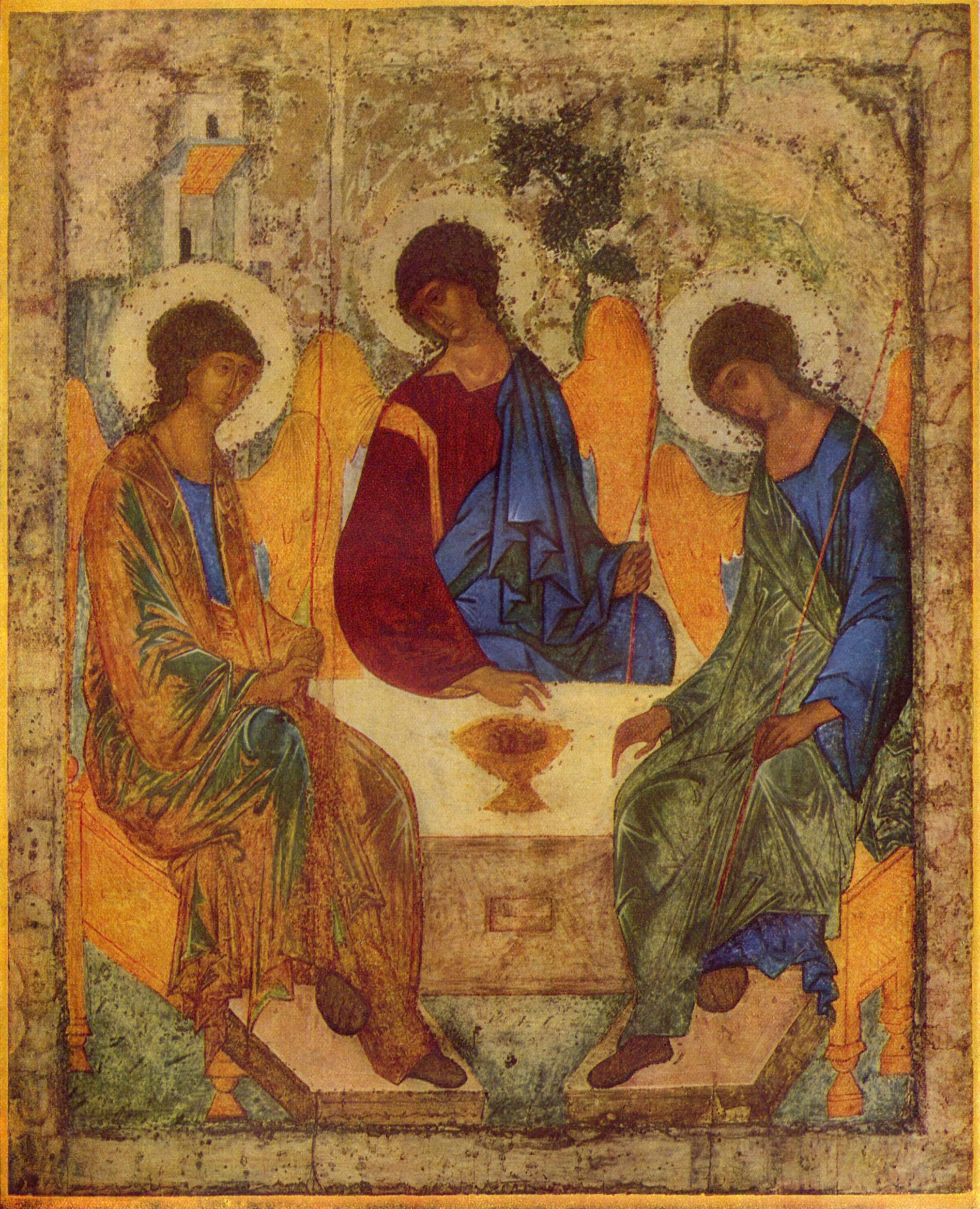
The one in the middle is the Father of the Universe, who in the Sacred Scriptures is called by his proper name, I am that I am ; and the Beings on each side are those most ancient Powers which are always close to the living God, one of which is called his Creative Power, and the other his Royal Power. And the Creative Power is God, for it is by this that he made and arranged the Universe; and the Royal Power is the Lord, for it is fitting that the Creator should lord it over and govern the creature.
chapter 24, paragraph 121.
The Council of Carthage and the Doctrine of Original Sin
It must be made known that Eastern Christianity differs from Western Christianity when it comes to the "Understanding" of what Original sin means. It also must be known that both the Augustinians as well as the Semi-Pelagians were at that council to combat the Pelagians. And as we know, the Augustinians and the Semi-pelagians had a different understanding about the condition of man.
Some Eastern Orthodox scholars have called the eastern christian understanding "ancestral sin". The reason why I mentioned this is because John Cassian came from the East to the West, and he as well as his followers were both at the council. So His understanding about the doctrine of Original sin would have been an Eastern One.
The Basic difference between the two views depends on how one reads Romans chapter 5:12
The Rev. Antony Hughes shows the difference when he said:
http://orthodoxnorth.net/ancestral_vs_original_sin.htm
"The piety and devotion of Augustine is largely unquestioned by Orthodox
theologians, but his conclusions on the Atonement are (Romanides, 2002).
Augustine, by his own admission, did not properly learn to read Greek and this
was a liability for him. He seems to have relied mostly on Latin translations of
Greek texts (Augustine, 1956a, p. 9). His misinterpretation of a key scriptural
reference, Romans 5:12, is a case in point (Meyendorff, 1979). In Latin the
Greek idiom eph ho which means because of was translated as in whom. Saying that
all have sinned in Adam is quite different than saying that all sinned because
of him. Augustine believed and taught that all humanity has sinned in Adam
(Meyendorff, 1979, p. 144). The result is that guilt replaces death as the
ancestral inheritance (Augustine, 1956b) Therefore the term original sin conveys
the belief that Adam and Eve’s sin is the first and universal transgression in
which all humanity participates"
HE also writes:
"Ancestral sin has a specific meaning. The Greek word for sin in this case,
amartema, refers to an individual act indicating that the Eastern Fathers
assigned full responsibility for the sin in the Garden to Adam and Eve alone.
The word amartia, the more familiar term for sin which literally means “missing
the mark”, is used to refer to the condition common to all humanity (Romanides,
2002). The Eastern Church, unlike its Western counterpart, never speaks of guilt
being passed from Adam and Eve to their progeny, as did Augustine. Instead, it
is posited that each person bears the guilt of his or her own sin. The question
becomes, “What then is the inheritance of humanity from Adam and Eve if it is
not guilt?” The Orthodox Fathers answer as one: death. (I Corinthians 15:21)
“Man is born with the parasitic power of death within him,” writes Fr.
Romanides (2002, p. 161). Our nature, teaches Cyril of Alexandria, became
“diseased…through the sin of one” (Migne, 1857-1866a). It is not guilt that is
passed on, for the Orthodox fathers; it is a condition, a disease."
This is the basic difference between East and west in regards to the doctrine of Original sin.
We believe mankind inherited death, as well as the tendency/propensity to sin from Adam and Eve.
We do not believe we inherited their guilt. And it is because of this that alot of Orthodox don't like to use the term "original sin".
I kind of think we have to because of the Council of Carthage. We are linked to that Council through the decrees of the 6th ecumenical council. So it would be best to just say our interpretation of the term "original sin" is different from the western interpretation.
Our interpreation is one of "Ancestral sin"
The Syrian Influence on Iconography
The eastern provinces of the Roman empire were heirs of the civilizations of Egypt, Syria and Mesopotamia. The link between early Christian portrait icons and Egyptian funerary portraits is evident. But it is the Syrian physical type which eventually became established in Christian iconography for the portrait of Christ, a bearded figure with full dark hair falling over his forehead, large almond eyes, straight nose and small lips. The reign of the Roman Emperor Justinian (527-65) marks a turning point in art. His support of the arts was part of his mission to civilize, Christianize and unify God's terrestrial Kingdom, of which he was the viceroy. In his capital emerged a synthesis of classical, late antique and hieratic eastern stylistic elements. Justinian's Divine Wisdom (523-7) expresses the world view of imperial Christianity. In the sixth century all the essential elements of a truly Christian stylistic system had already been forged and synthesized. Iconography entered a new phase when canon 82 of the Quinisext Council (692) prohibited symbolic images of Christ, prescribing portrayal of Christ in his human form so that "we comprehend thereby the humility of God the Word, and are guided to the recollection of his way of life in the flesh". Although Byzantine ICONOCLASM in the eighth and ninth centuries challenged the validity of the portrayal of Christ and of the cult of icons, the 'Triumph of Orthodoxy' in 843 promoted a creative synthesis of theology and religious art that was of great significance for the subsequent history of European art.
edited by Ken Parry, David J. Melling, Dimitri Brady,
Sidney H. Griffith, and John F. Healey.
Blackwell, 1999, 2001.
The Protestant Scriptural Dilemma in 6 Easy Steps
- Protestants use the New Testament canon decided and compiled by figures such as St. Athanasius of Alexandria (the first author in history to list the books of the New Testament as we have them today), St. Irenaeus of Lyons (the first author in history to specifically delineate the fourfold Gospel), and Tertullian of Carthage (the first author in history to use the phrase "New Testament" to refer to a collection of writings).
- The basis upon which these individuals and others decided and compiled the New Testament canon was the contents of the Faith they held. It was assumed that as the Church held the Apostolic Faith, anything that disagreed with this Faith was not Apostolic; this was the standard used in sorting the Apostolic writings (which now make up the New Testament) from forgeries (such as the Gnostic writings). For an example of this process, see Eusebius of Caesarea's Church History, book 6, chapter 12.
- The Faith which these deciders and compilers of the New Testament canon held is significantly different from that held by Protestants (of nearly any strain) today. Differences include, but are not limited to: the nature of salvation, the means by which salvation is accomplished, the nature and composition of Christ, the nature and composition of the Godhead, the effective action of the crucifixion and resurrection of Christ, the meaning of the incarnation of Christ, the proper means of service to God, etc.
- Protestants, then, must (and more often than not do) hold that the Faith of the deciders and compilers of Scripture was in error.
- Error produces further error; error cannot produce truth and certainly not perfection.
- The New Testament used by Protestants must, having its sources in error, be in error. Protestants are found to blaspheme the Word of God.
A Defense of the Holy Icons (Part II – Presence of Icons in Early Christianity)
Previous installment: Part I (Introduction)
An obvious and important question to ask when examining the validity of the presence and veneration of the Holy Icons in the churches today is whether or not the earliest Christians, roughly those of the first five hundred years of the Church, used iconography and, if so, how they used it. The faith and practice of these earliest Christians is supremely important in deciding correct faith and practice of Christians today as these early Christians lived the closest in time, place, and culture to the Apostles and other first century followers of Christ. Many of the Christians who lived during this period were members of churches which had been directly founded by Apostles and lived in cities mentioned in the Bible. In addition, very importantly, most of the Christians of this period spoke the ancient Greek of the New Testament as their own native language. Recognizing the importance and authority of the early Church, John Calvin wrote:
If the authority of the ancient church moves us in any way, we will recall that for about five hundred years, during which religion was still flourishing, and a pure doctrine thriving, Christian Churches were commonly empty of images. Thus, it was when the purity of the ministry had somewhat degenerated that they were first introduced for the adornment of churches.12
Until fairly recently, Calvin's words here were the common assumption of both Protestants and historians of early Christianity. It was widely believed and taught that the churches of the first several hundred years were largely imageless and that Christians themselves were generally hostile to figurative art, rejecting it as an idolatrous pagan practice. This assumption was largely based on a dearth of archaeological evidence and on a false assumption of Jewish iconophobia coupled with erroneous prooftexting of various early Christian writers' criticisms of the idols of the pagans.
All three bases of the theory of early Christian hostility toward images have been dismantled by the introduction of new evidence throughout the 20th century, and more evidence continues to be uncovered today through archaeological exploration.14 The hole that once existed in physical evidence of the worship of ancient Christians and Jews has now been filled with numerous discoveries throughout the Middle East, Southern and Eastern Europe, and North Africa.
Perhaps the most famous of these discoveries is the ancient city of Dura Europos.15 Dura Europos was a diverse city, home to Christians, pagans, and Jews alike, located near the western border of what is now the nation of Syria. While under Roman rule, the city was left abandoned by its inhabitants due to a Sassanian seige in AD 256-257,16 preserving for modern archaeologists, who would begin excavating the city shortly after its rediscovery in 1920, a particularly interesting look into the lives of Romans in Syria in the third century.
And of particular interest to us for the purposes of this essay is the church of the city, the oldest Christian church yet discovered, dating to about AD 233.17 Though they are in some rough condition, several examples of early Christian iconography are preserved within the church.18 On the wall near the baptismal font, there is an icon of Christ as the Good Shepherd,19 with Adam and Eve below the figure. On the south wall of the baptistry are icons of St. Photini, better known as “the woman at the well”20 and, to the left of that, an image of the Prophet-King David's fight with Goliath.21 On the north wall of the baptistry are an illustration of the healing of the paralytic22 and a depiction of Christ and St. Peter walking on water.23 A large icon below these depicts three women, probably the Virgin Mary, St. Mary Magdalene, and St. Salome, walking towards what appears to be a tomb, probably a depiction of the cave in which Christ's body was placed after the Crucifixion.24
And the Christians of the city weren't the only ones whose house of worship had lots of images. The Jewish synagogue discovered at Dura Europos, the construction of which was probably finished in about AD 245,25 is filled nearly top to bottom with ornate iconographic depictions of Old Testament events and figures.26 Throughout the dozens of icons present in the synagogue are images of Prophets, such as Moses, David, Ezekiel, Elijah, and Abraham, symbols such as the Menorah and the Torah Scroll, and depictions of events such as the near-sacrifice of Isaac27 and Moses' reception of the Ten Commandments.28 The synagogue at Dura Europos, though a very striking example because of its excellent preservation, is by no means unique in the ancient world; there are many more synagogues with much more iconographic art which archaeologists have discovered and are still in the process of discovering.29
The abundance of images in these synagogues is especially important to our current purposes as it significantly undermines one of the key pillars of the theory that early Christians were hostile to images, namely, the assumption, which passed unquestioned for quite some length of time, that the early Judaism from which Christianity emerged was aniconic and even iconophobic. Clearly, the opposite was true; Christianity emerged from and grew up alongside a Judaism with a vibrant iconographic tradition.
The statements of early Christians writing against idolatry have been interpreted in the context of this false assumption by many for some time. But, with this new archaeological evidence, including both the synagogues and the church at Dura Europos, new interpretations are necessary. The textual evidence can not continue to be interpreted in a vacuum, but must now be interpreted alongside and within the context of the archaeological evidence.
Why would the early Christians expend so much time and effort arguing so vehemently against the idolatry of the pagans while remaining silent about the idolatry, assuming they considered it to be so, rising up in their midst? Early Christian apologists simultaneously railed against the images of the pagans while attending worship services in churches with images; the only plausible explanation for how to reconcile these two facts is that they must not have considered their own images to be idolatrous.
Additionally, early Christian apologists were never shy about criticizing the Jews for any of even the slightest perceived transgressions;30 if the widespread use of images in the synagogues was viewed by them as idolatrous, why did they never take the opportunity to attack the Jews for this? Why, instead, does it seem that early Christians in fact picked up their art forms and styles from the Jews?31 Contrary to the former allegations of Calvin and his faithful disciples, the introduction of icons into the churches was not the result of later pagan influence upon a weaker Church, but was part of the early Jewish inheritance assumed by the new Christian Faith in its first centuries.
These are questions and conundrums that, because the evidence was unavailable until fairly recently, never occurred to earlier Protestant proponents of iconoclasm like John Calvin and which iconoclasm's modern proponents have yet to sufficiently answer or explain. But these are questions which demand an answer if their views are going to continue to be taken seriously in the light of modern archaeological evidence.
Next installment: Part III (Veneration of Icons in Early Christianity)
12 See Calvin, Institutes 1.11.13
15 For more information on Dura Europos, see Hopkins, C., The Discovery of Dura Europos. New Haven and London, 1979. and Rostovtzeff, M.I. Dura-Europos and Its Art. Oxford University Press, 1938.
16 Anglim, Simon, Phyllis G. Jestice, Rob S. Rice, Scott M. Rusch, and John Serrati. Fighting Techniques of the Ancient World: 3000 BC-500 AD : Equipment, Combat Skills, and Tactics. New York: St. Martin's, 2002. pg. 218.
17 González, Justo L. The Story of Christianity. San Francisco: Harper & Row, 1984. pg. 95.
18 Perkins, Ann Louise. The Art of Dura-Europos. Oxford: Clarendon, 1973. and Snyder, Graydon F. Ante Pacem: Archaeological Evidence of Church Life Before Constantine. Macon, Ga.: Mercer UP, 2003. pp. 128-134
19 John 10:11. Depictions of Christ as the Good Shepherd in poetry, prayer, literature, and art were very popular amongst early Christians.
20 John 4:4-26
21 1 Samuel 17
22 Mark 2:1-12
23 Matthew 14:22-33
24 Mark 16:1
25 Goldstein, Jonathan. “The Judaism of the Synagogues (Focusing on the Synagogue of Dura-Europos” in Neusner, Jacob, Alan J. Avery-Peck, and Bruce Chilton. Judaism in Late Antiquity. Leiden: E.J. Brill, 1995. pg. 110.
26 Fine, Steven. Art and Judaism in the Greco-Roman World: toward a New Jewish Archaeology. Cambridge: Cambridge UP, 2005. ch. 11.
27 Genesis 22:1-24
28 Exodus 31:18
29 Urman, Dan, and Paul Virgil McCracken. Flesher. Ancient Synagogues Historical Analysis and Archaeological Discovery. Leiden: E. J. Brill, 1998.
30 See, for instance, St. Justin the Philosopher's (also known as Justin Martyr) lengthy diatribe against the Jews for what he alleges are their alterations, most of them nearly insignificantly minor, of the Scriptural texts, in his Dialogue with Trypho the Jew (written ca. AD 165).
31 For a very interesting and enlightening examination specifically of the Dura Europos synagogue on this point, see Weitzmann, Kurt, and Herbert L. Kessler. The Frescoes of the Dura Synagogue and Christian Art. Washington, D.C.: Dumbarton Oaks Research Library and Collection, 1990.
Fourth Century Arian Icons
So... not only did the pre-Constantinian Christians and Jews already have icons, –as the late-second to early-third century church and synagogue unearthed during the excavations at the Dura-Europos archeological site bear historical witness to this undisputable fact–, but the same also holds true for non-Constantinian and even anti-Constantinian Christian heretics... rather odd, isn't it?
Protestantism And Historical Continuity
Manasseh reigned fifty-five years in Jerusalem, and did that which was evil in the sight of the LORD, after the abominations of the heathen: for he built up again the high places which Hezekiah his father had destroyed, and reared up altars for Baal, and made a grove, as did Ahab king of Israel, and worshipped all the host of heaven, and served them, and built altars in the two courts of the house of the LORD for all the host of heaven; he wrought much wickedness in the sight of the LORD, to provoke him to anger, and set a graven image of the grove that he had made in the house of the LORD. Manasseh king of Judah hath done these abominations, and hath done wickedly above all that the Amorites did, which were before him, and hath made Judah also to sin with his idols. Moreover, he shed innocent blood very much, till he had filled Jerusalem from one end to another, beside his sin wherewith he made Judah to sin, in doing that which was evil in the sight of the LORD.
On the Invocation of the Saints
Originally posted to orrologion
Protestants often have a difficult time coming to terms with prayer to the saints. It is condemned as a christianized paganism, an example of the corruption of Christianity after the conversion of the Roman Empire under Constantine in 313 AD.
This issue falls under two broad headings: the saints’ intercession for the Church Militant and the Church Militant’s invocation of the saints.
Most Protestants would accept the fact that we are prayed for by the departed saints and the angels in heaven (intercession by the saints), just as our family, friends, and clergy here on earth pray us for.
The difficulty lies with our asking (praying, literally “to make earnest petition to or entreaty for”) the departed saints and the angels for their prayers (invocation of the saints). How do we know they can hear us? Some, High Church Anglicans, would accept intercession and invocation, but not the Roman “excesses” of this practice. The 1917 [Roman] Catholic Encyclopedia expresses succinctly the position of the various traditional Protestant bodies:
…the High Church Anglicans contend that it is not the invocation of saints that is here rejected, but only the "Romish doctrine ", i. e. the excesses prevailing at the time and afterwards condemned by the Council of Trent. "In principle there is no question herein between us and any other portion of the Catholic Church. . . . Let not that most ancient custom, common to the Universal Church, as well Greek as Latin, of addressing Angels and Saints in the way we have said, be condemned as impious, or as vain and foolish" [Forbes, Bishop of Brechin (Anglican), "Of the Thirty-nine Articles", p. 422].
The reformed Churches, as a body, reject the invocation of the saints. Article xxi of the Augsburg Confession says: "Scripture does not teach us to invoke the Saints, or to ask for help from the Saints; for it puts before us Christ as the one mediator, propitiatory, high-priest and intercessor." In the "Apology of the Augsburg Confession" (ad art. xxi, sects. 3, 4), it is admitted that the angels pray for us, and the saints, too, "for the Church in general"; but this does not imply that they are to be invoked.
The Calvinists, however, reject both intercession and invocation as an imposture and delusion of Satan, since thereby the right manner of praying is prevented, and the saints know nothing of us, and have no concern as to what passes on earth ("Gall. Confess.", art. xxiv; "Remonst. Conf." c. xvi, sect. 3) [2]
It was my contention as an inquirer into Orthodox Christianity—which accepts both the intercession and invocation of the saints—that if I was willing to accept the testimony of the Fathers of the Church when it came to such abstruse dogmas as that of the Trinity (three hypostases, one ousia) and Christology (two ousia, one hypostasis; Mary as Theotokos and not Christokos; dyoenergism and dyotheletism over monoenergism and monotheletism) as well as the final canon of the New Testament Scriptures, then I must also accept their testimony concerning the intercession and invocation of the saints (and on other matters of daily piety and practice, in the main if not each detail.)
That is, if they had ever said anything about it, if it even existed in their day.
I vaguely assumed that this ‘pagan practice’ must have developed later, or outside of the truly Christian spheres in which these basic dogmas of our faith were formulated.
However, as I read further into Church History and the history of Christian doctrine[3] and the surviving works of these Fathers, these great defenders of the grand doctrines of traditional Christianity held to and practiced many decidedly contrary to “the Bible”.
How could I gauge the worth and reliability of these Fathers? How could their greatness, their contributions to the true Faith, be retained while covering their nakedness?[4] How could we learn from them without making their mistakes? Could the Fathers even be counted as trustworthy?
…At what point do these fallen men cease being quotable and citable and become unreliable and heretical? Can we hold the Fathers in high esteem as reliable ‘recognizers’ of the true Faith? Or, are we just using them as window-dressing for perfunctory, imposing and academic sounding dogmatics? Do we flee ‘cafeteria Christianity’ by way of ‘cafeteria patristics’ and ‘cafeteria history’?
Important, paradigmatic comments (for me, as a traditional, confessional Lutheran) were made by Martin Chemnitz in his Examination of the Council of Trent:
1. There is a very great difference between the primitive church, which was at the time of the apostles
2. and of apostolic men testifying with regard to the books of the Holy Scripture,
3. and the papal church, which is foisting its fictions as apostolic traditions on us without proof.[5]
This comment by Chemnitz places the Fathers in time and defines when the Fathers were still trustworthy, “apostolic” men: that is, when the church testified “with regard to the books of the Holy Scripture.”
Chemnitz here and elsewhere[6] in his Examination refers to the greater trustworthiness of these men whose more ancient and clear-sighted understanding of the truly Apostolic Faith allowed them to testify to (witness to) truly Apostolic traditions such as the inspired canon of Holy Scripture. These “apostolic men” had greater authority than the institutional Roman Catholic Church of Luther and Chemnitz’s day with its innovative (pejorative) ‘traditions of men’[7] – quite similar, actually, to the Orthodox allergy to ‘innovation’.
I had unreflectively assumed that this church of “apostolic men” was limited to either the Apostolic Church of the 1st Century, the generation immediately following the Apostles or perhaps to the Ante-Nicene Church prior to Constantine (a la Dan Brown's The DaVinci Code).
Chemnitz notes that after the self-authentication of Scripture’s inspiration by the Holy Spirit and the ‘sure and special testimonies’ of the Scriptural authors, Scripture:
…has its authority from the primitive church as from a witness at whose time these writings were published and approved. This witness of the primitive Church concerning the divinely inspired writings was later transmitted to posterity by a perpetual succession from hand to hand and diligently preserved in reliable histories of antiquity in order that the subsequent church might be the custodian of the witness of the primitive church concerning the Scripture.[8]
The Lutheran definition of the reliability of the “primitive church” put forward by Chemnitz was that its witness was trustworthy at the time of the recognition of the inspired canon of Holy Scripture.
The Christian canon of Holy Scripture, i.e., the 27 Books of the New Testament, “were decreed by the Synod of Laodicea in 381, and later officially [i.e., universally] ratified by the Sixth Ecumenical Synod of the Church in 680” [9] – the Council that anathematized monotheletism.
By 680 AD [10] we already see all sort of other quite un-Lutheran and ‘un-biblical’ teachings and practices such as the invocation of the saints, the veneration of relics, etc.
‘Early’ and ‘late’ are in the eye of the beholder; how we define ‘early’ and ‘late’ has (or should have, if we are to be consistent) a significant effect on whether and how we hold to the orthodox, catholic doctrines of the Trinity and the Person of Christ. That is, again, if we are willing to accept the testimony of the Fathers of the Church when it came to such abstruse dogmas as that of the Trinity (three hypostases, one ousia) and Christology (two ousia, one hypostasis; Mary as Theotokos and not Christokos; dyoenergism and dyotheletism over monoenergism and monotheletism) as well as the final canon of the New Testament Scriptures, then we must also accept their testimony concerning matters of daily piety and practice (e.g., invocation of the saints) up to at least 680 AD!
In this post I have compiled a less then exhaustive digest of patristic and scriptural citations concerning our invocation of the departed saints of God through only the fifth century.
I hate to admit it, but I actually didn’t do this research before I became Orthodox. I assumed there was no written testimony to be had until many centuries after the Church came out of the catacombs in 313-14. My own understanding of the invocation of the saints came from praying to them, from praying my way into an understanding that the saints can and do hear us.
I was shocked to find that there was, in fact, comparatively early patristic testimony in support of “prayer to the saints”. And this testimony came not from some random, half-pagan “saint” from the backwaters of Mesopotamia or the Pentapolis (or Ireland, Frigia, Scythia, etc) but from the defenders and promoters of the Nicene Creed: the Fathers that had suffered, struggled, and died for the doctrine of the Trinity, and the full divinity of Jesus and the Holy Spirit, those who described this relationship in language too rarified for me to fully comprehend to this day. Most Protestants, Catholics, and Orthodox Christians still hold these doctrines in common—in the face of all that we disagree on. The witness, therefore, of these Christian giants must be taken as more than simply “the doctrine of men”. They prayed to the saints without considering them to be demi-gods; they asked the prayers of those who to whom the Psalmist and Christ said, “Ye are gods.”[11]
Could the Church Which Christ promised would withstand the “Gates of Hades” really have apostatized within a generation of its freedom across the breadth of the entire ancient world?
All ye saints, pray to God for us!
Book of Tobit (~ 200 – 100 BC)
When thou didst pray with tears… I [Archangel Raphael] offered thy prayer to the Lord.[12]
St. John the Evangelist (+101)
And another angel came, and stood before the altar, having a golden censer; and there was given to him much incense, that he should offer of the prayers of all saints upon the golden altar, which is before the throne of God. And the smoke of the incense of the prayers of the saints ascended up before God from the hand of the angel.[13]
Egyptian Liturgy for the Nativity of Christ (200s)
This sung prayer was included in the 3rd-century, Orthodox, Coptic (Egyptian) Liturgy for the Nativity of Christ:
we take refuge, O Theotokos,
disdain not our supplications in our necessity,
but deliver us from perils,
O only pure and blessed one.
St. Ephraim the Syrian (+373)
Remember me, ye heirs of God, ye brethren of Christ, supplicate the Saviour earnestly for me, that I may be freed though Christ from him that fights against me day by day.[14]
Ye victorious martyrs who endured torments gladly for the sake of the God and Saviour; ye who have boldness of speech towards the Lord Himself; ye saints, intercede for us who are timid and sinful men, full of sloth, that the grace of Christ may come upon us, and enlighten the hearts of all of us that so we may love him.[15]
Letter of the Second Ecumenical Council to Emperor St. Theodosius the Great (Constantinople, 381 AD)
May God by the prayers of the Saints, show favour to the world, that you may be strong and eminent in all good things as an Emperor most truly pious and beloved of God.
St. Cyril of Jerusalem (+386)
We then commemorate also those who have fallen asleep before us, first, patriarchs, prophets, apostles, martyrs, that God, by their prayers and intercessions, may receive our petitions.[16]
George Bebis on the Cappadocian Fathers
“In one of his letters, St. Basil (+379) explicitly writes that he accepts the intercession of the apostles, prophets and martyrs, and he seeks their prayers to God. (Letter 360) Then, speaking about the Forty Martyrs, who suffered martyrdom for Christ, he emphasizes that they are common friends of the human race, strong ambassadors and collaborators in fervent prayers. (Chapter 8)
“St. Gregory of Nyssa (+395-400) asks St. Theodore the Martyr …to fervently pray to our Common King, our God, for the country and the people (Encomium to Martyr Theodore).
“The same language is used by St. Gregory the Theologian (+390) in his encomium to St. Cyprian. (Gen. 44: 2 and Encomium to Julian, Iuventinus and Maximinus, 3).”[17]
St. Basil the Great, of Caesarea in Asia Minor (+379)
According to the blameless faith of the Christians which we have obtained from God, I confess and agree that I believe in one God the Father Almighty; God the Father, God the Son, God the Holy Ghost; I adore and worship one God, the Three. I confess to the oeconomy of the Son in the flesh, and that the holy Mary, who gave birth to Him according to the flesh, was Mother of God. I acknowledge also the holy apostles, prophets, and martyrs; and I invoke them to supplication to God, that through them, that is, through their mediation, the merciful God may be propitious to me, and that a ransom may be made and given me for my sins. Wherefore also I honour and kiss the features of their images, inasmuch as they have been handed down from the holy apostles, and are not forbidden, but are in all our churches.[18]
We beseech you, O most holy martyrs, who cheerfully suffered torments and death for his love, and are now more familiarly united to him, that you intercede with God for us slothful and wretched sinners, that he bestow on us the grace of Christ, by which we may be enlightened and enabled to love him.[19]
O holy choir! O sacred band! O unbroken host of warriors! O common guardians of the human race! Ye gracious sharers of our cares! Ye co-operators in our prayer! Most powerful intercessors![20]
St. Gregory the Theologian, Patriarch of Constantinople; of Nazianzus in Asia Minor (+389-390)
Mayest thou [Cyprian] look down from above propitiously upon us, and guide our word and life; and shepherd [or shepherd with me] this sacred flock . . . gladdening us with a more perfect and clear illumination of the Holy Trinity, before Which thou standest.[21] [“In like manner does Gregory pray to St. Athanasius (Orat. xxi, "In laud. S. Athan.", P.G., XXXV, 1128).][22]
“...we should here bear in mind Bellarmine's remarks: "When we say that nothing should be asked of the saints but their prayer for us, the question is not about the words, but the sense of the words. For as far as the words go, it is lawful to say: 'St. Peter, pity me, save me, open for me the gate of heaven'; also, 'Give me health of body, patience, fortitude', etc., provided that we mean 'save and pity me by praying for me'; 'grant me this or that by thy prayers and merits.' For so speaks Gregory of Nazianzus (Orat. xviii — according to others, xxiv — "De S. Cypriano" in P. G., XXXV, 1193; "Orat. de S. Athan.: In Laud. S. Athanas.", Orat. xxi, in P. G., XXXV, 1128); in "De Sanct. Beatif.", I, 17. … In like manner does Gregory pray to St. Athanasius (Orat. xxi, "In laud. S. Athan.", P. G., XXXV, 1128).”[23]
St. Gregory of Nyssa in Lower Armenia (+395-400)
...I wish to commemorate one person who spoke of their noble testimony because I am close to Ibora, the village and resting place of these forty martyrs' remains. Here the Romans keep a register of soldiers, one of whom was a guard ordered by his commander to protect against invasions, a practice common to soldiers in such remote areas. This man suffered from an injured foot which was later amputated. Being in the martyrs' resting place, he earnestly beseeched God and the intercession of the saints. One night there appeared a man of venerable appearance in the company of others who said, "Oh soldier, do you want to be healed [J.167] of your infirmity? Give me your foot that I may touch it." When he awoke from the dream, his foot was completely healed. Once he awoke from this vision, his foot was restored to health. He roused the other sleeping men because he was immediately cured and made whole. This men then began to proclaim the miracle performed by the martyrs and acknowledged the kindness bestowed by these fellow soldiers…. We who freely and boldly enter paradise are strengthened by the [martyrs'] intercession through a noble confession in our Lord Jesus Christ, to whom be glory forever and ever. Amen.[24]
Do thou, [St. Ephraim the Syrian] that art standing at the Divine altar, and art ministering with angels to the life-giving and most Holy Trinity, bear us all in remembrance, petitioning for us the remission of sins, and the fruition of an everlasting kingdom.[25]
St. Ambrose of Milan (+397)
May Peter, who wept so efficaciously for himself, weep for us and turn towards us Christ's benignant countenance.[26]
St. John Chrysostom, Patriarch of Constantinople; b. Antioch, Syria (+407)
When thou perceivest that God is chastening thee, fly not to His enemies . . . but to His friends, the martyrs, the saints, and those who were pleasing to Him, and who have great power [parresian, "boldness of speech"].[27]
He that wears the purple, laying aside his pomp, stands begging of the saints to be his patrons with God; and he that wears the diadem begs the Tent-maker and the Fisherman as patrons, even though they be dead.[28]
“[St. John] says that we should seek the intercession and the fervent prayers of the saints, because they have special "boldness" (parresia), before God. (Gen. 44: 2 and Encomium to Julian, Iuventinus and Maximinus, 3).”[29]
St. Jerome (+419)
If the Apostles and Martyrs, while still in the body, can pray for others, at a time when they must still be anxious for themselves, how much more after their crowns, victories, and triumphs are won! One man, Moses, obtains from God pardon for six hundred thousand men in arms; and Stephen, the imitator of the Lord, and the first martyr in Christ, begs forgiveness for his persecutors; and shall their power be less after having begun to be with Christ? The Apostle Paul declares that two hundred three score and sixteen souls, sailing with him, were freely given him; and, after he is dissolved and has begun to be with Christ, shall he close his lips, and not be able to utter a word in behalf of those who throughout the whole world believed at his preaching of the Gospel? And shall the living dog Vigilantius be better than that dead lion?[30]
St. Augustine of Hippo, in North Africa (+430)
At the Lord's table we do not commemorate martyrs in the same way that we do others who rest in peace so as to pray for them, but rather that they may pray for us that we may follow in their footsteps.[31]
Endnotes
[1] The LCMS Lutheran internet radio show Issues, Etc. aired a segment on the Roman Catholic and Orthodox practice of "Invocation of the Saints" recently (4/22/10); I have been asked to re-post “On the Intercession and Invocation of the Saints” in response. It is presented here with additional material from “Solum Corpus Christi: The Authority of Scripture in the Orthodox Church, for Lutherans”, parts 6 – 8 of which were delivered on September 10, 2007 at Faith of Our Fathers: A Colloquium on Orthodoxy for Lutherans sponsored by St. Andrew House – Center for Orthodox Christian Studies, Detroit, MI.
[2] Catholic Encyclopedia, 1917. http://www.newadvent.org/cathen/08070a.htm.
[3] E.g., Pelikan, Jaroslav. The Christian Tradition: A History of the Development of Doctrine, vols. 1-5: The Emergence of the Catholic Tradition (100-600); The Spirit of Eastern Christendom (600-1700); The Growth of Medieval Theology (600-1300); Reformation of Church and Dogma (1300-1700); and Christian Doctrine and Modern Culture (since 1700). (Chicago: University of Chicago Press, 1975-91).
[4] Genesis 9.
[5] Chemnitz, Examination of the Council of Trent, p. 228. (formatting mine)
[6] Cf. “…we confess that we are greatly confirmed by the testimonies of the ancient church the true and sound understanding of the Scripture. Nor do we approve of it if someone invents for himself a meaning which conflicts with all antiquity, and for which there are clearly no testimonies of the church” (Ibid., p. 208-9); and, “There is therefore a great difference between (1) the witness of the primitive church which was at the time of the apostles and (2) the witness of the church which followed immediately after the time of the apostles and which had received the witness of the first church and (3) the witness of the present [Roman Catholic] church concerning Scripture. For if the church both that which is now and that which was before, can show the witness of those who received and knew the witness of the first church concerning the genuine writings, we believe her as we do one who proves his statements. But she has no power to establish or to decide anything concerning the sacred writings for which she cannot produce reliable documents from the testimony of the primitive church (Ibid., p. 177).
[7] Mark 7:8.
[8] Chemnitz, Examination, p. 176-177. (italics mine)
[9] Mastrantonis, George. A New Style Catechism on the Eastern Orthodox Faith for Adults (St. Louis, MO: The OLOGOS Mission, 1969), p. 30. See Canon 2 of St. Athanasius and Canon 85 of the Apostles.
[10] Ibid., p. 30. St. Athanasius of Alexandria in the 39th Festal Letter (367 AD) and the Synod of Laodicea in Phrygia in 381 had only locally decreed on the list of canonical books.
[11] St. John 10:34.
[12] Tobit xii, 12
[13] Apoc., viii, 3, 4
[14] "De Timore Anim.", in fin..
[15] "Encom. in Mart.".
[16] "Cat. Myst.", v, n. 9 in P. G., XXXIII, 1166.
[17] Bebis, George. “The Saints of the Orthodox Church” (Greek Orthodox Archdiocese of America, http://www.goarch.org/en/resources/saints/).
[18] Letter 360, “Of the Holy Trinity, the Incarnation, the invocation of Saints, and their Images”.
[19] “Homily on the Forty Soldier Martyrs of Sebaste”, quoting St. Ephrem the Syrian, “Homil. in SS. Martyres”, Op. Gr. and Lat. ed. Vat. an. 1743, t. 2, p. 341.
[20] "Hom. in XL Mart.", P. G., XXXI, 524.
[21] Orat. xvii — according to others, xxiv — "De S. Cypr.", P. G., XXXV, 1193.
[22] Catholic Encyclopedia, 1917. http://www.newadvent.org/cathen/08070a.htm.
[23] Ibid.
[24] “Second Letter Concerning the Forty Martyrs”.
[25] "De vita Ephraemi", in fin., P. G., XLVI, 850.
[26] "Hexaem.", V, xxv, n. 90, in P. L., XIV, 242.
[27] Orat. VIII, "Adv. Jud.", n. 6, in P. G., XLVIII, 937.
[28] "Hom. xxvi, in II Ep. ad Cor.", n. 5, in P. G., LXI, 581.
[29] Bebis, “The Saints of the Orthodox Church”.
[30] "Contra Vigilant.", n. 6, in P. L., XXIII, 344.
[31] "In Joann.", tr. lxxxiv, in P. L., XXXIV, 1847.

LORD JESUS CHRIST,
SON OF GOD,
HAVE MERCY ON US,
THE SINNERS.

Subscribe To


 Posts
All Comments
Posts
All Comments