Showing posts with label Heretical Christology. Show all posts
Showing posts with label Heretical Christology. Show all posts
Wednesday, September 5, 2012
The Dyophysite Christology of Tertullian
There was a Christological
debate back in his day (against the heretic Marcion and others). It was
more of an external debate and not an internal one like some centuries(the 4th to 6th centuries)
in the future. Because this was before the major Christological debates of later centuries we can see a few mistakes that Tertullian made. I can now see where Saint Leo probably got some of his ideas from. But yeah, Tertullian was a little loose in his language. Something that the feuds of later centuries would refine.
http://www.ccel.org/ccel/schaff/anf03.v.vii.v.html
[As a side note: When Tertullian makes use of the term "NATURE", he means substance or Essence. I could be wrong, but I don't recall the Christian West having more than one meaning in regards to that term.]
You can read the whole thing at the link, but this should be good enough.
http://www.ccel.org/ccel/schaff/anf03.v.ix.xxvii.html
To read the whole thing please go to the link
Elsewhere in his works, we see Tertullian advocating that the Logos had assumed it's own human soul as well as it's own human flesh. This long before the 4th century with the feud with Apollinaris, and so some regions of the church did talk about Christology long before the 4th and 5th centuries.
But in the quote above we see that Tertullian rejected the idea of the mixing(the confusion or changing of, an example would be the mixing of two colors to create a brand new third color) of Natures(essences). The compound Nature that he was fighting against was one in where the natures were either mixed to create some sort of hybrid 3rd nature, which would neither be divine nor human, but something else completely.
He is not fighting against the later Cyrillian interpretation of a compound Nature(Person, concrete Identity, Hypostasis....etc)
But he(Tertullian) is fighting against what we Orthodox Christians would call an Eutychian interpretation of "compound Nature". However, his dyophysitism is un-developed and thus has a couple problems with it. But the core essence of what we would later see in Chalcedon is obviously present in Tertullian some centuries earlier.
http://www.ccel.org/ccel/schaff/anf03.v.vii.v.html
[As a side note: When Tertullian makes use of the term "NATURE", he means substance or Essence. I could be wrong, but I don't recall the Christian West having more than one meaning in regards to that term.]
quote:
"The Son of God was crucified; I am not ashamed because men must needs be ashamed of it. And the Son of God died; it is by all means to be believed, because it is absurd. And He was buried, and rose again; the fact is certain, because it is impossible. But how will all this be true in Him, if He was not Himself true—if He really had not in Himself that which might be crucified, might die, might be buried, and might rise again? I mean this flesh suffused with blood, built up with bones, interwoven with nerves, entwined with veins, a flesh which knew how to be born, and how to die, human without doubt, as born of a human being. It will therefore be mortal in Christ, because Christ is man and the Son of man.
Else why is Christ man and the Son of man, if he has nothing of man, and nothing from man? Unless it be either that man is anything else than flesh, or man’s flesh comes from any other source than man, or Mary is anything else than a human being, or Marcion’s man is as Marcion’s god. Otherwise Christ could not be described as being man without flesh, nor the Son of man without any human parent; just as He is not God without the Spirit of God, nor the Son of God without having God for His father. Thus the nature
of the two substances displayed Him as man and God,—in one respect born, in the other unborn; in one respect fleshly, in the other spiritual; in one sense weak, in the other exceeding strong; in one sense dying, in the other living. This property of the two states—the divine and the human—is distinctly asserted with equal truth of both natures alike, with the same belief both in respect of the Spirit. and of the flesh. The powers of the Spirit, proved Him to be God, His sufferings attested the flesh of man. If His powers were not without the Spirit in like manner, were not His sufferings without the flesh. If His flesh with its sufferings was fictitious, for the same reason was the Spirit false with all its powers. Wherefore halve Christ with a lie?
He was wholly the truth. Believe me, He chose 526rather to be born, than in any part to pretend—and that indeed to His own detriment—that He was bearing about a flesh hardened without bones, solid without muscles, bloody without blood, clothed without the tunic of skin, hungry without appetite, eating without teeth, speaking without a tongue, so that His word was a phantom to the ears through an imaginary voice. A phantom, too, it was of course after the resurrection, when, showing His hands and His feet for the disciples to examine, He said, “Behold and see that it is I myself, for a spirit hath not flesh and bones, as ye see me have;” without doubt, hands, and feet, and bones are not what a spirit possesses, but only the flesh."
You can read the whole thing at the link, but this should be good enough.
This
Christological argument by Tertullian is against the heretical
Valentinians (gnostics). And so some regions of the Church did talk
about Christology before the 4th and 5th centuries.
quote:
"Now what Divine Person was born in it? The Word, and the Spirit which became incarnate with the Word by the will of the Father. The Word, therefore, is incarnate; and this must be the point of our inquiry: How the Word became flesh,—whether it was by having been transfigured, as it were, in the flesh, or by having really clothed Himself in flesh. Certainly it was by a real clothing of Himself in flesh. For the rest, we must needs believe God to be unchangeable, and incapable of form, as being eternal. But transfiguration is the destruction of that which previously existed.
For whatsoever is transfigured into some other thing ceases to be that which it had been, and begins to be that which it previously was not. God, however, neither ceases to be what He was, nor can He be any other thing than what He is. The Word is God, and “the Word of the Lord remaineth for ever,”—even by holding on unchangeably in His own proper form. Now, if He admits not of being transfigured, it must follow that He be understood in this sense to have become flesh, when He comes to be in the flesh, and is manifested, and is seen, and is handled by means of the flesh; since all the other points likewise require to be thus understood. For if the Word became flesh by a transfiguration and change of substance, it follows at once that Jesus must be a substance compounded of two substances—of flesh and spirit,—a kind of mixture, like electrum, composed of gold and silver; and it begins to be neither gold (that is to say, spirit) nor silver (that is to say, flesh),—the one being changed by the other, and a third substance produced.
Jesus, therefore, cannot at this rate be God for He has ceased to be the Word, which was made flesh; nor can He be Man incarnate for He is not properly flesh, and it was flesh which the Word became. Being compounded, therefore, of both, He actually is neither; He is rather some third substance, very different from either. But the truth is, we find that He is expressly set forth as both God and Man; the very psalm which we have quoted intimating (of the flesh), that “God became Man in the midst of it, He therefore established it by the will of the Father,”—certainly in all respects as the Son of God and the Son of Man, being God and Man, differing no doubt according to each substance in its own especial property, inasmuch as the Word is nothing else but God, and the flesh nothing else but Man. Thus does the apostle also teach respecting His two substances, saying, “who was made of the seed of David;” in which words He will be Man and Son of Man. “Who was declared to be the Son of God, according to the Spirit;”
in which words He will be God, and the Word—the Son of God. We see plainly the twofold state, which is not confounded, but conjoined in One Person—Jesus, God and Man. Concerning Christ, indeed, I defer what I have to say. (I remark here), that the property of each nature is so wholly preserved, that the Spirit on the one hand did all things in Jesus suitable to Itself, such as miracles, and mighty deeds, and wonders; and the Flesh, on the other hand, exhibited the affections which belong to it. It was hungry under the devil’s temptation, thirsty with the Samaritan woman, wept over Lazarus, was troubled even unto death, and at last actually died. If, however, it was only a tertium quid, some composite essence formed out of the Two substances, like the electrum (which we have mentioned), there would be no distinct proofs apparent of either nature. But by a transfer of functions, the Spirit would have done things to be done by the Flesh, and the Flesh such as are effected by the Spirit; or else such things as are suited neither to the Flesh nor to the Spirit, but confusedly of some third character.
Nay more, on this supposition, either the Word underwent death, or the flesh did not die, if so be the Word was converted into flesh; because either the flesh was immortal, or the Word was mortal. Forasmuch, however, as the two substances acted distinctly, each in its own character, there necessarily accrued to them severally their own operations, and their own issues. Learn then, together with Nicodemus, that “that which is born in the flesh is flesh, and that which is born of the Spirit is Spirit.”
Neither the flesh becomes Spirit, nor the Spirit flesh. In one Person they no doubt are well able to be co-existent. Of them Jesus consists—Man, of the flesh; of the Spirit, God—and the angel designated Him as “the Son of God,”
in respect of that nature, in which He was Spirit, reserving for the flesh the appellation “Son of Man.” In like manner, again, the apostle calls Him “the Mediator between God and Men,” and so affirmed His participation of both substances. Now, to end the matter, will you, who interpret the Son of God to be flesh, be so good as to show us what the Son of Man is? Will He then, I want to know, be the Spirit? But you insist upon it that the Father Himself is the Spirit, on the ground that “God is a Spirit,” just as if we did not read also that there is “the Spirit of God;” in the same manner as we find that as “the Word was God,” so also there is “the Word of God.” ""
To read the whole thing please go to the link
Elsewhere in his works, we see Tertullian advocating that the Logos had assumed it's own human soul as well as it's own human flesh. This long before the 4th century with the feud with Apollinaris, and so some regions of the church did talk about Christology long before the 4th and 5th centuries.
But in the quote above we see that Tertullian rejected the idea of the mixing(the confusion or changing of, an example would be the mixing of two colors to create a brand new third color) of Natures(essences). The compound Nature that he was fighting against was one in where the natures were either mixed to create some sort of hybrid 3rd nature, which would neither be divine nor human, but something else completely.
He is not fighting against the later Cyrillian interpretation of a compound Nature(Person, concrete Identity, Hypostasis....etc)
But he(Tertullian) is fighting against what we Orthodox Christians would call an Eutychian interpretation of "compound Nature". However, his dyophysitism is un-developed and thus has a couple problems with it. But the core essence of what we would later see in Chalcedon is obviously present in Tertullian some centuries earlier.
Sunday, August 26, 2012
Were the Pre-Nicene Church Fathers ""semi-Arians""?
The answer is NO!
As seen from the book An Outline of Orthodox Patristic Dogmatics

Many modern theologians spoke about a Semi-Arianism of the first Church Fathers and authors. This, however, seems to be based on the fact that they did not understand their teaching and manner of thought. According to certain ancient theologians, we have the "spoken" and the "innate" Word (Logos). This distinction between these two senses of logos clearly indicates that in the perception of these more ancient theologians, there is a distinction between the natural and eternal existence of God and His Logos and their relation to the world and operation in it. Before the creation of the world out of nothing, God has had His innate logos eternally in Himself.
Through His creative operation (energy), God through the Logos produces created beings out of nothing, and for this purpose, the innate logos becomes spoken. So, to begin with, the Logos is potentially spoken, and afterwards, it becomes spoken actively. What, however, is particularly important is that, for the ancient authors, the innate Logos and the spoken Logos are not two hypostaseis, but one and the same being. The spoken and the innate Logos do not differ from each other. The same Logos becomes spoken having first been innate. On the contrary, Arius accepts an un-heard of doctrine of two Logoi and, as it appears, following Lucian, he adapts it to the views of Paul of Samosata.
page 19 from the book "An Outline of Orthodox Patristic Dogmatics" by Protopresbyter John Romanides, translated and edited by Protopresbyter George Dion. Dragas. 2004 Orthodox Theological Library
Saturday, August 25, 2012
Augustinian dualism, Protestantism, and heretical Christology
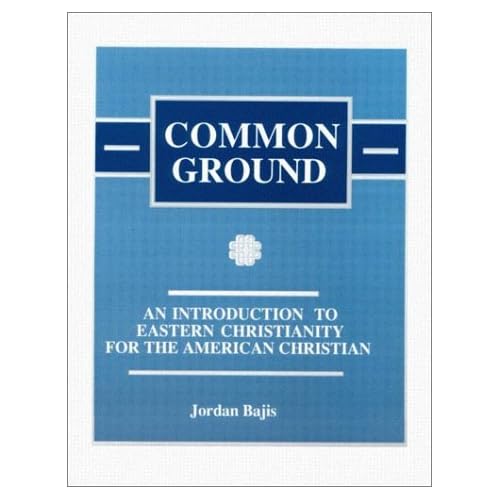
From the book Common Ground: An Introduction to Eastern Christianity for the American Christian
Matter As "Unspiritual"
The influence of Augustine
Evangelical-Fundamentalism is generally wary of the earthly being associated with the spiritual. As I have briefly mentioned, this attitude was inherited from the Reformers who, in their own way, adopted it from Rome's understanding of Augustine.(1) Let me refresh our memories. Augustine's theological system saw the world as being divided into two distinct parts: the world of the spirit, and the world of matter. The material world was understood as something that is always divorced, distinct, and separate from anything resident in God's realm, i.e., the invisible domain of the spirit.
In this spirit-matter division, Augustine has a great a great deal of similarity to Platonic philosophy.(2) Platonism saw the spiritual world as being the only real (or ideal) world; the material world was but an image or shadow of that reality. Augustine sympathized with this distinction. In fact, it was this division between matter and spirit that lay behind his understanding of a sacrament as "an outward and visible sign of an inward and invisible grace." To Augustine, the reality of a sacrament was spiritual-something which was cloaked behind the material and "visible sign." Not only did this formula become a popular Roman Catholic definition, but it found its way into all the major Reformation catechisms as well.(3)
What then is sacramental grace, and how is it received? The Roman Catholicism of the Middle Ages answered that question by saying that grace was the "saving power" energizing the sacraments. The Reformers held a similar view, but most of them qualified this understanding by affirming that it was one's faith in what the elements represented, not the elements themselves, that communicated God's grace. In both contexts grace was not understood as "favor," its literal Biblical meaning. Grace was redefined by Augustinian-schooled scholastics as an "energy" able to bring the Christian alongside of God. The "Reformed" Augustine is little different from the "Catholic" Augustine. In both systems, grace is understood as a non-personal substance, not a direct, intimate communion of God with the believer. The reason for this deduction was clear: matter is matter and God is God, and never the two shall meet.(4)
The Chasm Between Matter and Spirit: The Evil of Flesh and Blood
In general, the various streams of Protestant Christianity have often flowed in sympathy with Augustine, Platonism, and pietism Humanism. Luther, himself a former Augustinian monk, clearly reflected an Augustinian dualism in his theological treatises and Biblical exegesis.(5) Calvin was also heavily influenced by these schools of thought, having had the opportunity to study them seriously for years.(6) The Catholic-Reformer, Desiderius Erasmus (1469-1536), was another scholar who emphasized the Platonist spirit-earth dichotomy,(7) and his thinking made a significant impact on Anabaptist sacramental thinking.(8) Lastly, Zwingly, a man whose influence within Fundamentalism is still very much present, also demonstrated his allegiance to these philosophies and demonstrated it in his distrust of "outward things" in religion.(9)
As might be expected, these perspectives encouraged a very low view of human nature. While the spirit of an individual was pure, the tactile and sensible dimension of his personhood was ignoble and base. It was not just a person's "fleshliness" (i.e., carnal appetites) that was evil, but the body's very skin and bones as well! Zwingli clearly thought this way:
The actual origin of sin Zwingli ascribes to the contrariety of soul and body, the tension between spiritual aspiration and the down-drag of carnal appetite. Thus by the 'flesh' he means the 'fleshliness' of the actual physical body, so narrowing the sense in which St. Paul uses the word. Indeed it was characteristic of Zwingli always to distinquish sharply between man's true being. That the argument is more rationalist than biblical Zwingli himsels is frank enough to admit...(10)
Zwingli extended his dualistic thinking to the point of contradicting the Church's traditional teaching on the Incarnation. For example, he taught that Christ's humanity and divinity did not inter-dwell each other.(11) Instead of understanding Christ's human nature as participating in His divine nature, he saw the two natures as merely existing "side-by-side."
What consequence did this have on his view of the sacraments? Simply this: if divinity is distinct and does not co-inhabit the humanity given to Christ, how can any spiritual reality occupy "lesser" material symbols such as bread, wine, or water? The basic Platonist teaching is again emphasized: the material world is intrinsically incompatible with that which is spiritual.(13)
Zwingli's aversion to the marriage of matter and spirit was complemented and carried further by the South German Anabaptist, Menno Simons(1496-1561). Not only is this former Roman Catholic priest the "spiritual father" of most Mennonites today, but much of his thinking is still well received by many twentieth century Fundamentalists as well.(14) Simons was similar to Zwingli in his strong repugnance to the idea that divinity could co-reside within Christ's humanity. But unlike the Swiss Reformer, he did not divide Christ into two separate entities. Instead, he taught that Christ had only one nature-a divine one.
According to Simons, Christ's flesh was totally divine; not one speck of it was human.(15) This perspective seemed to address the problem left unanswered from the Augustinian interpretation of original sin he had once been taught. If, as this doctrine explained, it was impossible for man to escape from Adam's sin and guilt, how could a sinful woman (Mary) give birth to a sinless Man(Jesus)?(16) To answer this question, Simons cited John 6:63: "It is the Spirit who gives life; the flesh profits nothing..."
In other words, Mary gave nothing of her humanity to Christ in the Incarnation; she was merely "a tube" through which Christ passed unaffected.(17)
'Jesus Christ is alone the Word of God, who himself became flesh through his divine power, and received nothing from the Virgin Mary; else she would not have have remained a virgin. He is alone the seed of the Spirit. Even as the water in the jars at the wedding of Cana became wine through divine power, and took unto itself no wine from the jars nor from any other wine. As the Bread from heaven, [Christ] fell from heaven and became himself a seed [corn], but received nothing from the earth.'(18)
Although Calvin clearly did not teach such an erroneous view of Christ, neither did he, in common with both Zwingli and Simons, hold a high place for the human body. He reserved honor only for "the spiritual side of man," and "considered the spirit-soul the exclusive bearer of the image of God and the essence of human personality to the disparagement of the body and its drives."(19) Once again, this this entire way of thinking was "plainly a direct result of Platonism as absorbed into medieval Augustinianism."(20)
In this view, sin has defaced God's image in humanity beyond all recognition, having been passed on from one generation to another through biological reproduction. Therefore, man as a product of human sex, must be depraved (i.e., the concept of total depravity) since nothing pure could naturally live in his "fallen-matter" flesh. This Platonic theme was continually emphasized in Reformation theology, and, though to a much lesser degree, in Anabaptist teaching as well.(21)
This leads us back to where we began. God, as the Supreme Good, stands at an eternal arm's length from anything "matter-like," either in creation or in humanity. The conclusion: anything material-in man or sacrament-has little real value.(22) Today, many Christians in the West would certainly not agree with the distorted perspectives of Christ's humanity some of the Reformers maintained, nor would they explain grace in such academic terms. However, the Augustinian and Platonic prejudice against creation, and the scholastic definition of grace, especially in respect to the sacraments, still has its proponents.
from pages 199- 202 from the book "Common Ground: An introduction to Eastern Christianity for the American Christian" by Jordan Bajis
Friday, August 17, 2012
Heretical Christology 101
Dyophysitism is Orthodox Christology; however, there is a heretical form of Dyophysitism as advocated by Diodorus of Tarsus and Theodore of Mopsuestia. They laid the ground work for the heretical Christology of Nestorius. Below is a quote from a protestant German scholar from the 19th century. I may not agree with all of his biases in other places, but he articulated their Christology very well and so I wanted to share it here so that people will know why Nestorianism was saying something totally different from the Cappadocian Fathers (also Dyophysites) and Chalcedon.
The great teachers of the Antiochene school, at the end of the fourth and the beginning of the fifth centuries, not satisfied with all that had been done, thought themselves bound to strike out a new path, so as to define in an intelligible manner the union of the two natures. All their predecessors seemed to them to have preserved insufficiently the particular and inviolable character of each nature, and not to have given a sufficiently fundamental opposition to Apollinaris, but to have more or less given in to his views. And thus Apollinaris now found much more violent opponents in his own native country, Syria, than elsewhere, men of high reputation and great endowments, particularly Diodorus of Tarsus and Theodore afterwards Bishop of Mopsuestia in Cilicia.Everything the heretic Apollinaris said wasn't wrong. And so there was no need to disagree with him on every point. He got the Identity right, he was wrong in saying Jesus didn't have a human soul. Also, there is nothing wrong in those before their time believing in a full communication of the attributes. There is also nothing wrong in believing in a real Incarnation.
In the latter we behold the special representative and spokesman of. this school, who, further developing and rectifying the ideas of ' Diodorus, built up a new christological system. In opposition to Apollinaris, Theodore holds most decidedly that complete humanity and so also moral freedom must be 4 ascribed to the redeemer. In order, however, to keep at a ' distance from the notion of the mutability of Christ,—a theory which, however objectionable, seemed to be involved in that of His liberty,—Theodore did not allow the idea of liberty to result in that of liberty of choice, but went on to the idea of a higher, ethical liberty, "which consists in the unchangeable harmony of the human will with the divine, and ascribed to the human nature of Christ such a higher liberty, a kind of liberty which practically excluded all sin. So far he was right. But he further regarded the union of the divine and human in Christ only in the sense of ivoucrjai^, that is, indwelling, because to him the idea of Incarnation seemed to be identical with transmutation of the Logos into a man, and was therefore rejected by him as absurd.
"When, however, God dwells in any one, he thinks, He does not dwell in Him according to His nature, and so not by the expression of His power, but by His good pleasure (evSoKia). This indwelling is not alike in all the righteous, but its measure is determined by the measure of the divine evBoKui. But in no one did it take place in so high a degree as in Christ. In order to show mankind its future perfected condition, to which it was destined, God formed a man in a miraculous manner, in the womb of the Virgin, by the Holy Ghost ; and in the moment in which this man was formed, the Logos limited Himself with Him. After some time the Logos led the man to baptism, then to death, then raised Him again, took Him up into heaven, placed Him (by reason of His union with Himself) at the right hand of the Father, and from that time He (the man) is worshiped by all and will judge all.
What he just said here is very important when it comes to understanding why Theodore's Christology was different.
As every one who strives after righteousness progresses in union with God, so also it is with Christ. His union with the Logos had first begun with His conception and birth, and now increased gradually as moral union, wherein His humanity was constantly impelled, elevated, strengthened, and preserved from all aberrations by the indwelling Logos.' This moral union was confirmed and strengthened peculiarly in the temptations and at the passion of Christ, but it receives its perfection only after the death of Christ, when He has exchanged the state of humiliation for that of exaltation. If,|according to this theory, the union of the divine and human in Christ is placed on the same level with the union of the divine good-pleasure with every righteous man, yet the two are in the highest degree essentially different, and Christ can in no way be compared with men. On the contrary. He transcends all men (a) by His supernatural birth, and (b) by His sinlessness ; but (c) also in this respect, that it is not merely the evhoKia of God generally, but the Logos, and so God Himself, the second Person of the Trinity, who dwells in Him ; and {d) the Logos is so closely imited with the man in whom He dwells, that He has destined him to participate in all the honours which properly belong to the Logos alone.
It is true that in this manner Theodore could maintain the two natures in their perfection, and fundamentally oppose all mingling of the two ; and he also explains that this is his aim, when he says, " Mingling is not suitable for the two natures ; there is a difference between the divine form and the form of a servant, between the temple which is adopted and Him who dwells therein, between Him who was dissolved in death and Him who raised Him, between Him who was made perfect through sufferings and Him who perfected Him, and so forth. This difference must be preserved: each nature remains indissoluble by itself, in its essence." But Theodore, and here / is his fundamental error, ntjt merely maintained the existence ) of two Natures in Christ, but of two persons, as, he says himself, no subsistence can be thought of as perfect without personality.
As, however, he did not ignore the fact that the consciousness of the Church rejected such a double personality in Christ, he endeavored to get rid of the difficulty, and he repeatedly says expressly : " The two natures united together make only one Person, as man and wife are only one flesh. . . . If we consider the natures in their distinction, we should define the nature of the Logos as perfect and complete, and so also His Person, and again the nature and the person of the man as perfect and complete. If, on the other hand, we have regard to the union (avvdjieia), we say it is one Person."^ The very illustration of the union of man and wife shows that Theodore did not suppose a true union of the two natures in Christ, but that his notion was rather that of an external connection of the two.
The expression (xvvd^eia, moreover, which he selected here, instead of the term ei/wcrt?, which he elsewhere employs, being derived from a-vvaTrrco [to join together^], expresses only an external connection, a fixing together, and is therefore expressly rejected in later times by the doctors of the Church. And again, Theodore designates a merely external connection also in the phrase already quoted, to the effect that " the Logos dwells in the man assumed as in a temple." As a temple and the statue set up within it are one whole merely in outward appearance, so the Godhead and manhood in Christ appear only from without in their actuality as one Person, while they remain essentially two Persons."
All quotes are from pages 5 to 7 from the book "A HISTORY of the
COUNCILS OF THE CHURCH,
FROM THE ORIGINAL DOCUMENTS.
VOLUME III.
A.D. 431 TO A.D. 451"
BY THE RIGHT REV. CHARLES JOSEPH HEFELE, D.D
EDINBURGH: T. oc T. CLARK, 38 GEORGE STREET, 1883
Subscribe to:
Posts (Atom)

LORD JESUS CHRIST,
SON OF GOD,
HAVE MERCY ON US,
THE SINNERS.

Subscribe To


 Posts
All Comments
Posts
All Comments