Showing posts with label Jehovah's Witnesses. Show all posts
Showing posts with label Jehovah's Witnesses. Show all posts
Wednesday, November 3, 2010
Protestantism as a Demonic Religion
Have you ever noticed how Protestantism demonizes (divides) between things which no sane, God-fearing person would ever dare to tear asunder? Like between God and His Saints, the Lord and His mother, Christ and His Cross, Scripture and Tradition, faith and good works, Baptism and regeneration, the Lord's body and Holy Communion, the universal and the sacerdotal Priesthood, or -as in the case of the Jehovah's Witnesses- between the Heavenly Father and His Only-Begotten Son. Truly, as our Savior Himself said: "Every kingdom divided against itself is brought to desolation; and every city or house divided against itself shall not stand." ( Matthew 12:25; Mark 3:24-25; Luke 11:17 ). -- Actually, how can any religious faith or belief-system that confesses the Holy Trinity believe in "Sola" anything ?
Friday, September 24, 2010
The Jewish Trinity
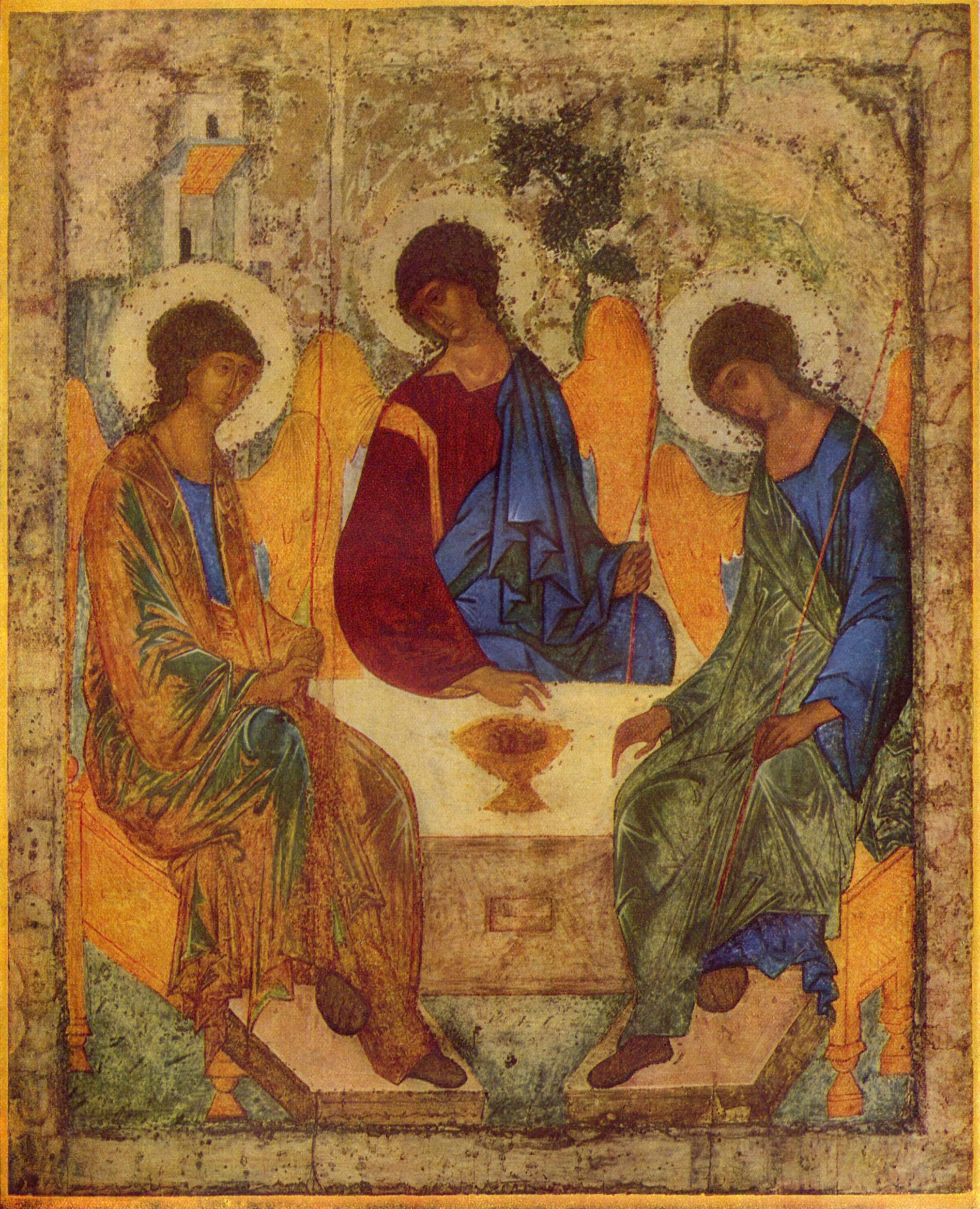
The one in the middle is the Father of the Universe, who in the Sacred Scriptures is called by his proper name, I am that I am ; and the Beings on each side are those most ancient Powers which are always close to the living God, one of which is called his Creative Power, and the other his Royal Power. And the Creative Power is God, for it is by this that he made and arranged the Universe; and the Royal Power is the Lord, for it is fitting that the Creator should lord it over and govern the creature.
Philo of Alexandria, On Abraham,
chapter 24, paragraph 121.
chapter 24, paragraph 121.
Monday, August 2, 2010
Saint Hippolytus Changed His Mind About Chiliasm
Hippolytus defended millenarianism in his Commentary on Daniel and De Christo et Antichristo. Opposition to the doctrine, however, was gathering force, the leader of the reaction at Rome being the priest Caius. In face of this Hippolytus departed from Irenaeus's exegesis of the key-passage, Rev. 20, 2-5. The thousand years there mentioned, he now explained, are not to be taken as referring literally to the duration of the kingdom, but are a symbolical number which should be interpreted as pointing to its splendor.
J.N.D. Kelly, Early Christian Doctrines, Revised Edition, page 469,
published by Harper Collins.
published by Harper Collins.
Friday, May 21, 2010
The Fallacy Of Believing That Jesus Was A Mere Man, Later Deified By His Followers
Acts 10:25 And as Peter was coming in, Cornelius met him, and fell down at his feet, and worshipped him. 26 But Peter took him up, saying, Stand up; I myself also am a man.
Acts 12:21 And upon a set day Herod, arrayed in royal apparel, sat upon his throne, and made an oration unto them. 22 And the people gave a shout, saying, It is the voice of a god, and not of a man. 23 And immediately the angel of the Lord smote him, because he gave not God the glory: and he was eaten of worms, and gave up the ghost.
Acts 14:11 And when the people saw what Paul had done, they lifted up their voices, saying in the speech of Lycaonia, The gods are come down to us in the likeness of men. 12 And they called Barnabas, Jupiter; and Paul, Mercurius, because he was the chief speaker. 13 Then the priest of Jupiter, which was before their city, brought oxen and garlands unto the gates, and would have done sacrifice with the people. 14 Which when the apostles, Barnabas and Paul, heard of, they rent their clothes, and ran in among the people, crying out, 15 And saying, Sirs, why do ye these things? We also are men of like passions with you, and preach unto you that ye should turn from these vanities unto the living God, which made heaven, and earth, and the sea, and all things that are therein: 16 Who in times past suffered all nations to walk in their own ways. 17 Nevertheless he left not himself without witness, in that he did good, and gave us rain from heaven, and fruitful seasons, filling our hearts with food and gladness. 18 And with these sayings scarce restrained they the people, that they had not done sacrifice unto them.
Romans 1:21 Because that, when they knew God, they glorified him not as God, neither were thankful; but became vain in their imaginations, and their foolish heart was darkened. 23 And changed the glory of the uncorruptible God into an image made like to corruptible man, and to birds, and fourfooted beasts, and creeping things. 25 Who changed the truth of God into a lie, and worshipped and served the creature more than the Creator, who is blessed for ever. Amen.
Saturday, December 5, 2009
The Invincible Trophy
The Jehovah's Witnesses organization feature an article on their website entitled "Did Jesus Really Die on a Cross?" I would like to take this opportunity to respond to that question, emphatically and unequivocally: YES!
The article opens its arguments with the statement that the Babylonians used a "cross" in the worship of the pagan deity Tammuz. All of my searches and reference-checks for this assertion led me back to one man: Alexander Hislop. Many of the articles I came across cited him as a "historian" or "expert in [pick your poison]." He was neither; he was, instead, a minister in the Free Church of Scotland, a Calvinist organization of the 19th century. He also seems to have dedicated a significant portion of his writing career to attacking the Roman Catholic Church, and his comments about Tammuz and the cross are part of these attacks. If the statements about Tammuz and the cross were true, you'd think its proponents could find a better source than a 19th century Calvinist minister with a serious case of Romophobia. I'm not saying it's not possible that he was right in this assertion, but I have my doubts until I see it from a much less biased source.
That said, I will freely and readily admit that symbols with close similarities to the cross were in use well before Christianity, including the swastika, the "plus sign," and the ankh. But my question in reponse to this is: so what? I don't mean that rudely or dismissively, but in all seriousness. First of all, it's a logical fallacy to assert that similarity implies causality.
And, more importantly, the pre-Christian existence of the cross actually supports the pro-cross position. We don't claim that Christians somehow invented the cross or that the use of a cross was unique to Christ's crucifixion; we claim that it was a symbol of death, the very instrument of execution used by the Romans, which Christ, through accomplishing the redemption of mankind via death on a cross, transformed into a symbol of eternal life. Clearly, it would have to have had a long history of use for this assertion to be true.
The article then goes on to cite a book called The Non-Christian Cross by someone named "J.D. Parsons," quoting thus:
Now that we know who J.D. Parsons was, let's look at his statement as quoted by this article. His claim is that "there is not a single sentence" in the entire New Testament which, even indirectly, supports the belief that the word "stauros," when used to refer to the instrument of Christ's death in the New Testament, means a cross. He's wrong; I can think of a few:

This piece of ancient "artwork" (I use that word very loosely in this case) is called the "Alexamenos graffito." It was carved on a plaster wall in Rome some time in the late first century. The figures depicted are a donkey-headed man attached to a cross (not a "torture stake") and a man in front of the crucified figure with arms raised in worship. The wording reads "Alexamenos worships [his] God." Most scholars agree that the purpose of this carving was to mock Christians (specifically poor Alexamenos) and our God, Jesus Christ. Even the pagans knew of the cross of Christ, in their own twisted way.
The Jehovah's Witnesses' article concludes with a few paragraphs on whether the instrument of Christ's death, whether a cross or a "torture stake," should be used in worship. They posit the question: if you a had a friend who was murdered, would you adore the instrument of his murder by venerating it, making jewelry fashioned after it, and adorning your home with pictures of it? This is a false comparison, though, because Christ's death is not simply a meaningless murder -- it is the redemption of all mankind, "trampling down death by death," as one of the Paschal hymns of the Orthodox Church says.
The cross is described time and again by early Christian authors as our "trophy," and this is why we reverence the cross. In ancient Greek and Roman culture, a trophy was a monument which a conquering army set up to commemorate the defeat of their enemies. Typically, the trophy took the form of a tree upon which was hung the weapons which the defeated enemy had used. It was a symbol of victory over one's foes. And this is what the cross is for Christians. The cross, which formerly had been the weapon of death and the devil, has become the Holy Cross of Christ, a trophy of Christ's victory over death and the devil. In the Orthodox Church, on the Feast of the Procession of the Honorable Wood of the Life-Giving Cross of the Lord, we sing this hymn:
The article opens its arguments with the statement that the Babylonians used a "cross" in the worship of the pagan deity Tammuz. All of my searches and reference-checks for this assertion led me back to one man: Alexander Hislop. Many of the articles I came across cited him as a "historian" or "expert in [pick your poison]." He was neither; he was, instead, a minister in the Free Church of Scotland, a Calvinist organization of the 19th century. He also seems to have dedicated a significant portion of his writing career to attacking the Roman Catholic Church, and his comments about Tammuz and the cross are part of these attacks. If the statements about Tammuz and the cross were true, you'd think its proponents could find a better source than a 19th century Calvinist minister with a serious case of Romophobia. I'm not saying it's not possible that he was right in this assertion, but I have my doubts until I see it from a much less biased source.
That said, I will freely and readily admit that symbols with close similarities to the cross were in use well before Christianity, including the swastika, the "plus sign," and the ankh. But my question in reponse to this is: so what? I don't mean that rudely or dismissively, but in all seriousness. First of all, it's a logical fallacy to assert that similarity implies causality.
And, more importantly, the pre-Christian existence of the cross actually supports the pro-cross position. We don't claim that Christians somehow invented the cross or that the use of a cross was unique to Christ's crucifixion; we claim that it was a symbol of death, the very instrument of execution used by the Romans, which Christ, through accomplishing the redemption of mankind via death on a cross, transformed into a symbol of eternal life. Clearly, it would have to have had a long history of use for this assertion to be true.
The article then goes on to cite a book called The Non-Christian Cross by someone named "J.D. Parsons," quoting thus:
There is not a single sentence in any of the numerous writings forming the New Testament, which, in the original Greek, bears even indirect evidence to the effect that the stauros used in the case of Jesus was other than an ordinary stauros; much less to the effect that it consisted, not of one piece of timber, but of two pieces nailed together in the form of a cross.I'll get back to the quote in a moment; first, let's find out who was "J.D. Parsons." Or, perhaps more important, who he was not, namely: a historian, an expert in Greek language, a theologian, or, to sum it all up at once, anybody worth quoting as an authority! No, he was John Denham Parsons, a writer on many topics he didn't know much about, a denier of the historicity of Christ, a 19th century neo-pagan, and a member of a group called the "Society for Physical Research," which Society's stated purposes were to understand "events and abilities commonly described as psychic or paranormal by promoting and supporting important research in this area" and to "examine allegedly paranormal phenomena in a scientific and unbiased way." Right... I don't mean to sound disrespectful, but where does the Watch Tower dig these guys up from?
Now that we know who J.D. Parsons was, let's look at his statement as quoted by this article. His claim is that "there is not a single sentence" in the entire New Testament which, even indirectly, supports the belief that the word "stauros," when used to refer to the instrument of Christ's death in the New Testament, means a cross. He's wrong; I can think of a few:
- "And He, bearing His cross, went out to a place called the Place of a Skull, which is called in Hebrew, Golgotha," - John 19:17. The stipes, the upright pole of the cross, was generally fixed in a certain spot used for executions. It was too large and heavy to carry, plus the Roman soldiers didn't want to have to replant the post every time they were crucifying someone -- anyone who has ever driven fence stakes or put up a mailbox can tell you why; it's a pain. The patibulum, the cross-beam, though, generally only weighed about 100 pounds -- heavy, but carriable; and it was often a part of the punishment of the condemned man to have to carry the patibulum to the execution site. There is, however, not a single piece of art or writing from the ancient world which depicts or speaks of a condemned man carrying his own stipes.
- "The other disciples therefore said to him, 'We have seen the Lord.' So he said to them, 'Unless I see in His hands the print of the nails, and put my finger into the print of the nails, and put my hand into His side, I will not believe.'" - John 20:25. Notice that St. Thomas here says "nails" -- plural. More than one nail would only need to be used if Christ's hands were separated, as on a cross. What need would there be to have more than one nail if Christ's hands were overlapping one another on a "torture stake" as in illustrations of the crucifixion used by Jehovah's Witnesses, such as this one. Notice that there's only one nail being used to hold the crucified man's hands there?
- "And they put up over His head the accusation written against Him: THIS IS JESUS THE KING OF THE JEWS." - Matthew 27:37. If Christ's hands were nailed above his head on a "torture stake" why does St. Matthew here say that this sign was attached to the cross "over His head." If Christ's hands are over his head, shouldn't the sign be over his hands? Perhaps his hands are somewhere else -- like stretched out across the patibulum?
I could give more examples of evidence from Scripture, but I'll stop there and move on to the rest of the Jehovah's Witnesses' article. They next claim that St. Peter's use of the word "tree" in Acts 5:30 to refer to the instrument of Christ's crucifixion somehow supports their claim that said instrument was an upright stake alone. This is eisegesis at its very worst and, for that reason, not worth responding to. That said, trees don't look much like straight, upright stakes to me.
We move next to a very interesting claim, which I'll quote from the article:
It was not until about 300 years after Jesus’ death that some professed Christians promoted the idea that Jesus was put to death on a two-beamed cross.So, assuming that Christ was crucified in AD 33, this article is claiming that the belief in "a two-beamed cross" didn't come about until about AD 333. Well, let's see:
- "For the scripture saith; 'And Abraham circumcised of his household eighteen males and three hundred.' What then was the knowledge given unto him? Understand ye that He saith 'the eighteen' first, and then after an interval 'three hundred.' In the eighteen 'I' stands for ten, 'H' for eight. Here thou hast JESUS (IHSOYS). And because the cross in the 'T' was to have grace, He saith also 'three hundred.' So He revealeth Jesus in the two letters, and in the remaining one the cross." - Letter of St. Barnabas, 9, 7 (ca. AD 80). St. Barnabas' argument here is based on gematria, an ancient Jewish practice of interpreting the meaning of words based on the numerical values of the letters (in Hebrew and Greek, letters also act as numbers). What's important to our argument here from Barnabas' argument is that he says the "three hundred" represents the cross ("strauros" in the original Greek of the letter) of Christ. The letter used to represent 300 in Greek is the Tau -- which looks like the English letter "T" -- a cross.
- "For the [Passover] lamb, which is roasted, is roasted and dressed up in the form of the cross. For one spit is transfixed right through from the lower parts up to the head, and one across the back, to which are attached the legs of the lamb." - St. Justin Martyr, Dialogue with Trypho, 40 (ca. AD 150). St. Justin Martyr is here explaining how the Passover of the Jews foreshadowed the redemptive sacrifice of Christ on the cross. I think this quote speaks for itself.
- "For it is right to mount upon the cross of Christ, who is the word stretched out, the one and only, of whom the spirit saith: For what else is Christ, but the word, the sound of God? So that the word is the upright beam whereon I am crucified. And the sound is that which crosseth it, the nature of man. And the nail which holdeth the cross-tree unto the upright in the midst thereof is the conversion and repentance of man." - Acts of Peter, 38 (ca. AD 170. As you can see, this writing specifically mentions both the upright beam and the cross-beam by name, assigning a symbolic reference to each.
- "The very form of the cross, too, has five extremities, two in length, two in breadth, and one in the middle, on which [last] the person rests who is fixed by the nails." - St. Irenaeus of Lyons, Against Heresies, 2, 24, 4 (ca. AD 180). I believe this is clear enough to speak for itself.

This piece of ancient "artwork" (I use that word very loosely in this case) is called the "Alexamenos graffito." It was carved on a plaster wall in Rome some time in the late first century. The figures depicted are a donkey-headed man attached to a cross (not a "torture stake") and a man in front of the crucified figure with arms raised in worship. The wording reads "Alexamenos worships [his] God." Most scholars agree that the purpose of this carving was to mock Christians (specifically poor Alexamenos) and our God, Jesus Christ. Even the pagans knew of the cross of Christ, in their own twisted way.
The Jehovah's Witnesses' article concludes with a few paragraphs on whether the instrument of Christ's death, whether a cross or a "torture stake," should be used in worship. They posit the question: if you a had a friend who was murdered, would you adore the instrument of his murder by venerating it, making jewelry fashioned after it, and adorning your home with pictures of it? This is a false comparison, though, because Christ's death is not simply a meaningless murder -- it is the redemption of all mankind, "trampling down death by death," as one of the Paschal hymns of the Orthodox Church says.
The cross is described time and again by early Christian authors as our "trophy," and this is why we reverence the cross. In ancient Greek and Roman culture, a trophy was a monument which a conquering army set up to commemorate the defeat of their enemies. Typically, the trophy took the form of a tree upon which was hung the weapons which the defeated enemy had used. It was a symbol of victory over one's foes. And this is what the cross is for Christians. The cross, which formerly had been the weapon of death and the devil, has become the Holy Cross of Christ, a trophy of Christ's victory over death and the devil. In the Orthodox Church, on the Feast of the Procession of the Honorable Wood of the Life-Giving Cross of the Lord, we sing this hymn:
As You were voluntarily crucified for our sake,
Grant mercy to those who are called by Your name;
Make all Orthodox Christians glad by Your power,
Granting them victories over their adversaries,
By bestowing on them the invincible trophy, Your weapon of peace!

Wednesday, November 25, 2009
Myths of the Council of Nicaea
In these five videos, I explore and debunk some of the common myths surrounding the Council of Nicaea, as propagated by books like The Da Vinci Code, movies like Zeitgeist, and groups like the Jehovah's Witnesses and the Mormons. The myths I address in these videos are:
1. Constantine headed the Council and/or dictated its decrees.
2. Nicaea determined the canon of the New Testament and had other books destroyed.
3. The Bishops at Nicaea betrayed the true Christian Faith.
4. Constantine the Great was a pagan when he convoked and attended the Council of Nicaea.
5. The Arians were the true Christians, the "Orthodox" were the heretics.
6. The Council of Nicaea invented the Divinity of Christ.
7. After Nicaea, the Church was used as a tool for the political power of Rome, justifying its wars and atrocities.
The Truth about the Council
Subscribe to:
Posts (Atom)

LORD JESUS CHRIST,
SON OF GOD,
HAVE MERCY ON US,
THE SINNERS.

Subscribe To


 Posts
All Comments
Posts
All Comments