Orthodox Family Values
2 Maccabees 7:20 But the mother was marvellous above all, and worthy of honourable memory: for when she saw her seven sons slain within the space of one day, she bare it with a good courage, because of the hope that she had in the Lord. 21 Yea, she exhorted every one of them in her own language, filled with courageous spirits; and stirring up her womanish thoughts with a manly stomach, she said unto them: 22 I cannot tell how ye came into my womb: for I neither gave you breath nor life, neither was it I that formed the members of every one of you; 23 But doubtless the Creator of the world, who formed the generation of man, and found out the beginning of all things, will also of his own mercy give you breath and life again, as ye now regard not your own selves for his laws' sake. 28 I beseech thee, my son, look upon the heaven and the earth, and all that is therein, and consider that God made them of things that were not; and so was mankind made likewise. 29 Fear not this tormentor, but, being worthy of thy brethren, take thy death that I may receive thee again in mercy with thy brethren. 41 Last of all after the sons the mother died.
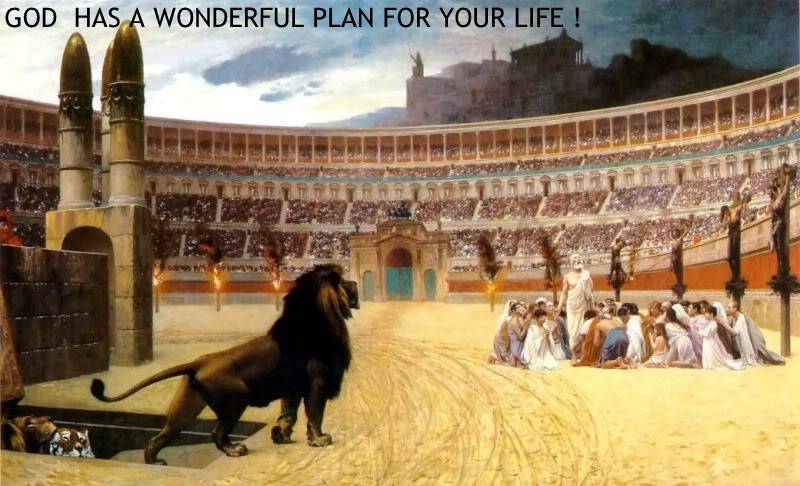
Orthodoxy: providing a safe and secure family-friendly environment since 170 BC
Propitiation or Expiation in Saint Paul
"All have sinned, all come short of the glory of God, but they are justified for nothing by His grace through the ransom provided in Christ Jesus, whom God put forward as the means of propitiation by His blood, to be received by faith". (Romans 3:23-25).The Term "Propitiation"
The Greek word (hilasterion) is derived from a verb which in pagan writers and inscriptions has two meanings:
(a) "to placate" a man or a god;
(b) "to expiate" a sin, i.e. to perform an act (such as the payment of a fine or the offering of a sacrifice) by which its guilt is annulled.
The former meaning is overwhelmingly the more common. In the Septuagint, on the other hand, the meaning (a) is practically unknown where God is the object, and the meaning (b) is found in scores of passages. Thus the biblical sense of the verb is "to perform an act whereby guilt or defilement is removed." The idea underlying it is characteristic of primitive religion. The ancients felt that if a taboo was infringed, the person or thing involved became unclean, defiled or profane. The condition of defilement might be removed by the performance of the appropriate act: it might be washing with water, or sprinkling with blood, or simply the forfeiture of some valuable object to the deity concerned with the taboo. Such acts were felt to have the value, so to speak, of a disinfectant. Thus in the Old Testament a whole range of ritual actions are prescribed for disinfecting the priest, the altar, or the people from various forms of defilement, ritual or moral. Our versions in such cases use the phrase "to make propitiation"; but the more proper translation would be "to make expiation". This meaning holds good wherever the subject of the verb is a man. But, as religious thought advanced, it came to be felt that, where the defilement was moral, God alone could annul it; and so the same verb is used with God as subject in the sense "to forgive".1
In accordance with biblical usage, therefore, the substantive (hilasterion) would mean, not propitiation, but "a means by which guilt is annulled": if a man is the agent, the meaning would be "a means of expiation"; if God, "a means by which sin is forgiven". Biblical usage is determinative for Paul. The rendering "propitiation" is therefore misleading, for it suggests the placating of an angry God, and although this would be in accord with pagan usage, it is foreign to biblical usage. In the present passage it is God who puts forward the means whereby the guilt of sin is removed, by sending Christ. The sending of Christ, therefore, is the divine method of forgiveness. This brings the teaching of the present passage into exact harmony with that of v. 8-9.
1 The full evidence for all this is given in my book, The Bible and the Greeks, pp. 82-95, where I have examined, I believe, every occurrence of the verb in the Septuagint.
Catch-22
Is it any surprise to anyone that the oldest Christian New Testament Canon (that of the Syriac Peshitta) had exactly the same number of books as that of the Jewish Old Testament Canon, especially given their common Semitic background? Or that the current New Testament Canon has 27 books, according to the same Jewish reckoning? (Since five of these 22 books are "doubled": 1st & 2nd Samuel, 1st & 2nd Kings, 1st & 2nd Chronicles, Ezra-Nehemiah, and Jeremiah-Lamentations).
Copyright Infringements
On the 25th day of the ninth month, Orthodox Jews celebrate the Feast of the Purification of the Temple in Jerusalem by Judah Maccabee.
On the 21st day of the ninth month, Orthodox Christians celebrate the Entrance of the Holy Mother of God into the Temple, herself being the fleshly Temple whose womb, just like the Holy of Holies, housed the incarnated Lord of Glory (which is made abundantly clear in the hymns of the Feast).
Islam's Sexual Self-Contradictions
Do you think that Islam and ancient biblical Judaism are alike? That Allah is just another way of spelling Elohim? That the Qur'an is similar to the Old Covenant? That Moses and Musa are one and the same? Well, think again:
Exodus 19:15 And he said unto the people, Be ready against the third day: come not at your wives. 16 ¶And it came to pass on the third day in the morning, that there were thunders and lightnings, and a thick cloud upon the mount, and the voice of the trumpet exceeding loud; so that all the people that was in the camp trembled. 17 And Moses brought forth the people out of the camp to meet with God; and they stood at the nether part of the mount. 18 And mount Sinai was altogether on a smoke, because the LORD descended upon it in fire: and the smoke thereof ascended as the smoke of a furnace, and the whole mount quaked greatly. 19 And when the voice of the trumpet sounded long, and waxed louder and louder, Moses spake, and God answered him by a voice. 20 And the LORD came down upon mount Sinai, on the top of the mount: and the LORD called Moses up to the top of the mount; and Moses went up.
1 Samuel 21:4 And the priest answered David, and said, There is no common bread under mine hand, but there is hallowed bread ; if the young men have kept themselves at least from women. 5 And David answered the priest, and said unto him, Of a truth women have been kept from us about these three days, since I came out, and the vessels of the young men are holy, and the bread is in a manner common, yea, though it were sanctified this day in the vessel. 6 So the priest gave him hallowed bread: for there was no bread there but the shewbread, that was taken from before the LORD, to put hot bread in the day when it was taken away.
Matthew 22:29 Jesus answered and said unto them, Ye do err, not knowing the scriptures, nor the power of God. 30 For in the resurrection they neither marry, nor are given in marriage, but are as the angels of God in heaven.
Mark 12:24 And Jesus answering said unto them, Do ye not therefore err, because ye know not the scriptures, neither the power of God ? 25 For when they shall rise from the dead, they neither marry, nor are given in marriage; but are as the angels which are in heaven.
Luke 20:34 And Jesus answering said unto them: The children of this world marry, and are given in marriage: 35 But they which shall be accounted worthy to obtain that world, and the resurrection from the dead, neither marry, nor are given in marriage: 36 Neither can they die any more: for they are equal unto the angels; and are the children of God, being the children of the resurrection.
Biblical accounts of especial encounters with the divine, as well as scriptural commandments about approaching the holy things, not to mention the Judeo-Christian depictions of the afterlife, always require chastity as a necessary prerequisite and non-negotiable condition, as opposed to the more lax Muslim view of Paradise, expressed by Muhammad in the Qur'an, and described by his closest faithful followers in the Ahadith.
Islam's Iconographic Inconsistencies
Do you think that Islam and ancient biblical Judaism are alike? That Allah is just another way of spelling Elohim? That the Qur'an is similar to the Old Covenant? That Moses and Musa are one and the same? Well, think again:
Exodus 25:18 And thou shalt make two cherubims of gold, of beaten work shalt thou make them, in the two ends of the mercy seat. 19 And make one cherub on the one end, and the other cherub on the other end: even of the mercy seat shall ye make the cherubims on the two ends thereof. 20 And the cherubims shall stretch forth their wings on high, covering the mercy seat with their wings, and their faces shall look one to another; toward the mercy seat shall the faces of the cherubims be. 22 And there I will meet with thee, and I will commune with thee from above the mercy seat, from between the two cherubims which are upon the ark of the testimony, of all things which I will give thee in commandment unto the children of Israel.
Exodus 26:1 ¶Moreover thou shalt make the tabernacle with ten curtains of fine twined linen, and blue, and purple, and scarlet: with cherubims of cunning work shalt thou make them.
Exodus 26:31 ¶And thou shalt make a vail of blue, and purple, and scarlet, and fine twined linen of cunning work: with cherubims shall it be made.
Exodus 36:8 ¶And every wise hearted man among them that wrought the work of the tabernacle made ten curtains of fine twined linen, and blue, and purple, and scarlet: with cherubims of cunning work made he them.
Exodus 36:35 ¶And he made a vail of blue, and purple, and scarlet, and fine twined linen: with cherubims made he it of cunning work.
Exodus 37:7 And he made two cherubims of gold, beaten out of one piece made he them, on the two ends of the mercy seat; 8 One cherub on the end on this side, and another cherub on the other end on that side: out of the mercy seat made he the cherubims on the two ends thereof. 9 And the cherubims spread out their wings on high, and covered with their wings over the mercy seat, with their faces one to another; even to the mercy seatward were the faces of the cherubims.
Numbers 7:89 And when Moses was gone into the tabernacle of the congregation to speak with him, then he heard the voice of one speaking unto him from off the mercy seat that was upon the ark of testimony, from between the two cherubims: and he spake unto him.
1 Kings 6:23 And within the oracle he made two cherubims of olive tree, each ten cubits high. 24 And five cubits was the one wing of the cherub, and five cubits the other wing of the cherub: from the uttermost part of the one wing unto the uttermost part of the other were ten cubits. 25 And the other cherub was ten cubits: both the cherubims were of one measure and one size. 26 The height of the one cherub was ten cubits, and so was it of the other cherub. 27 And he set the cherubims within the inner house: and they stretched forth the wings of the cherubims, so that the wing of the one touched the one wall, and the wing of the other cherub touched the other wall; and their wings touched one another in the midst of the house. 28 And he overlaid the cherubims with gold. 29 And he carved all the walls of the house round about with carved figures of cherubims and palm trees and open flowers, within and without. 32 The two doors also were of olive tree; and he carved upon them carvings of cherubims and palm trees and open flowers, and overlaid them with gold, and spread gold upon the cherubims, and upon the palm trees. 35 And he carved thereon cherubims and palm trees and open flowers: and covered them with gold fitted upon the carved work.
1 Kings 7:29 And on the borders that were between the ledges were lions, oxen, and cherubims: and upon the ledges there was a base above: and beneath the lions and oxen were certain additions made of thin work. 36 For on the plates of the ledges thereof, and on the borders thereof, he graved cherubims, lions, and palm trees, according to the proportion of every one, and additions round about.
1 Kings 8:6 And the priests brought in the ark of the covenant of the LORD unto his place, into the oracle of the house, to the most holy place, even under the wings of the cherubims. 7 For the cherubims spread forth their two wings over the place of the ark, and the cherubims covered the ark and the staves thereof above.
1 Chronicles 28:18 And for the altar of incense refined gold by weight; and gold for the pattern of the chariot of the cherubims, that spread out their wings, and covered the ark of the covenant of the LORD.
2 Chronicles 3:7 He overlaid also the house, the beams, the posts, and the walls thereof, and the doors thereof, with gold; and graved cherubims on the walls. 10 ¶And in the most holy house he made two cherubims of image work, and overlaid them with gold. 11 And the wings of the cherubims were twenty cubits long: one wing of the one cherub was five cubits, reaching to the wall of the house: and the other wing was likewise five cubits, reaching to the wing of the other cherub. 12 And one wing of the other cherub was five cubits, reaching to the wall of the house: and the other wing was five cubits also, joining to the wing of the other cherub. 13 The wings of these cherubims spread themselves forth twenty cubits: and they stood on their feet, and their faces were inward. 14 And he made the vail of blue, and purple, and crimson, and fine linen, and wrought cherubims thereon.
2 Chronicles 5:7 And the priests brought in the ark of the covenant of the LORD unto his place, to the oracle of the house, into the most holy place, even under the wings of the cherubims: 8 For the cherubims spread forth their wings over the place of the ark, and the cherubims covered the ark and the staves thereof above.
Just out of curiosity: Do Mosques also have their walls covered in ornate iconographic depictions of Angels and Cherubim? If not, then why not?
The Jewish Trinity
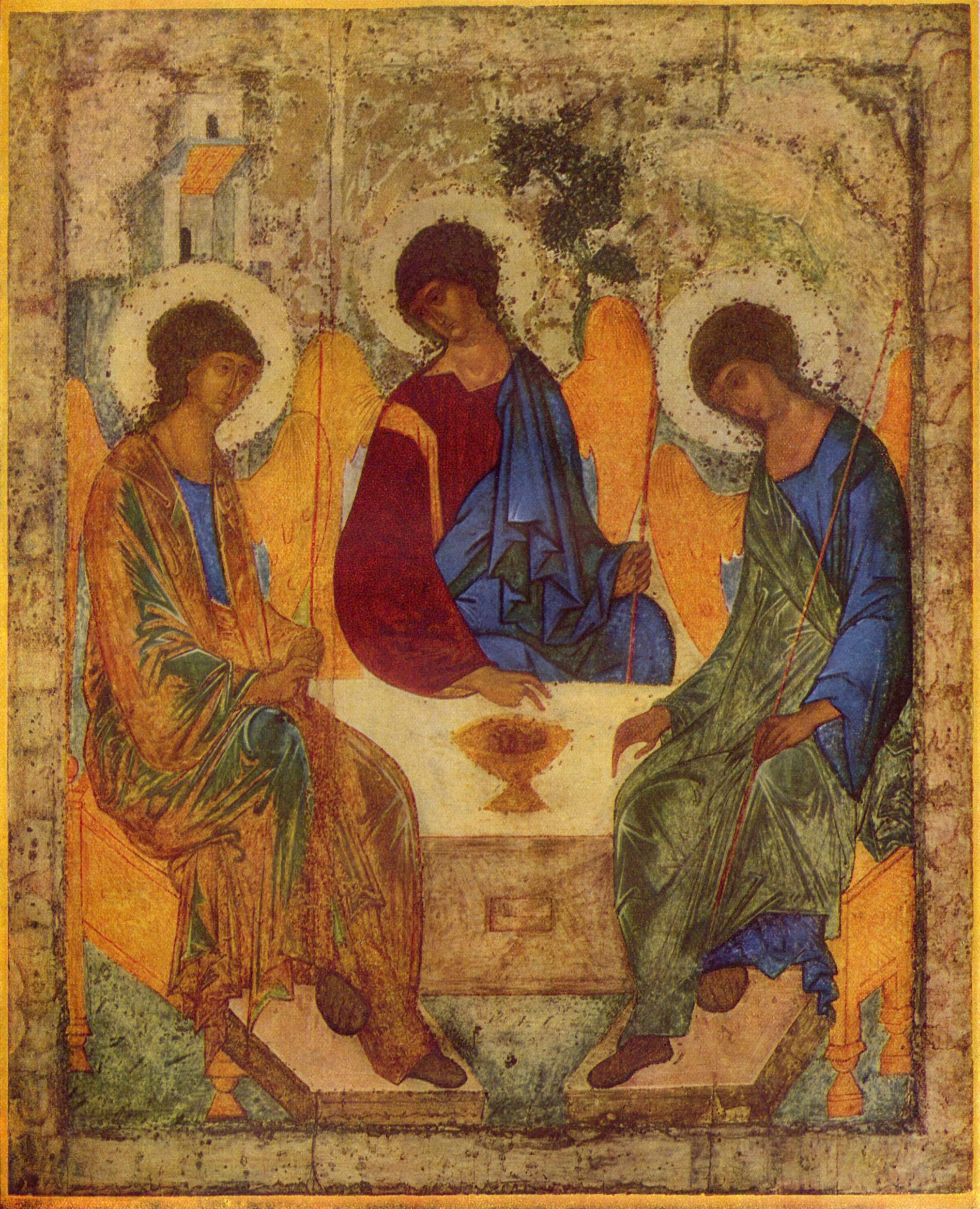
The one in the middle is the Father of the Universe, who in the Sacred Scriptures is called by his proper name, I am that I am ; and the Beings on each side are those most ancient Powers which are always close to the living God, one of which is called his Creative Power, and the other his Royal Power. And the Creative Power is God, for it is by this that he made and arranged the Universe; and the Royal Power is the Lord, for it is fitting that the Creator should lord it over and govern the creature.
chapter 24, paragraph 121.
The Number 23
After serving at the Temple in Jerusalem for the Day of Atonement, offering up incense and prayers for the people of Israel, the righteous Zechariah remained there for the Feast of Booths or Tabernacles as well, continuing to execute the function of his priestly office before God on behalf of the people, and then, seven days later, on the twenty-second day of the seventh month, when the Feast was over, returned home to his wife, Elizabeth, and -by their bodily union- conceived Saint John the Baptist, the Holy Prophet and Forerunner of our Lord, God, and Savior Jesus Christ.
Orthodox Christianity: Copycatting Orthodox Judaism Since 33 AD
On the first day of the seventh month, Orthodox Jews celebrate the Jewish New Year; on the first day of the seventh month, Orthodox Christians celebrate the Ecclesiastical New Year.
On the tenth day of the seventh month, Orthodox Jews celebrate the Day of Atonement, by observing a very strict fast; on the fourteenth day of the seventh month, Orthodox Christians celebrate the Uplifting of the Holy Cross, also by fasting, commemorating Christ's atoning sacrifice on Golgotha.
Talmudic Icons
Not much later, at about the time the Dura Synagogue came into being, the Palestinian Talmud records the grudging recognition of Jewish art ( Abodah Zarah 48d ): “In the days of Rabbi Jochanan, men began to paint pictures on the walls, and he did not hinder them”, and “In the days of Rabbi Abun, men began to make designs of mosaics and he did not hinder them.” ( Abodah Zarah 42b ). To the above passages, we add still another, Targum Pseudo-Jonathan on Leviticus 26:1. This Aramaic translation first paraphrases the prohibition against making idols and graven images and such figures in stone as men bow down to. Then the text makes an exception: “But a stone column carved with images and likeness you may make upon the premises of your sanctuaries, but not to worship them.” At last we hear the correct application of the second commandment.
Scriptures for the Modern World, ed. Paul R. Cheesman and C. Wilfred Griggs
(Provo, UT: Religious Studies Center, Brigham Young University, 1984), 29–60.
When Did Rabbinical Jews "Officially" Reject the Deuterocanon?
The word "deuterocanon" simply means "secondary". Or the secondary order of books. The historical title for the other set of books is "protocanon". Which means, "primary", or the Primary order of books. Some Orthodox Scholars prefer not to use the term "Deuterocanon" because that is a western Roman Catholic term. But whatever the case, in varying degrees, the Church has always embraced at least some of these books as scripture.
So when did the nonbelieving Jews officially reject the "Deuterocanon"?
Well, in 135 A.D. "Akiba ben Joseph" was made head of the Academy of Jamnia. It was under his influence that the Jews "officially" rejected the Deuto-canon.
He supported "Bar kochba" by calling him the Jewish Messiah. The christians refused to see him as the Messiah and thus the hatred for the Deuto-canon and New Testament books. According to Wiki....and no....I don't really like wicki, and I reject their cynicism in thinking Akiba didn't really support Bar Kocka in the rebellion.....but one thing they did include was his dislike for Christianity and the D.C.'s
http://en.wikipedia.org/wiki/Akiba_ben_Joseph
As quoted from wicki:
"He has, however, no objection to the private reading of the
Apocrypha, as is evident from the fact that he himself makes frequent use of
Ecclesiasticus (W. Bacher, Ag. Tan. i. 277; H. Grätz, Gnosticismus, p. 120).
Akiba stoutly defended, however, the canonicity of the Song of Songs, and Esther
(Yad. iii.5, Meg. 7a). Grätz's statements (Shir ha-Shirim, p. 115, and Kohelet,
p. 169) respecting Akiba's attitude toward the canonicity of the Song of Songs
are misconceptions, as I.H. Weiss (Dor, ii. 97) has to some extent shown. To the
same motive underlying his antagonism to the Apocrypha, namely, the desire to
disarm Christians—especially Jewish Christians—who drew their "proofs" from the
Apocrypha, must also be attributed his wish to emancipate the Jews of the
Dispersion from the domination of the Septuagint, the errors and inaccuracies in
which frequently distorted the true meaning of Scripture, and were even used as
arguments against the Jews by the Christians."
And in Michuta's book he says:
"The first revolt(of 70 A.D.) was a national uprising; this
second Revolt(around 135 A.D. or maybe 150 A.D.) would be a messianic movement.
By means of Akiba's work, a large number of jews joined in the rebellion. Even
Samaritans and pagans joined Bar Cochba in his revolt. However, there was one
Jewish sect which refused to join: that obstinate tribe known as christians. The
Christians, a majority of whom were still ethnically jewish, were pressed to
join in this life and death struggle with Rome, but they refused. To accept bar
Cochba as Messiah, as Akiba insisted, would have been nothing short of Apostasy;
and because of their refusal to do so, Christians were treated by the Jews as
heretics and traitors. It is this same Rabbi Akiba who is the very first writer
to explicity and forthrightly reject the inspiration of both the christian New
Testament and the books of the Deuterocanon. Akiba's declaration is found in
Tosefta Yahayim 2:13 which reads;
"The Gospel and heretical books do not
defile the hands. The books of Ben Sira and all other books written from then
on, do not defile the hands."
Two outstanding points must be drawn from
this impious declaration: first, it must have been common knowledge even at this
early date that the christians accepted the Deutercanon and used it as Scripture
(along with the Gospels), otherwise, there would have been no need to rule
against them; secondly that at least some jews must also have shared that
acceptance, otherwise Akiba's decree would have been superfluous."
Here we
have a hostile witness confirming through his actions that the earliest
christians accepted both the Gospels and the Deuterocanon as inspired and sacred
Scripture. It was in this watershed event- the naming of the false Messiah Bar
Cochba and the Anathematizing of those who rejected him- which occasioned the
very first unquestionable rejection of the Deuteros by a single, widely
recognized Jewish authority. It was under Akiba's tenure that a single textual
tradition of the Old Testament was first adopted; before this time (as we have
shown) a variety of different texts were in use among the jews. It was here,
sometime in the middle of the second Christian century, that Judaism first
adopted an official normative text(i.e. the Masoretic Text or the MT).
pages 68-70 from the book "Why Catholic Bibles are Bigger: the untold Story of the lost books of the Protestant Bible" by Gary G. Michuta
Alot of christians in America don't know this particular theory or interpretation of history. I know I didn't until a few years ago. Before then I was told that a Jewish rabbinical council of Jamnia of either 70 A.D. or 90 A.D. rejected these books. But it seems as if officially such a thing probably didn't happen until some decades later. The truth is, the Jews didn't have church councils in the way that Christians did. So there was never really a Jewish council of Jamnia. Jamnia was a Jewish school. A type of rabbinical Academy, so it would be more accurate to call it, the Academy of Jamnia. The first person to call it a "synod" was the Jewish historian H. Graetz(1817-1891). Some christians who read his work speculated it was a jewish version of a christian church council.
And this is where the whole "council of Jamnia of 90 A.D." comes from. It comes from speculation. The sources that we do have about that time never mentions anything about any books being taken out of a canon. Most of the debates was around the Book of Ecclesiastes and maybe the Song of Songs. This Jamnia assembly didn't lay down the limits of the Old Testament canon.
Therefore, in regards to Jamnia, it is more accurate to point to what happened around 135 A.D. for this is when the Jamnia rabbinical school officially rejected not only the deuteros, but also the christian Gospels.
Jnorm
The Jewish Talmud Calls the Book of Sirach Scripture
Albert C. Sundberg, Jr. -a Protestant scholar- says the Talmud in a few places calls the book of "Sirach" scripture. He also mentions that the D.C.'s were circulated among the Pharisees, as seen below from the website:
There are evidences of a continued use of this apocryphal literature in rabbinic literature of later times. Sirach is quoted three times in the Talmud as scripture. It is twice quoted with the introductory formula, "for so it is written in the Book of Ben Sira." [ Hagigh 13a; Yebamoth 63b; cf., Erubin 54a ]. Ben Sira is also sometimes quoted as "Writings" when the rabbis were proof-texting, e.g., "This matter is written in the Pentateuch, as written..., repeated in the Prophets, as written..., mentioned a third time in the Hagiographa, as written, (here Sirach 12.15 is quoted), it was learned in the Mishnah,..." [ Baba Kamma 92b ]. Pfeiffer (1941:66) tells us that the Hebrew text of Sirach was still being copied as late as the twelfth century C.E. It is cited by name in Sanhedrin 100b ( Yeb. 63c ), which quotes several verses. According to L. Israel (1905:390) single verses appear in: Yer. Ber. 11b; Yer. Hag. 77c; Yer. Ta'an. 66d; Hag. 13a; Niddah 16b; Gen. R. 8, 10, 73; Lev. R. 33; Tan. Wayishlah 8; Tan., Mikkez. 10; Tan. Hukkat. 1; etc.
Origen knew a Hebrew name for the books of Maccabees, "Sar beth Sabnai el." [Eusebius, Ecclesiastical History 6.25.2]. J.E.L. Oulton has observed, "this name is interesting as evidence of the existence in the third century of the Hebrew original of I Maccabees..." Jerome obtained Hebrew texts of Sirach, I Maccabees, Tobit and Judith in Aramaic ("Chaldee"), presumably from Jews, which he, with the help of a hired expert in Aramaic and Hebrew, translated into Latin. Marx (1921) noticed that Moses ben Nahman (Nachmanides, ca. 1194-1270 C.E.) knew and used an Aramaic (!) text of Wisdom, citing 7.5-8, 17-21 in the introduction and 1.7, 8, 11 on Deut. 20.14 in his Commentary on the Pentateuch; he also noted some acquaintance with the story of Bel and the Dragon and Judith by Jews in Spain in the twelfth and thirteenth centuries.
A Defense of the Holy Icons (Part III – Veneration of Icons in Early Christianity)
Previous installment: Part II (Presence of Icons in Early Christianity)
Now that we've established that icons were present in the early Church, the next question that must be answered in our examination of the historical validity of iconography is how these ancient icons were viewed and used by Christians during that time. Were they merely decorative? Were they an active part of the worship service or merely a background setting for it? Most importantly, were they venerated?
The only honest and straightforward answer that can be given to these questions is the admission that we don't know anything for sure. There are some things that archaeologists just don't have access to – and the minds and hearts of early third century Christians and Jews are amongst those things. Of course, we can't travel back in time to witness their worship services and pious practices or to interview them on these things for ourselves. But we do have a few clues withinin the archaeological evidence if we pay close attention.
Returning to the syngagogue at Dura Europos as our outstanding example, we find, as in nearly every synagogue, a niche in which the Torah scroll was placed located on the wall towards the direction of Jerusalem, in this case the western wall. This is the holiest place in a Jewish temple, the location of the scroll containing the Torah, the Law of Moses, the direction, again, towards Jerusalem, which Jews face for prayer, the center of the community's liturgical life.32 And on this same wall, surrounding the Torah niche, are dozens of icons. This means that the Jewish congregants at this synagogue would have been facing toward these images throughout their worship, chanting, singing, praying, and bowing.
Also of note is the orientation of the figures depicted in the iconography at the synagogue; they are facing outward, toward the viewer, looking at the individual looking at them. This is true not only of those icons intentionally painted in portrait style, but even of those which illustrate a biblical story or otherwise show a scene or movement; the individual depicted is almost always facing toward the worshipers.
Visualize yourself, for a moment, in this synagogue in the third century in the midst of a worship service. You are facing toward a wall filled with images. You pray and raise your eyes, looking at the Saints of God, and they are looking back at you. The effect that these icons must have been intended to have and surely did have is obvious.
Similarly, the surviving icons in the church at Dura Europos are not located in a backroom or even in the back of the room; they are in the baptistry, the place within the church building where baptism, one of the most sacred rites of Christianity, takes place. The icon of Christ as the Good Shepherd is located in an apse above the baptismal font at about eye level with a standing man. Is it really a stretch of the imagination to wonder if the priest or bishop presiding at the baptism, given that he would have been standing eye to eye with this image of Christ, might have been looking with love upon this image of his Savior as he recited the prayers which would bring another sheep into the Good Shepherd's pasture? Is it really such a stretch of the imagination to think that this newly-illuminated Christian, arising from the baptismal waters cleansed of his sins and a new creation in Christ, might have looked to this icon of his Master and uttered even the briefest prayer, exclamation, or thought of thanks? I don't think that either is a very far stretch, but instead the greatest likelihood.
In trying to determine whether early Christians, or Jews for that matter, venerated icons, the question of what exactly constitutes veneration must first be answered. Webster's Dictionary defines the word venerate as to “regard with reverence.”33 Veneration is not merely the outward act we currently see in Orthodox churches; veneration is much, much more. One need not touch or even come especially close to an icon to venerate it. The very presence of these icons at all in fact attests to their veneration. Why else did the early Christians and ancient Jews decorate their temples so lavishly with icons? In the ancient world, art was not only intended for beauty but almost always for utility as well.34 These icons, then, were created as and for more than mere decoration.
The artists who made these images and/or the individuals who originally commissioned their production were moved by their piety and reverence to create these depictions of holy men and women in the service of God. It is hard to imagine that these same individuals who were so moved to create them, as well as the many others who would view them in the temple, would not also be moved by their piety and devotion to God with feelings of reverence and awe as they gazed upon the beauty of the finished product. What truly reverent Jew could look into the eyes of the image of the Prophet Moses in the synagogue during Sabbath worship and not feel moved with awe at this great holy man of God? What truly religious Christian could look upon the image of Christ healing the paralytic in the church and not feel moved with love and gratefulness to his Lord and Savior for healing his own spiritual sickness?
So, did early Christians perform the standardized ritual of bowing twice, kissing the icon, and bowing once more as Orthodox Christians commonly do today? Perhaps, but probably not. Did they bow while standing in front of these icons? Unless the Christians and Jews of Dura Europos were the only Christians and Jews who didn't bow during worship, the answer is a clear affirmative. Did they pray in front of these icons? Clearly they did; as we have seen, the icons are located on walls which would have been faced during prayer. Did they kiss these icons? There's no way to tell; as these ancient cultures were certainly “kissing cultures” I don't think it's a great leap of logic to think they might have, but, as far as I know, archaeologists haven't looked for lipstick smudges yet! But did they venerate these icons? Did they “regard [them] with reverence”? Absolutely, without a doubt.
Next installment: Part IV (Necessity of Iconography)
Notes
32Morrison, R. "Missionary Intelligence." The Asiatic Journal and Monthly Miscellany 4 (1817): pg. 403. For example, see Daniel 6:10.
33 Specifically: Morehead, Albert H., Loy Morehead, Philip D. Morehead, and Andrew T. Morehead. The New American Webster Handy College Dictionary. New York, N.Y.: New American Library, 1981. see the entry for “venerate”.
34 Cary, Richard. Critical Art Pedagogy: Foundations for Postmodern Art Education. New York: Garland Pub., 1998. pg. 71.
A Defense of the Holy Icons (Part II – Presence of Icons in Early Christianity)
Previous installment: Part I (Introduction)
An obvious and important question to ask when examining the validity of the presence and veneration of the Holy Icons in the churches today is whether or not the earliest Christians, roughly those of the first five hundred years of the Church, used iconography and, if so, how they used it. The faith and practice of these earliest Christians is supremely important in deciding correct faith and practice of Christians today as these early Christians lived the closest in time, place, and culture to the Apostles and other first century followers of Christ. Many of the Christians who lived during this period were members of churches which had been directly founded by Apostles and lived in cities mentioned in the Bible. In addition, very importantly, most of the Christians of this period spoke the ancient Greek of the New Testament as their own native language. Recognizing the importance and authority of the early Church, John Calvin wrote:
If the authority of the ancient church moves us in any way, we will recall that for about five hundred years, during which religion was still flourishing, and a pure doctrine thriving, Christian Churches were commonly empty of images. Thus, it was when the purity of the ministry had somewhat degenerated that they were first introduced for the adornment of churches.12
Until fairly recently, Calvin's words here were the common assumption of both Protestants and historians of early Christianity. It was widely believed and taught that the churches of the first several hundred years were largely imageless and that Christians themselves were generally hostile to figurative art, rejecting it as an idolatrous pagan practice. This assumption was largely based on a dearth of archaeological evidence and on a false assumption of Jewish iconophobia coupled with erroneous prooftexting of various early Christian writers' criticisms of the idols of the pagans.
All three bases of the theory of early Christian hostility toward images have been dismantled by the introduction of new evidence throughout the 20th century, and more evidence continues to be uncovered today through archaeological exploration.14 The hole that once existed in physical evidence of the worship of ancient Christians and Jews has now been filled with numerous discoveries throughout the Middle East, Southern and Eastern Europe, and North Africa.
Perhaps the most famous of these discoveries is the ancient city of Dura Europos.15 Dura Europos was a diverse city, home to Christians, pagans, and Jews alike, located near the western border of what is now the nation of Syria. While under Roman rule, the city was left abandoned by its inhabitants due to a Sassanian seige in AD 256-257,16 preserving for modern archaeologists, who would begin excavating the city shortly after its rediscovery in 1920, a particularly interesting look into the lives of Romans in Syria in the third century.
And of particular interest to us for the purposes of this essay is the church of the city, the oldest Christian church yet discovered, dating to about AD 233.17 Though they are in some rough condition, several examples of early Christian iconography are preserved within the church.18 On the wall near the baptismal font, there is an icon of Christ as the Good Shepherd,19 with Adam and Eve below the figure. On the south wall of the baptistry are icons of St. Photini, better known as “the woman at the well”20 and, to the left of that, an image of the Prophet-King David's fight with Goliath.21 On the north wall of the baptistry are an illustration of the healing of the paralytic22 and a depiction of Christ and St. Peter walking on water.23 A large icon below these depicts three women, probably the Virgin Mary, St. Mary Magdalene, and St. Salome, walking towards what appears to be a tomb, probably a depiction of the cave in which Christ's body was placed after the Crucifixion.24
And the Christians of the city weren't the only ones whose house of worship had lots of images. The Jewish synagogue discovered at Dura Europos, the construction of which was probably finished in about AD 245,25 is filled nearly top to bottom with ornate iconographic depictions of Old Testament events and figures.26 Throughout the dozens of icons present in the synagogue are images of Prophets, such as Moses, David, Ezekiel, Elijah, and Abraham, symbols such as the Menorah and the Torah Scroll, and depictions of events such as the near-sacrifice of Isaac27 and Moses' reception of the Ten Commandments.28 The synagogue at Dura Europos, though a very striking example because of its excellent preservation, is by no means unique in the ancient world; there are many more synagogues with much more iconographic art which archaeologists have discovered and are still in the process of discovering.29
The abundance of images in these synagogues is especially important to our current purposes as it significantly undermines one of the key pillars of the theory that early Christians were hostile to images, namely, the assumption, which passed unquestioned for quite some length of time, that the early Judaism from which Christianity emerged was aniconic and even iconophobic. Clearly, the opposite was true; Christianity emerged from and grew up alongside a Judaism with a vibrant iconographic tradition.
The statements of early Christians writing against idolatry have been interpreted in the context of this false assumption by many for some time. But, with this new archaeological evidence, including both the synagogues and the church at Dura Europos, new interpretations are necessary. The textual evidence can not continue to be interpreted in a vacuum, but must now be interpreted alongside and within the context of the archaeological evidence.
Why would the early Christians expend so much time and effort arguing so vehemently against the idolatry of the pagans while remaining silent about the idolatry, assuming they considered it to be so, rising up in their midst? Early Christian apologists simultaneously railed against the images of the pagans while attending worship services in churches with images; the only plausible explanation for how to reconcile these two facts is that they must not have considered their own images to be idolatrous.
Additionally, early Christian apologists were never shy about criticizing the Jews for any of even the slightest perceived transgressions;30 if the widespread use of images in the synagogues was viewed by them as idolatrous, why did they never take the opportunity to attack the Jews for this? Why, instead, does it seem that early Christians in fact picked up their art forms and styles from the Jews?31 Contrary to the former allegations of Calvin and his faithful disciples, the introduction of icons into the churches was not the result of later pagan influence upon a weaker Church, but was part of the early Jewish inheritance assumed by the new Christian Faith in its first centuries.
These are questions and conundrums that, because the evidence was unavailable until fairly recently, never occurred to earlier Protestant proponents of iconoclasm like John Calvin and which iconoclasm's modern proponents have yet to sufficiently answer or explain. But these are questions which demand an answer if their views are going to continue to be taken seriously in the light of modern archaeological evidence.
Next installment: Part III (Veneration of Icons in Early Christianity)
12 See Calvin, Institutes 1.11.13
15 For more information on Dura Europos, see Hopkins, C., The Discovery of Dura Europos. New Haven and London, 1979. and Rostovtzeff, M.I. Dura-Europos and Its Art. Oxford University Press, 1938.
16 Anglim, Simon, Phyllis G. Jestice, Rob S. Rice, Scott M. Rusch, and John Serrati. Fighting Techniques of the Ancient World: 3000 BC-500 AD : Equipment, Combat Skills, and Tactics. New York: St. Martin's, 2002. pg. 218.
17 González, Justo L. The Story of Christianity. San Francisco: Harper & Row, 1984. pg. 95.
18 Perkins, Ann Louise. The Art of Dura-Europos. Oxford: Clarendon, 1973. and Snyder, Graydon F. Ante Pacem: Archaeological Evidence of Church Life Before Constantine. Macon, Ga.: Mercer UP, 2003. pp. 128-134
19 John 10:11. Depictions of Christ as the Good Shepherd in poetry, prayer, literature, and art were very popular amongst early Christians.
20 John 4:4-26
21 1 Samuel 17
22 Mark 2:1-12
23 Matthew 14:22-33
24 Mark 16:1
25 Goldstein, Jonathan. “The Judaism of the Synagogues (Focusing on the Synagogue of Dura-Europos” in Neusner, Jacob, Alan J. Avery-Peck, and Bruce Chilton. Judaism in Late Antiquity. Leiden: E.J. Brill, 1995. pg. 110.
26 Fine, Steven. Art and Judaism in the Greco-Roman World: toward a New Jewish Archaeology. Cambridge: Cambridge UP, 2005. ch. 11.
27 Genesis 22:1-24
28 Exodus 31:18
29 Urman, Dan, and Paul Virgil McCracken. Flesher. Ancient Synagogues Historical Analysis and Archaeological Discovery. Leiden: E. J. Brill, 1998.
30 See, for instance, St. Justin the Philosopher's (also known as Justin Martyr) lengthy diatribe against the Jews for what he alleges are their alterations, most of them nearly insignificantly minor, of the Scriptural texts, in his Dialogue with Trypho the Jew (written ca. AD 165).
31 For a very interesting and enlightening examination specifically of the Dura Europos synagogue on this point, see Weitzmann, Kurt, and Herbert L. Kessler. The Frescoes of the Dura Synagogue and Christian Art. Washington, D.C.: Dumbarton Oaks Research Library and Collection, 1990.

LORD JESUS CHRIST,
SON OF GOD,
HAVE MERCY ON US,
THE SINNERS.

Subscribe To


 Posts
All Comments
Posts
All Comments