The Protestant Scriptural Dilemma in 6 Easy Steps
- Protestants use the New Testament canon decided and compiled by figures such as St. Athanasius of Alexandria (the first author in history to list the books of the New Testament as we have them today), St. Irenaeus of Lyons (the first author in history to specifically delineate the fourfold Gospel), and Tertullian of Carthage (the first author in history to use the phrase "New Testament" to refer to a collection of writings).
- The basis upon which these individuals and others decided and compiled the New Testament canon was the contents of the Faith they held. It was assumed that as the Church held the Apostolic Faith, anything that disagreed with this Faith was not Apostolic; this was the standard used in sorting the Apostolic writings (which now make up the New Testament) from forgeries (such as the Gnostic writings). For an example of this process, see Eusebius of Caesarea's Church History, book 6, chapter 12.
- The Faith which these deciders and compilers of the New Testament canon held is significantly different from that held by Protestants (of nearly any strain) today. Differences include, but are not limited to: the nature of salvation, the means by which salvation is accomplished, the nature and composition of Christ, the nature and composition of the Godhead, the effective action of the crucifixion and resurrection of Christ, the meaning of the incarnation of Christ, the proper means of service to God, etc.
- Protestants, then, must (and more often than not do) hold that the Faith of the deciders and compilers of Scripture was in error.
- Error produces further error; error cannot produce truth and certainly not perfection.
- The New Testament used by Protestants must, having its sources in error, be in error. Protestants are found to blaspheme the Word of God.
St. Hippolytus of Rome & Sola Scriptura
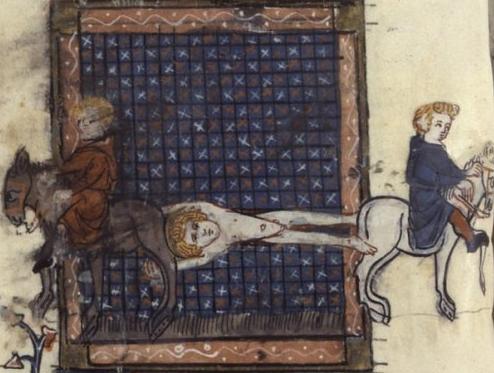 St. Hippolytus of Rome, who was born in about AD 170 and departed this life in about AD 235, is known for many things, both good and bad. He was a Priest; a prolific writer; the first "Antipope"; a genius; a hard-liner; and a martyr.
St. Hippolytus was a disciple of St. Irenaeus of Lyons. As a Priest in Rome, he broke communion with the Bishop of Rome in about AD 220, accusing St. Callixtus I, then Bishop of Rome, of being too lax in the matter of receiving back into the Church those guilty of gross offenses. After this break, he allowed himself to be elected as a kind of counter-Bishop of Rome, becoming the first so-called "Antipope". Later, he and the legitimate Pope of Rome were exiled together by the Emperor, reconciled with each other, and eventually martyred together.
Let's take a look at the commonly quoted proof-text presented in favor of Sola Scriptura:
"There is, brethren, one God, the knowledge of whom we gain from the Holy Scriptures, and from no other source. For just as a man, if he wishes to be skilled in the wisdom of this world, will find himself unable to get at it in any other way than by mastering the dogmas of philosophers, so all of us who wish to practise piety will be unable to learn its practice from any other quarter than the oracles of God. Whatever things, then, the Holy Scriptures declare, at these let us look; and whatsoever things they teach, these let us learn; and as the Father wills our belief to be, let us believe; and as He wills the Son to be glorified, let us glorify Him; and as He wills the Holy Spirit to be bestowed, let us receive Him. Not according to our own will, nor according to our own mind, nor yet as using violently those things which are given by God, but even as He has chosen to teach them by the Holy Scriptures, so let us discern them." - St. Hippolytus of Rome, Against the Heresy of One Noetus, 9What the Sola Scripturists are ignoring here, though, is context. Noetus was the inventor of a heresy which held to the position now called Modalism, claiming that Father, Son, and Holy Spirit are not distinct Persons within the Godhead, but, instead "modes" or "aspects" of the One God as perceived by the believer.
The statement by Hippolytus above comes at a transition point in his writing against this heresy. He has discussed the history and contents of the heresy, refuting it, and is now moving on to an explanation of the truth of the Trinity. And what he's telling us here is that the true knowledge of God is to be found in the Holy Scriptures, if those Scriptures are rightly interpreted. Take a look at his last sentence: we are not to interpret Scripture "according to our own will, nor according to our own mind," but "even as He has chosen to teach them." And where is the Scripture taught with the right interpretation? Only in the Holy Church, as St. Hippolytus makes clear in the remainder of this writing, closing with this doxology:
"To Him be the glory and the power, with the Father and the Holy Spirit, in the holy Church both now and ever, and even for evermore. Amen." - St. Hippolytus of Rome, Against the Heresy of One Noetus, 18Not only is the Sola Scripturists' proof-text out of context within that single writing of St. Hippolytus, it is also out of context within the entirety of his writings. Here's an example:
"And certain other heretics, contentious by nature, and wholly uninformed as regards knowledge, as well as in their manner more than usually quarrelsome, combine in maintaining that Pascha [Easter] should be kept on the fourteenth day of the first month, according to the commandment of the law, on whatever day of the week it should occur. But in this they only regard what has been written in the law, that he will be accursed who does not so keep the commandment as it is enjoined. They do not, however, attend to this fact, that the legal enactment was made for Jews, who in times to come should kill the real Passover [Pascha]. And this Paschal sacrifice in its efficacy, has spread unto the Gentiles, and is discerned by faith, and not now observed in letter merely. They attend to this one commandment, and do not look unto what has been spoken by the Apostle: 'For I testify to every man that is circumcised, that he is a debtor to keep the whole law.' In other respects, however, these consent to all the Traditions delivered to the Church by the Apostles." - St. Hippolytus of Rome, Refutation of All Heresies, 8, 11The individuals here being referred to by St. Hippolytus are a group called the Quartodecimans; they held that Pascha (otherwise known as "Easter"), the annual celebration of the Resurrection of Christ, was to be held on the 14th day of Nisan, the first month in the Jewish calendar, no matter what day it fell on. The rest of the Church, as Hippolytus points out, observed Pascha on a Sunday, as that was the day of the week Christ Resurrected on.
There are two things are really important about this quote when it comes to determining whether Hippolytus held to Sola Scriptura:
- In the first sentence, Hippolytus calls the Quartodecimans "heretics," a word applied to those who have chosen to separate themselves from the Church through false belief. Sola Scripturists maintain that every essential matter of Faith is contained in the Bible; no date for Pascha is given in the New Testament, and yet Hippolytus clearly considers it an essential matter of Faith, else the Quartodecimans couldn't be called heretics.
- In his last sentence, Hippolytus tells us that the Quartodecimans observe all of the other Traditions established by the Apostles except the correct date of Pascha. This tells us that Hippolytus believed that the Apostles had established more in the Church that was essential to the True Faith than what is contained in Scripture alone.
"Now, driven by love towards all the saints, we have arrived at the essence of the Tradition which is proper for the Churches. This is so that those who are well informed may keep the Tradition which has lasted until now, according to the explanation we give of it, and so that others by taking note of it may be strengthened against the fall or error which has recently occurred because of ignorance and ignorant people, with the Holy Spirit conferring perfect Grace on those who have a correct Faith, and so that they will know that those who are at the head of the Church must teach and guard all these things." - St. Hippolytus of Rome, The Apostolic Tradition, 1Let's make special note of three things in particular here:
- Hippolytus tells us that Christian must be informed of the Tradition in order to avoid falling into error, that is, heresy.
- Tradition is part of the "correct Faith" (Orthodoxy), and the Holy Spirit confers perfect Grace on those who have this correct Faith.
- Bishops and Priests "must teach and guard all these things" -- none are optional.
Go here to read The Apostolic Tradition for yourself. To read more of St. Hippolytus of Rome's writings, go here.
(originally posted at Pious Fabrications on 20 January 2010 [slightly edited from original])
Tertullian & Sola Scriptura
 Before I begin, I want to note that Tertullian is not a Church Father. There's no doubt that he was a genius and produced some great writings during his long career as a Christian apologist; however, his rigidity on moral issues eventually led him to renounce the Church and join the Montanist movement, a bizarre heretical group whose leader claimed to be an incarnation of the Holy Spirit. In spite of the great writings which he contributed to the library of Orthodox Christianity, his later heretical affiliations exclude him from being classed with the Fathers.
Although he is not a Father, I've decided to address him here because of his importance to the history of early Christianity. He is often called "the father of Latin Christianity" for having been the first significant Christian author to write in Latin, writing as an Orthodox Christian from about AD 197 to AD 207 and after that, until AD 220, as a Montanist. In his writings he did a great deal to defend the Christians from the various accusations of immorality that had been leveled against them, including charges that Christians cannibalized infants and committed incest during their services. And not only did he defend Christianity from false accusations, he also went on the offensive against pagans and heretics.
One of his most interesting tracts against heretics, which has great bearing on the issue of whether or not he might have held to Sola Scriptura, is a relatively short writing called The Prescription Against Heretics, in which Tertullian provides "the prescription against heretics": the Church! He argues that, in a dispute between the Church and some heretical group which has broken off therefrom, the burden of proof lies strictly with the heretical group, as the Church's very existence, being the only Christian body with a direct physical link to the Apostles, verifies its Truth. I'll let Tertullian speak for himself on this point:
"Now, what that was which they [the Apostles] preached—in other words, what it was which Christ revealed to them—can, as I must here likewise prescribe, properly be proved in no other way than by those very Churches which the Apostles founded in person, by declaring the Gospel to them directly themselves, both vivâ voce, as the phrase is, and subsequently by their epistles. If, then, these things are so, it is in the same degree manifest that all doctrine which agrees with the Apostolic Churches—those moulds and original sources of the Faith must be reckoned for truth, as undoubtedly containing that which the (said) Churches received from the Apostles, the Apostles from Christ, Christ from God. Whereas all doctrine must be prejudged as false which savours of contrariety to the Truth of the Churches and Apostles of Christ and God. It remains, then, that we demonstrate whether this doctrine of ours, of which we have now given the rule, has its origin in the Tradition of the Apostles, and whether all other doctrines do not ipso facto proceed from falsehood. We hold communion with the Apostolic Churches because our doctrine is in no respect different from theirs. This is our witness of truth." - Tertullian, The Prescription Against Heretics, 21 [emphasis mine]He also makes clear, in the chapter before the quote above, that in order for a new Church to be valid it must have a line of succession which it can trace to an Apostolic Church. No one can simply found a brand new Church all on their own -- for Tertullian, they've got to have credentials, and those credentials are found in Apostolic Succession. Let's take a look:
"They [the Apostles] then in like manner founded Churches in every city, from which all the other Churches, one after another, derived the Tradition of the Faith, and the seeds of doctrine, and are every day deriving them, that they may become Churches. Indeed, it is on this account only that they will be able to deem themselves Apostolic, as being the offspring of Apostolic Churches. Every sort of thing must necessarily revert to its original for its classification. Therefore the Churches, although they are so many and so great, comprise but the one primitive Church, (founded) by the Apostles, from which they all (spring). In this way all are primitive, and all are Apostolic, whilst they are all proved to be one, in (unbroken) unity, by their peaceful communion, and title of brotherhood, and bond of hospitality,—privileges which no other rule directs than the one Tradition of the selfsame mystery." - Tertullian, The Prescription Against Heretics, 20 [emphasis mine -- note that Tertullian's words here mention all four of the "marks of the Church": One, Holy, Catholic, Apostolic]As we can see, Tertullian held that there was a single, visible Church which was founded by the Apostles and within this Church was uniquely preserved the Ancient Christian Faith. In fact, for Tertullian, Apostolic Succession was a necessity in determining whether one held to the Ancient Christian Faith; if you didn't have Apostolic Succession, according to Tertullian, you didn't have the Faith:
"But if there be any (heresies) which are bold enough to plant themselves in the midst of the Apostolic Age, that they may thereby seem to have been handed down by the Apostles, because they existed in the time of the Apostles, we can say: Let them produce the original records of their churches; let them unfold the roll of their bishops, running down in due succession from the beginning in such a manner that [that first bishop of their] bishop shall be able to show for his ordainer and predecessor some one of the Apostles or of Apostolic men,—a man, moreover, who continued stedfast with the Apostles. For this is the manner in which the Apostolic Churches transmit their registers." - Tertullian, The Prescription Against the Heretics, 32Now, let's take a look at what Tertullian has to say about Scripture's relationship to this Church:
"But even if a discussion [with the heretics] from the Scriptures should not turn out in such a way as to place both sides on a par, (yet) the natural order of things would require that this point should be first proposed, which is now the only one which we must discuss: “With whom lies that very Faith to which the Scriptures belong. From what and through whom, and when, and to whom, has been handed down that rule, by which men become Christians?” For wherever it shall be manifest that the true Christian rule and Faith shall be, there will likewise be the true Scriptures and expositions thereof, and all the Christian Traditions." - Tertullian, The Prescription Against the Heretics, 19 [emphasis mine]In fact, according to Tertullian, not only could the heretics not rightly interpret Scripture, but they shouldn't even be allowed by members of the Church founded by the Apostles to use the Scriptures in debates at all -- in fact, according to Tertullian, if you're not in the Church you're not even a Christian! Let's read:
"Since this is the case, in order that the truth may be adjudged to belong to us [the Church], 'as many as walk according to the rule,' which the Church has handed down from the Apostles, the Apostles from Christ, and Christ from God, the reason of our position is clear, when it determines that heretics ought not to be allowed to challenge an appeal to the Scriptures, since we, without the Scriptures, prove that they have nothing to do with the Scriptures. For as they are heretics, they cannot be true Christians, because it is not from Christ that they get that which they pursue of their own mere choice, and from the pursuit incur and admit the name of heretics. Thus, not being Christians, they have acquired no right to the Christian Scriptures; and it may be very fairly said to them, 'Who are you? When and whence did you come? As you are none of mine, what have you to do with that which is mine?'"- Tertullian, The Prescription Against the Heretics, 37According to Tertullian, the Scriptures belong to the Church which holds the True Faith, and we've seen what he says about this Church above. Without this True Church which holds the True Faith, we don't have the "true Scriptures and expositions thereof." In other words, as the Orthodox continue to say today, Scripture cannot be interpreted outside of the context of the One Holy Catholic and Apostolic Church.
In fact, Tertullian, in The Prescription Against the Heretics, advises us that, when debating with heretics, we shouldn't argue with them out of Scripture at all, as they simply twist it to their own whims and refuse to understand it properly. In fact, he says, we shouldn't argue with them at all; we should admonish them and if they persist in error, rebelling against Christ and his Church, leave them in their error. And he tells us also what our admonishment should consist of, which is pointing them in the direction of the Church founded by the Apostles and uniquely preserving their Faith.
Now that we've looked at exactly what Tertullian believed about the Scriptures, the Church, and the relationship and authority of the two, let's take a look at one last quote which should leave no doubt as to where he stood on the matter of Tradition and its authority, in which he nearly seems to be arguing against the Sola Scripturists of today:
"And how long shall we draw the saw to and fro through this line, when we have an ancient practice, which by anticipation has made for us the state, i.e., of the question? If no passage of Scripture has prescribed it, assuredly custom, which without doubt flowed from Tradition, has confirmed it. For how can anything come into use, if it has not first been handed down? Even in pleading Tradition, written authority, you say, must be demanded. Let us inquire, therefore, whether Tradition, unless it be written, should not be admitted. Certainly we shall say that it ought not to be admitted, if no cases of other practices which, without any written instrument, we maintain on the ground of Tradition alone, and the countenance thereafter of custom, affords us any precedent. To deal with this matter briefly, I shall begin with Baptism. When we are going to enter the water, but a little before, in the presence of the congregation and under the hand of the president, we solemnly profess that we disown the devil, and his pomp, and his angels. Hereupon we are thrice immersed, making a somewhat ampler pledge than the Lord has appointed in the Gospel. Then when we are taken up (as new-born children), we taste first of all a mixture of milk and honey, and from that day we refrain from the daily bath for a whole week. We take also, in congregations before daybreak, and from the hand of none but the presidents, the sacrament of the Eucharist, which the Lord both commanded to be eaten at meal-times, and enjoined to be taken by all alike. As often as the anniversary comes round, we make offerings for the dead as birthday honours. We count fasting or kneeling in worship on the Lord’s day to be unlawful. We rejoice in the same privilege also from Easter to Whitsunday. We feel pained should any wine or bread, even though our own, be cast upon the ground. At every forward step and movement, at every going in and out, when we put on our clothes and shoes, when we bathe, when we sit at table, when we light the lamps, on couch, on seat, in all the ordinary actions of daily life, we trace upon the forehead the sign. If, for these and other such rules, you insist upon having positive Scripture injunction, you will find none. Tradition will be held forth to you as the originator of them, custom as their strengthener, and Faith as their observer. That reason will support Tradition, and custom, and Faith, you will either yourself perceive, or learn from some one who has." - Tertullian, The Chaplet, 3-4 [emphasis mine -- also, compare the list of Traditions which Tertullian mentions here with those still to be found only in the Orthodox Church today]I highly recommend a reading of The Prescription Against the Heretics for yourself; Tertullian not only provides the prescription against the heretics of his own day, but ours as well. If you'd like to read it, you can do so here; you can also read The Chaplet here. And everything else Tertullian wrote, both Orthodox and Montanist, can be found here.
(originally posted at Pious Fabrications on 8 January 2010)
St. Clement of Alexandria & Sola Scriptura

Clement's writings, which he penned during his time in Alexandria from about AD 180 to AD 200, are some of the most difficult of the writings of the early Fathers. He never attempts, in any of his writings, to explicate a cohesive, overarching argument; he instead jumps from topic to topic, often without any logical transition, following his thoughts wherever they take him. His writings have also been the subject of some controversy in the Church, even into modern times, as he drew freely on pagan and heretical works and ideas, using them to support his own theses; but more on this in a moment.
First, let's look at the common proof-text presented by Protestant apologists:
Sounds like a good proof-text in support of Sola Scriptura at first read, but if we dig anywhere below surface level, we start to encounter some major problems. First, these apologists apparently didn't finish the chapter this quote comes from. Here's Clement a few paragraphs later on what heretics do with the Scriptures:"But those who are ready to toil in the most excellent pursuits, will not desist from the search after truth, till they get the demonstration from the Scriptures themselves." - St. Clement of Alexandria, The Stromata, 7, 16
"And if those also who follow heresies venture to avail themselves of the prophetic Scriptures; in the first place they will not make use of all the Scriptures, and then they will not quote them entire, nor as the body and texture of prophecy prescribe. But, selecting ambiguous expressions, they wrest them to their own opinions, gathering a few expressions here and there; not looking to the sense, but making use of the mere words. For in almost all the quotations they make, you will find that they attend to the names alone, while they alter the meanings; neither knowing, as they affirm, nor using the quotations they adduce, according to their true nature." - Stromata, 7, 16
According to Clement, then, the heretics introduce innovations and contradict the Apostles by falsely believing that they can interpret Scripture for themselves; they disregard the Apostolic Traditions which, according to Clement, have been "wedded" to the Scriptures, and produce their own necessarily false interpretations. And what is Clement's answer to this problem? The Church."For those are slothful who, having it in their power to provide themselves with proper proofs for the divine Scriptures from the Scriptures themselves, select only what contributes to their own pleasures. And those have a craving for glory who voluntarily evade, by arguments of a diverse sort, the things delivered by the blessed Apostles and teachers, which are wedded to inspired words; opposing the divine tradition by human teachings, in order to establish the heresy.
For, in truth, what remained to be said—in ecclesiastical knowledge I mean—by such men, Marcion, for example, or Prodicus, and such like, who did not walk in the right way? For they could not have surpassed their predecessors in wisdom, so as to discover anything in addition to what had been uttered by them; for they would have been satisfied had they been able to learn the things laid down before." - Stromata, 7, 16 [emphasis mine]
"Now, since there are three states of the soul—ignorance, opinion, knowledge—those who are in ignorance are the Gentiles [pagans], those in knowledge, the true Church, and those in opinion, the Heretics. Nothing, then, can be more clearly seen than those, who know, making affirmations about what they know, and the others respecting what they hold on the strength of opinion, as far as respects affirmation without proof." - Stromata, 7, 16
"Our Gnostic [not referring to the heretical groups of the same name, but to an Orthodox Christian with True Knowledge of God] then alone, having grown old in the Scriptures, and maintaining apostolic and ecclesiastic orthodoxy in doctrines, lives most correctly in accordance with the Gospel, and discovers the proofs, for which he may have made search (sent forth as he is by the Lord), from the law and the prophets. For the life of the Gnostic, in my view, is nothing but deeds and words corresponding to the tradition of the Lord." - Stromata, 7, 16
"For we must never, as do those who follow the heresies, adulterate the truth, or steal the canon of the Church, by gratifying our own lusts and vanity, by defrauding our neighbours; whom above all it is our duty, in the exercise of love to them, to teach to adhere to the truth." - Stromata, 7, 16
"But not having the key of entrance, but a false (and as the common phrase expresses it), a counterfeit key , by which they [heretics] do not enter in as we enter in, through the Tradition of the Lord, by drawing aside the curtain; but bursting through the side-door, and digging clandestinely through the wall of the Church, and stepping over the truth, they constitute themselves the Mystagogues [those who initiate into the mysteries] of the soul of the impious." - Stromata, 7, 17
"From what has been said, then, it is my opinion that the true Church, that which is really ancient, is one, and that in it those who according to God’s purpose are just, are enrolled. For from the very reason that God is one, and the Lord one, that which is in the highest degree honourable is lauded in consequence of its singleness, being an imitation of the one first principle. In the nature of the One, then, is associated in a joint heritage the one Church, which they strive to cut asunder into many sects." - Stromata, 7, 17
"But the pre-eminence of the Church, as the principle of union, is, in its oneness, in this surpassing all things else, and having nothing like or equal to itself." - Stromata, 7, 17
"Well, they [the three men whom Clement learned of the Faith from -- probably Tatian the Syrian, Theodotus of Byzantium, and Pantaenus of Alexandria] preserving the Tradition of the blessed doctrine derived directly from the Holy Apostles, Peter, James, John, and Paul, the sons receiving it from the father (but few were like the Fathers), came by God’s will to us also to deposit those ancestral and apostolic seeds. And well I know that they will exult; I do not mean delighted with this tribute, but solely on account of the preservation of the Truth, according as they delivered it. For such a sketch as this, will, I think, be agreeable to a soul desirous of preserving from escape the blessed Tradition." - Stromata, 1, 1
"He [Clement] refers to [pagan poet] Orpheus as 'the theologian', and speaks of [pagan philosopher] Plato as being 'under the inspiration of God'. Even the Epicurean [pagan philosopher] Metrodorus uttered certain words 'divinely inspired'. It is not surprising then that, that he can quote passages as inspired from the epistles of Clement of Rome and of Barnabas, the Shepherd of Hermas, and the Apocalypse of Peter." (page 134)
It's to be noted, though, that 1. he doesn't quote all of these various writings as Scriptural, though he quotes many that neither you nor I would consider Scriptural as such; and 2. even though Clement's definition of "Scripture" was a little wider than that used by your or I, he does seem to have attributed more authority to the writings of Apostles than to other writings. Even here, however, his list of books differed significantly from our current 27-book New Testament (the New Testament being, as it is, an attempt at a complete library of Apostolic writings).
St. Clement believed all of the following books were Apostolic writings, in addition to what we have in our New Testament today:
- Gospel of the Egyptians
- Gospel of the Hebrews
- Traditions of Matthias
- Preaching of Peter
- 1 Clement
- Epistle of Barnabas
- Didache
- Shepherd of Hermas
- Apocalypse of Peter
- Philemon
- James
- 2 Peter
- 2 John
- 3 John
If you'd like to read the writings of St. Clement of Alexandria for yourself, check them out here.
(originally posted as Pious Fabrications on 5 January 2010)
St. Irenaeus of Lyons & Sola Scriptura

St. Irenaeus of Lyons was a disciple of St. Polycarp of Smyrna, who was a disciple of St. John the Apostle. Irenaeus' greatest achievement, and the one for which he is most remembered, was his five-volume Against Heresies in which he thoroughly examines and refutes the Gnostic heretics. Every time I read anything from this great writing, I have to wonder if Irenaeus was a prophet; he often seems to be arguing against Protestantism over a thousand years before that particular heresy ever existed.
Of particular interest in examining St. Irenaeus' position on Sola Scriptura are the first five chapters of Book 3 of Against Heresies. Let's look at the common Protestant proof-text:
"We have learned from none others the plan of our salvation, than from those [the Apostles] through whom the Gospel has come down to us, which they did at one time proclaim in public, and, at a later period, by the will of God, handed down to us in the Scriptures, to be the ground and pillar of our Faith." - St. Irenaeus of Lyons, Against Heresies, 3, 1, 1In order to really understand what Irenaeus is saying here, we need to examine the context. This statement is only the beginning of his argument which extends until the end of chapter 5 in the same book. His argument is so intricate (and great, by the way) and his every word so important to that argument, that a summary can't do it justice. I'll attempt to summarize his argument, but I highly recommend that you read chapters 1-5 of Book 3 of Against Heresies for yourself here.
Now, I'll try to explain what Irenaeus is saying; forgive me if I oversimplify his argument. First, let's note two very important things which it may be easy for some to miss in the quote above:
- A careful reading of the quote reveals that St. Irenaeus is not referring to all Scripture as "the ground and pillar of our Faith;" he's referring specifically to the Gospels, and, even more specifically, to the message of the Gospels which he outlines in the paragraph that follows the quote above:
"These [the Gospels] have all declared to us that there is one God, Creator of heaven and earth, announced by the law and the prophets; and one Christ the Son of God." - AH, 3, 1, 2
These statements are "the ground and pillar of our Faith" which Irenaeus is referring to. And, in saying this, he's paraphrasing the dialogue between St. Peter the Apostle and Christ in Matthew 16:15-18:"He [Christ] said to them, 'But who do you say that I am?' Simon Peter answered and said, 'You are the Christ, the Son of the living God.' Jesus answered and said to him, 'Blessed are you, Simon Bar-Jonah, for flesh and blood has not revealed this to you, but My Father who is in heaven. And I also say to you that you are Peter, and on this rock I will build My Church, and the gates of hades shall not prevail against it." (NKJV)
- His wording is very intentional. He's calling his reader's attention back to the words of St. Paul in 1 Timothy 3:15, in which the Apostle says that the Church is "the ground and pillar of the truth." St. Irenaeus is hearkening back to this statement of the Apostle for a reason: he's identifying the message of the Gospel with the Church as being our "ground and pillar," and also identifying "our Faith" with "the truth." And he's doing all of this, as he explains in the chapters following, in contradistinction to the "secret traditions" of the Gnostics, which conflict with the True Faith taught by the Apostles about Christ and handed down in the Church via Apostolic Succession (but more on that in a moment).
"When, however, they are confuted from the Scriptures, they turn round and accuse these same Scriptures, as if they were not correct, nor of authority, and [assert] that they are ambiguous, and that the truth cannot be extracted from them by those who are ignorant of tradition. For [they allege] that the truth was not delivered by means of written documents, but vivâ voce." - AH, 3, 2, 1Taken alone, this is often made to sound as if Irenaeus is condemning tradition in general; he's not, though. As in the previous quotes, in which he juxtaposes Scripture with the Gnostic's "secret traditions," he now juxtaposes these "secret traditions" with Holy Tradition. Comparing Holy Tradition with the Gnostic's "secret traditions," he enumerates two major differences:
- Contrary to the "secret traditions" of the Gnostics, which often contradict each other and trace their lineage back to men like Basilides, Marcion, Valentinus, and Cerinthus, and which are passed down only to "the perfect," Irenaeus asserts that Holy Tradition comes from the Apostles themselves and is passed down through the Priests whom the Apostles appointed to oversee the Church:
"But, again, when we refer them to that Tradition which originates from the Apostles, [and] which is preserved by means of the succession of Priests in the Churches, they object to Tradition, saying that they themselves are wiser not merely than the Priests, but even than the Apostles, because they have discovered the unadulterated truth. ... It comes to this, therefore, that these men do now consent neither to Scripture nor to Tradition." - AH, 3, 2, 2
- In contradistinction to the secretive, "hidden" nature of the Gnostics' "traditions," Irenaeus contrasts Holy Tradition, which is open all people through the Church:
"It is within the power of all, therefore, in every Church, who may wish to see the truth, to contemplate clearly the Tradition of the Apostles manifested throughout the whole world; and we are in a position to reckon up those who were by the Apostles instituted Bishops in the Churches, and [to demonstrate] the succession of these men to our own times; those who neither taught nor knew of anything like what these [Gnostic heretics] rave about." - AH, 3, 3, 1
"Those, therefore, who desert the preaching of the Church, call in question the knowledge of the holy Priests, not taking into consideration of how much greater consequence is a religious man, even in a private station, than a blasphemous and impudent sophist. Now, such are all the heretics, and those who imagine that they have hit upon something more beyond the truth, so that by following those things already mentioned, proceeding on their way variously, inharmoniously, and foolishly, not keeping always to the same opinions with regard to the same things, as blind men are led by the blind, they shall deservedly fall into the ditch of ignorance lying in their path, ever seeking and never finding out the truth. It behoves us, therefore, to avoid their doctrines, and to take careful heed lest we suffer any injury from them; but to flee to the Church, and be brought up in her bosom, and be nourished with the Lord’s Scriptures. For the Church has been planted as a garden in this world; therefore says the Spirit of God, 'Thou mayest freely eat from every tree of the garden' that is, Eat ye from every Scripture of the Lord; but ye shall not eat with an uplifted mind, nor touch any heretical discord." - AH, 5, 20, 2So, we've now established that Irenaeus is not arguing for the authority of Scripture alone, nor does he assert Scripture's authority over or outside of the Church. Instead, Irenaeus asserts that Scripture is a part of the Holy Tradition of the Church whose Truth is preserved by means of Apostolic Succession from the Apostles. And I'll close this post with a quote from Irenaeus in which he tells us exactly where that Church is to be found -- even in our own day:
"Since therefore we have such proofs, it is not necessary to seek the truth among others which it is easy to obtain from the Church; since the Apostles, like a rich man [depositing his money] in a bank, lodged in her hands most copiously all things pertaining to the truth: so that every man, whosoever will, can draw from her the water of life. For she is the entrance to life; all others are thieves and robbers. On this account are we bound to avoid them, but to make choice of the thing pertaining to the Church with the utmost diligence, and to lay hold of the Tradition of the truth. For how stands the case? Suppose there arise a dispute relative to some important question among us, should we not have recourse to the most ancient Churches with which the Apostles held constant intercourse, and learn from them what is certain and clear in regard to the present question? For how should it be if the Apostles themselves had not left us writings? Would it not be necessary, [in that case,] to follow the course of the Tradition which they handed down to those to whom they did commit the Churches?" - AH, 3, 4, 1 [emphasis mine]Again, I can't recommend strongly enough that you read chapters 1-5 of Book 3 of Against Heresies for yourself here. St. Irenaeus' argument in those chapters is outstanding and I have no doubt that, like me, you'll be shaking your head as you read and wondering how the Protestant apologist can read these chapters and not realize that Irenaeus is talking about him all throughout. I'm almost certain that St. Irenaeus had the gift of prophecy.
(originally published 30 December 2009 at Pious Fabrications)
St. Melito of Sardis & Sola Scriptura
 Unfortunately, not a whole lot is known about St. Melito of Sardis. He wrote around the year AD 170. If the lists of books attributed to him by later Christian authors are any indication, he was a prolific writer, and most sources indicate he was held in very high regard by his contemporaries. Of his many writings, though, only some fragments, mostly found in quotes by later authors, remain to us today.
His significance in the debate over Sola Scriptura is that the oldest list of the books of the Old Testament made by a Christian is attributed to him. This quote is often put forward by Protestants as evidence that their trimmed-down canon of Scripture (which doesn't include the deuterocanonical books) is the original Christian Old Testament canon. This is an important point in their defense of Sola Scriptura because if Protestants have the wrong canon their entire proposition fails. One unknown but necessary commandment of Scripture is enough to turn Sola Scriptura on its head. Here's St. Melito of Sardis on the Old Testament canon:
"I accordingly proceeded to the East, and went to the very spot where the things in question were preached and took place; and, having made myself accurately acquainted with the books of the Old Testament, I have set them down below, and here with send you the list. Their names are as follows:- The five books of Moses -- Genesis, Exodus, Leviticus, Numbers, Deuteronomy; Joshua, Judges, Ruth, the four books of Kings, the two of Chronicles, the book of the Psalms of David, the Proverbs of Solomon, the Book of Wisdom also, Ecclesiastes, the Song of Songs, Job, the books of the prophets Isaiah, Jeremiah, of the twelve contained in a single book, Daniel, Ezekiel, Esdras." - St. Melito of Sardis, The Book of ExtractsThere are several problems with Protestants using this passage in support of their canon of Scripture, though. Here are a few:
- The list does include one deuterocanonical book -- the Wisdom of Solomon.
- The list doesn't include Esther, Nehemiah, or Lamentations (although the latter two are assumed to be included within Esdras and Jeremiah, respectively), all part of the Protestant Old Testament.
- There is no indication that the books Melito was reading were part of the Masoretic textual tradition espoused by Protestants. In fact, the evidence is in favor of Melito's books being part of the Septuagint textual tradition, including the fact that Nehemiah and Lamentations may be included in Esdras and Jeremiah; that Melito refers to the books by their Septuagint names (4 books of Kings = 1 Kings, 2 Kings, 1 Samuel, & 2 Samuel; Esdras = Ezra; etc.); and, of course, the fact that Melito's language was Greek, not Hebrew. For anyone who has compared the Septuagint with the Masoretic, the problem here is plain: there are verses and even large sections of books (such as in Isaiah, for example) that differ significantly between the two textual traditions.
- Melito probably made a mistake in choosing his source. The list of Old Testament books he gives here, which he says he became familiar with during his travel to the East, he probably got from the Palestinian Jews. Melito was probably unaware that the Jews had already begun to trim down their Bible at that point, largely as a reaction against Christians.
And, to conclude, there's absolutely no indication in any of St. Melito's surviving writings that he believed in Sola Scriptura.
If you're interested in reading the writings of St. Melito of Sardis, you may do so here.
[Note: There has been some contention over whether St. Melito lists Wisdom as a separate book or is giving another name for the book of Proverbs. The Greek phrase in question here is "Σολομῶνος Παροιμίαι ἡ καὶ Σοφία" which, literally translated, means "Solomon's Proverbs, Wisdom too." Scholars of Greek language have largely thrown out the propisition, first put forward by Protestant translators in the 19th century, that Melito intended to say "Solomon's Proverbs, also [known as] Wisdom," as the Greek would be better rendered in the plural as "Σολομῶνος Παροιμίαι αἱ καὶ Σοφία" if this were the case. As it stands, the proposition that Melito intended to refer to the same book by two different titles can safely be discarded as the product of misguided Protestant apologetics. He is clearly referring to two distinct books.]
(slightly edited from original; originally published at Pious Fabrications on 27 December 2009)
St. Justin Martyr & Sola Scriptura

St. Justin Martyr, also called "the Philosopher," was a follower of Greek pagan philosophies who converted to Christianity. He used his training in rhetoric, logic, and philosophical thought to write several outstanding defenses of the Christian Faith, addressing both Jews and pagans.
After winning a debate against a pagan philosopher, he was exposed by his opponent as a Christian to the authorities and martyred in Rome.
His writings are a strong witness to the Faith and practice of the early Church. One of the most interesting passages in his writings is an outline of Christian worship, which outline is the same as the Divine Liturgy of the Orthodox Church today:
"And on the day called Sunday, all who live in cities or in the country gather together to one place, and the memoirs of the apostles or the writings of the prophets are read, as long as time permits; then, when the reader has ceased, the president verbally instructs, and exhorts to the imitation of these good things. Then we all rise together and pray, and, as we before said, when our prayer is ended, bread and wine and water are brought, and the president in like manner offers prayers and thanksgivings, according to his ability, and the people assent, saying Amen; and there is a distribution to each, and a participation of that over which thanks have been given, and to those who are absent a portion is sent by the deacons. And they who are well to do, and willing, give what each thinks fit; and what is collected is deposited with the president, who succours the orphans and widows and those who, through sickness or any other cause, are in want, and those who are in bonds and the strangers sojourning among us, and in a word takes care of all who are in need." - St. Justin Martyr, First Apology, 67Justin's position on anything like Sola Scriptura seems to have been very similar to that we saw previously exhibited by Ignatius, namely, that the Scripture-only position of some Jews was antithetical to a true understanding of the Scriptures (at that time, only what we now call the Old Testament), which must be understood in the light of the Gospel, which existed almost entirely in oral Tradition at that time. Here's a relevant quote:
"For these words have neither been prepared by me, nor embellished by the art of man; but David sung them, Isaiah preached them, Zechariah proclaimed them, and Moses wrote them. Are you acquainted with them, Trypho? They are contained in your Scriptures, or rather not yours, but ours. For we believe them; but you, though you read them, do not catch the spirit that is in them." - St. Justin Martyr, Dialogue with Trypho, 29To read more of the writings of St. Justin Martyr, click here.
(originally published 21 December 2009 at Pious Fabrications)
St. Polycarp of Smyrna & Sola Scriptura
 St. Polycarp of Smyrna was a disciple of St. John the Apostle and a friend of both Sts. Papias of Hierapolis and Ignatius of Antioch, who were also disciples of the Apostle John. He was martyred by being burned at the stake in about AD 155 and a very interesting firsthand account of his martyrdom survives to us today, which we'll look at after his letter.
Unfortunately, only one writing of St. Polycarp survives to us today: a letter he addressed to the church in Philippi around AD 110. Let's look at some quotes:
"For neither am I, nor is any other like unto me, able to follow the wisdom of the blessed and glorious Paul, who when he came among you taught face to face with the men of that day the word which concerneth truth carefully and surely; who also, when he was absent, wrote a letter unto you, into the which if ye look diligently, ye shall be able to be builded up unto the faith given to you." - Letter to the Philippians 3:2 [emphasis mine]Read that whole passage carefully, paying special attention the parts I've bolded. Notice what Polycarp is saying: that St. Paul came to Philippi and taught the people "face to face," that is, orally, then, after he had left, wrote them a letter. And then Polycarp tells them that if they read that letter "diligently" they "shall be able to be builded up unto the faith given to you." Note that: "given to you." Polycarp is saying exactly what the Orthodox say today about Scripture's relationship to the Faith: not that it is the sole source, but that it builds us up in that Faith already given to us orally through our teachers.
It is with this letter by Polycarp that we also begin to see Protestant proof-texting of the Fathers in their attempts to make it appear that they believed in Sola Scriptura. I have seen this sentence quoted in support of that position:
"For I am persuaded that ye are well trained in the sacred writings, and nothing is hidden from you." - Letter to the Philippians 12:1But is Polycarp really supporting anything like Sola Scriptura here? No, he's not. Let's note that he's not making a logically exclusive connection between the "sacred writings" and "nothing is hidden from you." He says "and," not "so." And he also says nothing about the Scriptures alone.
In fact, his whole point in writing this letter was to attach it as a cover letter to copies of the seven letters written by St. Ignatius which he was sending to the church at Philippi. And here's what he has to say about Ignatius' letters:
"The letters of Ignatius which were sent to us by him, and others as many as we had by us, we send unto you, according as ye gave charge; the which are subjoined to this letter; from which ye will be able to gain great advantage. For they comprise faith and endurance and every kind of edification, which pertaineth unto our Lord." - Letter to the Philippians 13:2And, no doubt, if he had made this statement about some of the writings contained in Scripture Protestants would be proof-texting this in support of Sola Scriptura as well.
Now, we'll take a look at a quote from the firsthand account of his martyrdom, which records for us two ancient Christian practices preserved in the Orthodox Church today, the veneration of relics and the commemoration of the saints' feast days:
"Thus we [the Christians], having afterwards taken up his [Polycarp's] bones, more valuable than precious stones, laid them where it was suitable. There, so far as is allowed us, when we are gathered together in exultation and joy, the Lord will enable us to celebrate the birthday [actually the death day; their 'birthday' into heaven] of the martyrs, both for the memory of those who have contended, and for the exercise and preparation of those to come." - The Martyrdom of Polycarp, 18, 2-3Read St. Polycarp's letter to the Philippians for yourself here.
You can also read the firsthand account of his martyrdom here.
(originally published 18 December 2009 at Pious Fabrications)
St. Papias of Hierapolis & Sola Scriptura
And what makes St. Papias a very important figure in answering the question of whether the Fathers believed in Sola Scriptura is just this point. The sayings of Christ he records and explains are ones he learned directly from those who had been hearers of Christ and the Apostles. And the reason for this is because he placed more value on receiving the sayings of Christ orally from trustworthy individuals than on reading them from the books that would later become the New Testament! Here is St. Papias' position, apparently the diametric opposite of Sola Scriptura, in his own words:
"If, then, any one who had attended on the elders came, I asked minutely after their sayings,--what Andrew or Peter said, or what was said by Philip, or by Thomas, or by James, or by John, or by Matthew, or by any other of the Lord's disciples: which things Aristion and the Priest John, the disciples of the Lord, say. For I imagined that what was to be got from books was not so profitable to me as what came from the living and abiding voice." - Exposition of the Oracles of the Lord, fragmentsIf you'd like to read more of St. Papias' writings, click here.
(originally published 13 December 2009 at Pious Fabrications)
St. Ignatius of Antioch & Sola Scriptura
 St. Ignatius of Antioch was the third Bishop of Antioch after the Apostle Peter and St. Evodius, and was appointed to be Bishop of Antioch by St. Peter. Before becoming Bishop of Antioch, he had been a disciple of the Apostle John and is identified by several ancient authorities as being one of the children whom Christ blessed in Matthew 19:13-15.
While on his way from Antioch to be martyred in Rome (where he was eventually, in about AD 107, martyred by being eaten by lions in the Colosseum), he wrote a series of seven letters, six to various churches and a final one to his friend St. Polycarp of Smyrna, a fellow-Bishop and fellow-disciple of St. John the Apostle. His letters are important because of their forcefulness (he was a Bishop and, if his letters are any indication, expected his wishes to be fulfilled on this authority alone) and because of the details they contain about early Christian belief and practice, especially concerning the role of clergy, the Sacraments, and ecclesiology.
His writings are important to the debate about whether the Church Fathers believed in Sola Scriptura for a couple of reasons:
- Perhaps the most important reason is that he argues specifically against Sola Scriptura as it was being adopted by certain Jews in his time. Remember, he's writing at a time before the New Testament books were even widely recognized as Scriptural individually much less as a 27-book whole like we have today; for him and his contemporaries, the Gospel was almost completely oral Tradition. Here's what he says about those Jews who objected to the Gospel because they couldn't find it in Scripture:
"I heard some [Jews] saying, 'If I do not find it in the ancient Scriptures, I will not believe the Gospel;' on my saying to them, 'It is written,' they answered me, 'That remains to be proved.' But to me Jesus Christ is in the place of all that is ancient: His cross, and death, and resurrection, and the faith which is by Him, are undefiled monuments of antiquity." - Epistle to the Philadelphians, 8
- The second reason St. Ignatius' letters are important to this debate is that he is unequivocal about where authority is located in the Church, namely, in the Bishops who bear Apostolic Succession -- and what the state is of those who choose to break with or deny this authority. Here's a few relevant quotes:
"See that ye all follow the Bishop, even as Jesus Christ does the Father, and the Priests as ye would the Apostles; and reverence the Deacons, as being the command of God. Let no man do anything connected with the Church without the Bishop. Let that be deemed a proper Eucharist, which is [administered] either by the Bishop, or by one to whom he has entrusted it. Wherever the Bishop shall appear, there let the multitude [of the people] also be; even as, wherever Jesus Christ is, there is the catholic Church. It is not lawful without the Bishop either to Baptize or to celebrate a love-feast; but whatsoever he shall approve of, that is also pleasing to God, so that everything that is done may be secure and valid." - Epistle to the Smyrnaeans, 8
"... Continue in intimate union with Jesus Christ our God, and the Bishop, and the enactments of the Apostles. He that is within the altar is pure, but he that is without is not pure; that is, he who does anything apart from the Bishop, and Priests, and Deacons, such a man is not pure in his conscience." - Epistle to the Trallians, 7
"It is well to reverence both God and the Bishop. He who honours the Bishop has been honoured by God; he who does anything without the knowledge of the Bishop, does [in reality] serve the devil." - Epistle to the Smyrnaeans, 9
"Give ye heed to the Bishop, that God also may give heed to you. My soul be for theirs that are submissive to the Bishop, to the Priests, and to the Deacons, and may my portion be along with them in God!" - Epistle to Polycarp, 6
"As therefore the Lord did nothing without the Father, being united to Him, neither by Himself nor by the Apostles, so neither do ye anything without the Bishop and Priests." - Epistle to the Magnesians, 7
(originally published 11 December 2009 at Pious Fabrications)
St. Clement of Rome & Sola Scriptura
 St. Clement of Rome was the third Bishop of Rome after St. Peter the Apostle and was himself ordained by St. Peter. The letter called 1 Clement is his sole surviving writing, although there is a second, called 2 Clement, which is attributed to him but which most scholars think was written later, in about AD 140.
St. Clement's letter, written in approximately AD 95, is addressed to the Corinthian church, where it was long considered to be Scriptural. In his letter, Clement addresses a dispute in the church of Corinth in which several Priests had been deposed by their flock. Clement responds to this dispute by explaining the concept which would later be called "Apostolic Succession;" he commands that the deposed Priests be immediately restored on the grounds that these Priests possessed authority due to their line of succession from the Apostles.
And why is all of this important in a post that's supposed to be about Sola Scriptura? Because it demonstrates where early Christians believed that authority laid in Christianity -- and it was not in "Scripture alone." Authority resided in the hands of the men who had been appointed by the Apostles to receive this authority and stood in a direct line of succession via ordination by laying-on-of-hands from the Apostles. Here are a couple of quotes from 1 Clement:
"The Apostles received the Gospel for us from the Lord Jesus Christ; and Jesus Christ was sent by God. Christ, therefore, is from God, and the Apostles are from Christ. Both of these orderly arrangements, then, are by God’s will. Through countryside and city they preached; and they appointed their earliest converts, testing them by the Spirit, to be the Bishops and Deacons of future believers." - 1 Clement 42:1-4
"Our Apostles knew through our Lord Jesus Christ that there would be strife for the office of Bishop. For this reason, therefore, having received perfect foreknowledge, they appointed those who have already been mentioned, and afterwards added the further provision that, if they should die, other approved men should succeed to their ministry." - 1 Clement 44:1-2 [emphasis mine in both quotes]
Read the Epistle of St. Clement of Rome to the Corinthians for yourself here.
(originally posted on 4 December 2009 at Pious Fabrications)
The Didache & Sola Scriptura

Okay, so the Didache's not technically one of the Fathers. But I've decided to cover it in this series anyway for a few reasons:
- It's the earliest Orthodox Christian writing we have that is not contained in the New Testament. It was written around AD 60 (though, admittedly, this date is debated by some scholars), which means it actually predates much, if not most, of the writings contained in the New Testament.
- Because it predates so much of the New Testament, what we have here is a writing produced by a community by whom Sola Scriptura was not only not believed in, but for whom Sola Scriptura would have been impossible! (no Scriptura = no Sola Scriptura)
- Also because of its very early date, the Didache is a powerful witness to the early Church -- the earliest Church in fact; the Church of the Apostolic Age -- and is a powerful piece of evidence that the Faith of the Orthodox Church today is the exact same as that of Christians of those times.
The Didache (Greek, meaning "teaching") is a church order manual. Some of the early Fathers considered it Scriptural, but it was eventually excluded from the New Testament largely because it was unnecessary to include a manual of church order in Sacred Writ.
So let's look at the Faith as it was believed and lived by the early Christians who lived even before Scripture, and compare it on a few points with the Faith of the Orthodox Church today.
On Baptism:
"But concerning baptism, thus shall ye baptize. Having first recited all these things, baptize in the name of the Father and of the Son and of the Holy Spirit in living [running] water. But if thou hast not living water, then baptize in other water; and if thou art not able in cold, then in warm. But if thou hast neither, then pour water on the head thrice in the name of the Father and of the Son and of the Holy Spirit. But before the baptism let him that baptizeth and him that is baptized fast, and any others also who are able; and thou shalt order him that is baptized to fast a day or two before." - Didache, 7:1-7The early Christian practices of Baptism via triple immersion and fasting before Baptism are still preserved in the Orthodox Church today.
On fasting:
"And let not your fastings be with the hypocrites [Jews], for they fast on the second [Monday] and the fifth [Thursday] day of the week; but do ye keep your fast on the fourth [Wednesday] and on the preparation [the sixth -- Friday] day." - Didache, 8:1-2The early Christian practice of fasting on Wednesdays and Fridays is still preserved in the Orthodox Church today.
On the Eucharist:
"But let no one eat or drink of this eucharistic thanksgiving, but they that have been baptized into the name of the Lord; for concerning this also the Lord hath said:Give not that which is holy to the dogs." - Didache, 9:10-12The early Christian practice of closed Communion (that is, Communion only for Baptized members of the Church) is still preserved in the Orthodox Church today.
As you can see, the Didache preserves for us a record of how the earliest Christians lived, Christians who lived even before the writings of the New Testament were put to pen and paper. Sola Scriptura would have been completely impossible for them -- and yet they were a thriving Christian community and one whose Faith is still preserved and observed in the Holy Tradition of the Orthodox Church today, even in small details like triple immersion Baptism and fasting on Fridays. The community which produced the Didache was Apostolic in the most literal sense of the word and this document is a demonstration of the Apostolic nature of the Orthodox Church's Holy Traditions -- Traditions which may not be explicitly laid out in Scripture, in some cases, but which in many instances pre-date Scripture!
If you'd like to read the Didache for yourself and make your own comparisons with the various Christian groups today, you can check it out here.
(originally published 29 November 2009 at Pious Fabrications)
The Fathers & Sola Scriptura
Protestant apologists have been claiming for a long time that the Church Fathers believed in Sola Scriptura. They often present very persuasive evidence in this regard, including some rather strongly-worded quotes from the Fathers which seem to support this perspective. This seems like a death-stroke for the claims of the Orthodox Church. The Orthodox claim to maintain the ancient Apostolic Faith -- if we don't, then there's a serious problem.
So, the question I'm going to examine in this series of posts is did the Fathers really believe in Sola Scriptura? I will be going more or less chronologically, from earliest to latest, through the Fathers of the early Church. I will examine one Father at a time, presenting quotes relevant to that Father's position on Tradition, Scripture, and where authority lies in the Christian Church. I will also present the proof-texts from the writings of the Fathers most commonly used by Protestant apologists like James White and William Webster in their attempts to show that the Fathers believed in Sola Scriptura, looking at each in its historical and textual context.
What I'm not going to do is just do the inverse of what Protestants do; I'm not going to simply proof-text and quote mine for sentences which support Tradition, although we will look at those in the process. What I'm going to do here is to actually look at that individual, their life and writings as a whole, and really, finally answer the question: did he believe in the authority of Scripture alone?
The usual followup claim of a Protestant who presents these proof-texts and then is shown that this same Father elsewhere writes of the authority of the Church's Traditions and Councils is that this Father was inconsistent in what he taught. So, we'll also examine that question as we look at the context of the Protestant proof-texts: is this Father being inconsistent or is the Protestant simply misunderstanding (or intentionally twisting!) the Father's words to make him sound inconsistent.
This will be a lot of work for me, but I think it's worth it for finally putting this myth to rest, and it will be very interesting. My hypothesis: we won't find a single one of the Fathers who held to Sola Scriptura or anything even remotely resembling it.
(slightly edited from original posting at Pious Fabrications on November 27, 2009)

LORD JESUS CHRIST,
SON OF GOD,
HAVE MERCY ON US,
THE SINNERS.

Subscribe To


 Posts
All Comments
Posts
All Comments