Tuesday, February 5, 2013
Will Everyone Eventually Be Saved (Universalism)?
Perry Robinson will talk about this issue with Kevin Allen on February 10th at 8pm (EST) on Ancient Faith Today.
Play Audio
Don't miss it!
Wednesday, October 31, 2012
The Condemnation of Arianism at Nicea (325)
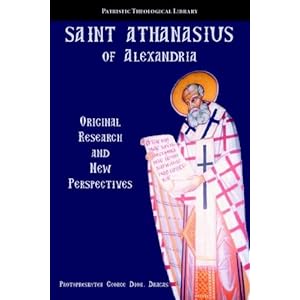
The Arian heresy was decisively fought at the First Ecumenical Synod, which was summoned at Nicea in Bithynia in the summer of 325, at which Athanasius was present, accompanying his spiritual master Alexander of Alexandria. Although he was merely a deacon, Athanasius was active in the deliberations of the Synod.(16) His later successor, the resourceful Patriarch Cyril, relates that: Athanasius was so brilliant and celebrated and was admired by all even in that holy and great Synod, the one of Nicea, which was summoned in critical times. He did not yet hold the office of the bishop, but rather belonged to the class of the clerics, and yet, because of his sagacity and gentleness besides, and because of his exceedingly subtle and incomparable mind, he was at that time, taken as his companion by Alexander, the bishop of blessed memory. He was as close to the old man as a son is to his father, leader in everything helpful, and the one who showed the way right well in all things, which were to be done.(17)
Athanasius himself explains the argumentation of the Arians in his letter on the Synod of Nicea and the objections of the Fathers. The Arians put forward biblical words and phrases in order to cover up their particular viewpoint. The Fathers, however, stressed the meaning of the biblical data and did not hesitate to make use of literally non-biblical terms, just as the Arians did, in order to clear up the orthodox meaning of the former. Thus, the fathers clarified the biblical statement that The Son was From the Father, saying that, He was from the essence (being) of the Father, over against the Arian claim that, The Son was out of nothing and, therefore, a creature; and in order that the phrase From the essence might not imply division, the Fathers also added the term Co-essential (Homoousios) to the Father in order to specify the unity of the one and undivided Essence of the Father and the Son. The Great Athanasius was, through his writings, the defender and supporter, par excellence, of these dogmatic decrees of the Synod of Nicea, i.e. of the From the Essence and Co-essential.
Pages 196 - 197 from the book Saint Athanasius of Alexandria: Original Research and New Perspectives (Patristic Theological Library) by ProtoPresbyter George Dion. Dragas
Friday, October 19, 2012
St. Alexander’s Letter to Alexander of Constantinople
Patriarch/Pope Alexander of Alexandria from 313 A.D. to 328 A.D.
Most of the Theology of the original Nicene Creed can be seen in the works of Saint Alexander of Alexandria(most of which was probably written by Saint Athanasius on his behalf). Also, a form of numeric unity as seen in the Nicene-Constantinople-1 Creed can also be seen in his works when he stresses how the Father and Son are inseparable. In another work before the time of the council of Nicea, Saint Athanasius wrote on his behalf a letter that stressed the doctrine of perichoresis between Father and Son. Also, the idea of Will being a function of Nature can also be seen in some of his letters.
The link:
http://www.fourthcentury.com/index.php/urkunde-14
The hypothesis that the Son came into being “out of nothing” is clearly impious: the Father must always be a father. He is always Father of a Son who is present, on account of whom he is called Father. Only if the Son is always present with him is he always a completed Father, lacking in nothing good. He could not, therefore beget his only Son in time, or in any interval of time, nor out of that which had no previous existence. (27.) Is it not then impious to say, “There was a time when the wisdom of God was not?” The very Wisdom who says, “I was by him as one brought up with him: I was daily his delight?” [Prov 8:30] Is it not also impious to say that at one time the power of God was not, or his Word, or anything else by which the Son is known, or the Father designated? To assert that the brightness of the Father’s glory [Heb 1:3] “once did not exist,” destroys also the original light of which it is the brightness. If there ever was a time in which the image of God [2 Cor 4:4] was not, it is plain that God, whose image he is, is not always. (28.) No, if the express image of God’s Person did not exist, then he was separated from the one of whom he is ever the express image. Hence it may be seen, that the sonship of our Savior has not even anything in common with the sonship of men. (29.) It has been shown that the nature of his existence cannot be expressed by language, and infinitely surpasses in excellence all things to which he has given being. So also his sonship, naturally partaking in his Father’s Divinity, is unspeakably different from the sonship of those who, by his appointment, have been adopted as sons. He is by nature unchangeable, perfect, and all-sufficient, whereas men are liable to change, and need his help. (30.) What further advance can be made by the wisdom of God [1 Cor 1:24]? What can the very Truth, or God the Word, add to itself? How can the Life or the True Light [John 14:6; 1:4, 9] be bettered in any way? And is it not still more contrary to nature to suppose that wisdom can be susceptible to folly? That the power of God can be united with weakness? That reason itself can be dimmed by unreasonableness, or that darkness can be mixed with the true light? Does not the Apostle say, “What communion has light with darkness? And what harmony has Christ with Belial?” [2 Cor 6:14-15] and Solomon, that “the way of a serpent upon a rock” [Prov 30:19] was “too wonderful” for the human mind to comprehend, which “rock,” according to St. Paul, is Christ [1 Cor 10:4]. Men and angels, however, who are his creatures, have received his blessing, enabling them to exercise themselves in virtue and in obedience to his commands, that thus they may avoid sin.
To read the rest please visit the link!
Tuesday, September 25, 2012
Beware of the Tri-Theists
Big ups to Maximus Scott for bringing this to my attention. The Tri-theists here were mainly the followers of the Monophysite John Philoponus :
As seen from HolyTrinityMission.org
As seen from HolyTrinityMission.org
During the period when the Monophysites were left somewhat undisturbed by the imperial arm, from 540 until about 570, personal disputes caused further factions. One faction was the Agnoetae — from αγνοέω. They were also known as Themistians, from the founder of their Monophysite faction, Themistius, a sixth century deacon of Alexandria and a student of Severus. Their basic position was in maintaining that the humanity of Christ was "ignorant." Another group, the Niobites, professed a belief in a distinction of natures after the union but refused to accept the expression "two natures" — the Niobites anathematized the entire Severian party.
A more serious schism was that of the Tritheists, also known as the Cononites from their leader Conon, one of the early associates of Jacob — they were also known as the Philoponists from John Philoponus (d.c. 565). According to the extant sources the origin of Tritheism occurred in a most casual way. In a meeting with the Chalcedonians John Philoponus allegedly asked: "If you speak about two natures, why do you not also speak of two hypostases since nature and hypostasis are identical?" The Chalcedonian response was that they would indeed do so "if we considered nature and hypostasis identical, but as a point of fact we distinguish between the two." The Chalcedonian reportedly continued by proposing that John Philoponus, if he held nature and hypostasis to be identical, should therefore speak of three natures in the Godhead. His reply allegedly was: "Then, we will do so." When the astonished Chalcedonian exclaimed that to do so would be to teach Tritheism, John reportedly replied that "in the Trinity I count as many natures, essences, and Godheads as I do hypostases."
Such a position may appear somewhat flippant and casual but it was a quite serious point by John Philoponus, who was not an ignorant monk but a sophisticated philosopher, a disciple of Ammonius of Hermias. He wrote works on Aristotle, works on Nichomachus of Gerosa, and at least two works on grammar. His works reflect an eclectic philosophical perspective which combines Aristotle, Plato, Stoic principles, and elements of Christian thought. Underlying his thought is a Stoic principle of considering fundamental matter as three dimensional. Pluralism was a cornerstone of his philosophical perspective.
In transferring his basic philosophical vision to the Trinity John Philoponus could easily affirm a Tritheism. It is interesting that in his philosophy he viewed created existence as a mere instrumentality of divine causation, a position which would make Monophysitism somewhat natural for him. In none of his works does he, however, explicitly affirm that there are three gods. John Philoponus was also extremely hostile toward the Roman see, attacking directly the primacy of Rome and explicitly calling Pope Leo the Great a Nestorian.Underlying the thought of the Tritheists was the distinction between hypostasis and nature. Christ was one hypostasis, an indivisible hypostasis, which, though united with God the Father, must be distinguished from the hypostasis of the Father and the hypostasis of the Holy Spirit. But because of the interaction between hypostasis and nature and because of a certain "assimilation" between the two, the individual "natures" had also to be distinguished. The Cappadocian balance between the hypostasis and nature was compromised and the compromise implied a Tritheism. When this thought pattern was presented by a philosopher and ascetic such as John Philoponus, it attracted the attention of some leaders within the Monophysite movement.
Sergius, a Syrian from Telia who was ordained patriarch of Antioch in 557 by Theodosius, became enamored by the teaching. The early associates of Jacob, Conon and Eugenius, now working in Cilicia and Isauria fell under the influence of Tritheism. In Constantinople John Asconaghes — his name referred to his slippery type of shoes which in turn referred to his "slippery" character; that is, he was constantly slipping from one faction to another — accepted this interpretation of hypostasis and nature and, through him, an important convert was won from the imperial court: Anastasius, the grandson of Theodora.For the next twenty years Anastasius was to be a personality to contend with. Michael the Syrian relates that Justinian had hoped to place Anastasius on the patriarchal throne of Alexandria (Chronicle
9, 30). Anastasius brought both money and a certain social prestige to the new faction. Very quickly this new faction had attracted to its cause another bishop, a significant event because this new bishop happened to be the third bishop in the new movement which now allowed them to ordain their own bishops. One of the sources claims that "all their disciples and followers — whoever joined them — they consecrated as bishops." They established new communities throughout the empire — in Africa, in Rome, in Greece, in Asia Minor, as well as in the traditionally non-Chalcedonian areas of Egypt and Syria. In Constantinople they also established themselves. Indeed, John of Ephesus relates how surprised he was at the number of persons from the court who attended the services of the new faction.
During all this Theodosius used persuasion and then excommunication with the new faction. Theodosius rejected any notion of separate natures. He excommunicated John Asconaghes and Patriarch Sergius. He had more difficulty with Conon and Eugenius, both of whom continued to reject and then accept again the position of the Tritheists throughout their lives. Anastasius had created a will that left an endowment to the new faction. He had a falling out with this new faction before his death but had not altered his will, the result of which was a financial source to perpetuate the new faction.
Attempts were made to reunite but nothing came of them ultimately. After mutual excommunication both parties appealed to the emperor. The task of judging two Monophysite groups was delegated to Patriarch John Scholasticus. He was to use the works of Severus, Theodosius, and Anthimus as the guide, the authoritative works from which to judge. The "trial" lasted for four days. Conon and Eugenius represented the Tritheists; Paul "the Black" and Jacob the "conservative" wing of the Monophysites. As could have been anticipated, the decision favored the "conservative" wing. Exile under escort was the decision for Conon and Eugenius. John of Ephesus relates that the head of the escort was the defrocked monk, Photius, the stepson of Belisarius, who was well-known for his cruelty. Indeed, it is related that he liked nothing more than to torture clergy.
This inner quarrel actually played into the hands of the Chalcedonians. The Tritheists had pushed the Monophysite position to an extremity and, in order to answer the Tritheists, the conservative Monophysites were forced to fall back to strictly Severian positions or to positions that pointed in the direction of Chalcedon. Michael the Syrian claims that thousands returned to the Chalcedonian hierarchy, for they believed it far more theologically sound to confess "two natures" rather than have anything to do with a theology that could fall into "three natures in the Trinity."
To read the rest please visit the website.
Subscribe to:
Posts (Atom)
POPULAR POSTS
-
Have you ever noticed how Protestantism demonizes (divides) between things which no sane, God-fearing person would ever dare to tear asunder...
-
I am Augustine, thy Father: Thou shalt have no other Fathers before me .
-
It's because of stuff like this floating around online: Calvinism Declared By The Church Fathers . TOTAL DEPRAVITY Barnabas (A.D. 70 ):...
-
Audio Confronting the Doctrine of Sola Scriptura , by Fr. Jon Braun. (This one is mostly about what some Protestants call Solo Scriptura , o...
-
 St. Polycarp of Smyrna was a disciple of St. John the Apostle and a friend of both Sts. Papias of Hierapolis and Ignatius of Antioch, who we...

LORD JESUS CHRIST,
SON OF GOD,
HAVE MERCY ON US,
THE SINNERS.

Subscribe To


 Posts
All Comments
Posts
All Comments