Thursday, February 9, 2012
Handbook of Patristic Exegesis: The Bible in Ancient Christianity
Just started to get into it:
Handbook of Patristic Exegesis: The Bible in Ancient Christianity

Something I thought was interesting:
[1] pages 130-132 from the Handbook of Patristic Exegesis: The Bible in Ancient Christianity by Charles Kannengiesser
Handbook of Patristic Exegesis: The Bible in Ancient Christianity

Something I thought was interesting:
Quote:
"Two Judaism and Rhetorical Culture
b. Midrash
Th e second group of texts which refl ect biblical interpretation dating from
the Amoraic period in Eretz Israel is called midrash. Th e term ( מִדְרָשׁ , from
דָּרַשׁ , darash, “to seek,” “inquire,” “investigate”) refers to a method of expounding
the text and to a collection of such texts. Th ese texts are commentary and
elaboration on the Written Torah. Th e various collections which fall under
the head of midrash, however, can focus on deriving rabbinic halakah based
on Scripture, or provide elaborations on narrative passages in the Bible. Th ey
may be organized according to the order of the biblical text, or arranged as
homilies corresponding to the lection on Sabbaths and Holy Days.
In midrash we can discern some of the interrelationship of Judaism
and Christianity during the early Christian period. Th ere are some remarkable
parallels in hermeneutical method between the midrashim and Greek
and Syriac patristic literature. Origen and Jerome are explicitly aware of
midrashic traditions. Moreover, in the third century tensions between Jews
and Christians (including Origen and Eusebius) living in Eretz Israel rose
to a level of confrontation. Th ese debates can be discerned in the pages of
midrash from this period, and the development of midrash in Eretz Israel
(not in Babylonia) may in part be the result of Jewish eff orts to confront their
Christian counterparts regarding interpretation of the Scriptures.
An example of rabbinic response to Christianity can be found in Genesis
Rabbah on the sacrifi ce of Isaac (the Akedah, Gen :–). Th e account
begins with the command to Abraham to go to the place he would be told,
and sacrifi ce his son (Gen :). He took two slaves and Isaac on the journey.
Th en he “saw the place from afar” (Gen :; מָקוֹם (maqom), meaning “place”
also serves as a euphemism for God. Th e midrash asks, “What did he see?”
“He saw a cloud attached to the mountain”—i.e., a manifestation of the divine
presence, which made it clear to him that this mountain was the place which
God had commanded as the appropriate place to off er up Isaac.
He [Abraham] said: “It would appear that is the place upon which the
Holy one, blessed be He, commanded me to sacrifi ce my son.” He said
to Isaac: “My son, do you see what I do?” He told him, “Yes.” He said
to his two young men, “Do you see what I do?” Th ey said to him, “No.”
He said: “Since you do not see it, REMAIN HERE WITH THE ASS
[Gen :], for you are like the ass [which also does not see].” (Gen.
Rab. .–)
We learn from other sources that the Gentiles are “a nation resembling an ass.”
Christians and Jews debated vehemently in the third and fourth centuries
about the possibility of how, aft er the destruction of the Second Temple, that
BblRieba ltebo b ttoihn teihc S eLe Sipteteupratautguainrgetin t
one could verify divine revelation, and whether divine revelation to a non-
Jew was possible at all. In the above passage we observe the denigration of
the two non-Jewish servants. Th ey do not have any perception of the divine.
As non-Jews they are like the ass, a dumb animal incapable of perception.
Modern scholars may have some disagreement about whether or not the
“people who is like an ass” refers specifi cally to Christians or more generally
to pagans. Nonetheless, there are many passages in midrash literature which
focus on the theme of Verus Israel and God’s continued covenant with the
Jewish people in their exile.
i. Tannaitic Midrashim
Th e oldest group of midrashim are the so-called Tannaitic midrashim, sometimes
called halakic midrashim or מִרְשֵׁי הֲלָכָה (midreshei halakah, meaning
“midrashim of the halakah”). Th e works included in this subgroup are the
Mekilta d’Rabbi Ishmael and the Mekilta de Rabbi Simeon ben Yohai on Exodus,
Sipra on Leviticus; and Sipre on Numbers and Deuteronomy. Th e Tannaitic
midrashim may be said to form a continuous commentary on the Pentateuch
from Exodus to Deuteronomy. In these midrashim there is extensive use
of rabbinic hermeneutics to demonstrate how various expansions of the
Oral Law are grounded in Scripture. Despite the use of the name halakic
midrashim, these collections all contain commentary on narrative passages
in their respective biblical books.
ii. Exegetical Midrashim
A second set of midrashim consists of those referred to as “exegetical” and
“homiletic.” Th e “exegetical” midrashim are later than the midreshei halakah, but
a number were compiled during the fi ft h century. It is important to remember
that the midreshei halakah are exegetical, but modern scholars refer to them as
“exegetical” because these collections are organized according to the biblical
verse order. Th e term “exegetical midrashim” merely distinguishes them from
the next group to be described, which are called “homiletic midrashim.”
Genesis Rabbah explicates the book of Genesis. Scholars postulate that
it was redacted in the fi ft h century. It is considered by some to be the best
example of the exegetical midrashim because the rabbis reveal deep layers
of meaning within the text. Th e meanings the rabbis sought in the Scriptures
included truths which pertained to their own age. Genesis Rabbah provides
many examples of rabbinic apologetic against pagan and Christian arguments.
In the narratives about the patriarchs and matriarchs, it is possible
Two Judaism and Rhetorical Culture
to discern their veiled arguments against Christian claims that these biblical
fi gures reached their true fulfi llment only in Christ.
In this period exegetical midrashim were also edited on the fi ve books
in the Hebrew Bible called the Five Megillot, or “Five Scrolls.” Th ese biblical
books were read as part of the synagogue liturgy for the three pilgrimage festivals:
Passover (Canticles), Pentecost (Ruth), and Tabernacles (Ecclesiastes);
and on Purim (the Feast of Esther) and the Ninth of Ab commemorating
the destruction of the Temple in Jerusalem (Lamentations). Th e earliest
description of the liturgical role for these books is in the Mishnah, tractate
Megillah.
Th ese midrashim would include Canticles Rabbah; Midrash Ruth (also
called Ruth Rabbah); Lamentations Rabbah; Midrash Qoheleth (also called
Ecclesiastes Rabbah); and the fi rst half (§§ –) of Esther Rabbah.
iii. Homiletic Midrashim
“Homiletic” midrashim are so called because the order of their composition
follows the readings for Sabbaths and for special Sabbaths, or Holy Days, in
the liturgical year. Th ese collections do not follow the order of the biblical
text. Rather, they develop thematically. As we have them, these homilies have
sometimes been subjected to abbreviation or other editorial reformulation.
Th e most signifi cant collections dating to the Amoraic period include Leviticus
Rabbah, containing thirty-seven homilies, which dates to the fi ft h century
(perhaps later); the Pesiqta de Rab Kahana, a collection of homilies for feasts
and special Sabbaths, redacted in the fi ft h century, though subject to later additions;
and the Tanhuma on the Pentateuch, which contains some material
from the Amoraic period but was not redacted until the medieval period.
Modern scholarship has concentrated considerable eff ort on the structure
of these homilies, especially the formal conventions for their beginning
and conclusion. Th e petiah, which is generally understood to be a kind of
proem or introduction to the homilies, is the most common rhetorical form
in midrashic literature. Petiot aim at artfully leading the hearer from verses
in other parts of the Hebrew Bible, such as Psalms or Proverbs, to consider
the opening verse(s) of the Pentateuchal reading of the day. Th e atimah, or
peroration of the homily, has also been studied. Particularly in the Pesiqta de
Rab Kahana, and Tanhuma, these atimot lead to an eschatological teaching
which concludes the homily with a message of hope in the messianic deliverance
of the Jewish people from the harshness of its exile. Th ese atimot may
off er students of patristic literature some understanding of the development
of early Christian typological exegesis." [1]
[1] pages 130-132 from the Handbook of Patristic Exegesis: The Bible in Ancient Christianity by Charles Kannengiesser
Saturday, February 4, 2012
Another Look at Romans Chapter 9
A conversation I had with someone else:
I see Thee Elect One as being Jesus Christ and so the Elect group are all those Elected In Christ. In this sense I believe in corporate election.
Originally Posted by lonehunter
Because Christ is the starting point. Let's look at some Old Testament prophesies about Christ being chosen:
Isaiah 42:1
"“Here is my servant, whom I uphold,
my chosen one in whom I delight;
I will put my Spirit on him,
and he will bring justice to the nations."
For a fuller typological context you can read to verse 7. But this shows that the Messiah is also Chosen or seen as Thee Chosen One. Let's look at another passage in Isaiah:
Isaiah 49:1
"Listen to me, you islands;
hear this, you distant nations:
Before I was born the LORD called me;
from my mother’s womb he has spoken my name."
To get the fuller typological context read all the way to verse 13. In this we see He is thee Called One. He is also a Nation, the True Nation of Israel, but I don't want to get into that right now. But yes, Jesus is the Elect One! This is seen more clearly in the New Testament.
1st Peter 1:20(read verses 18,19, and 21 too)
"He was chosen before the creation of the world, but was revealed in these last times for your sake."
and
1st Peter 2:4(you can read up to verse 6)
"As you come to him, the living Stone—rejected by humans but chosen by God and precious to him"
Jesus being Thee Elect/Chosen One can also be seen by Clement of Rome, one of the Apostolic Fathers
Clement of Rome
http://www.ccel.org/ccel/schaff/anf01.ii.ii.lviii.html
"May God, who seeth all things, and who is the Ruler of all spirits and the Lord of all flesh—who chose our Lord Jesus Christ and us through Him to be a peculia people—grant to every soul that calleth upon His glorious and holy Name, faith, fear, peace, patience, long-suffering, self-control, purity, and sobriety, to the well-pleasing of His Name, through our High Priest and Protector, Jesus Christ, by whom be to Him glory, and majesty, and power, and honour, both now and for evermore. Amen."
You are(I assume) a protestant and so you may not like the Book of Wisdom and the Book of Enoch, but if you read them then you will also see what I'm saying here. Election is Christ-Centric! For there can be no Election apart from Christ. Thus, He is thee Elect/Chosen One, and it is by way of Him that we become elect. Election in Christ is primarily Corporate and secondarily individualistic because the Covenant Community is inherently pluralistic. There is no such thing as a lone ranger Christian, correct?
Jesus said:
Matthew 18:20
For where two or three gather in my name, there am I with them.”
Noticed that Jesus never said wherever one is gathered in my name. Thus being In Christ is inherently Communal. It is inherently Koinonia.
Eph 2:11-19 shows that it is pluralistic. That it is covenant community based. And so it is the community that exist in Christ that is primary. The individual who is united to the community is secondary.
For more info about Christ being Thee Chosen one and how we are chosen by way of Him, well, you can listen to this mp3 if you want:
Jesus - The Chosen and Beloved

Yes, I agree with you that God's promise is given to those in Christ, as opposed to (all) the literal descendants of Jacob. However, the word Chosen is another way of saying Elect, and so Christ is the Elect One. And so I don't believe He is the recipient of the promise. What I believe is that He is the promise itself.
Christ is the promised seed as seen in Galatians.
Galatians 3:16
The promises were spoken to Abraham and to his seed. Scripture does not say “and to seeds,” meaning many people, but “and to your seed,” meaning one person, who is Christ.
Christ is also a Nation, the true Nation of Israel. If you look at the typology used by the Apostles in reference to Jesus then you will be able to see how Jesus is Israel.
Matthew 2:14-15
So he got up, took the child and his mother during the night and left for Egypt, where he stayed until the death of Herod. And so was fulfilled what the Lord had said through the prophet: “Out of Egypt I called my son.”
Hosea 11:1
“When Israel was a child, I loved him,
and out of Egypt I called my son."
The Church, which is His body, is also seen as the Israel of God:
Galatians 6:16
"Peace and mercy to all who follow this rule—to the Israel of God"
And so in this way we can see the connection between the Promised Seed(Who is Jesus) and all those who believe in the Promise.
We can see the connection between the Nation of Israel (Who is Jesus) and all those who want to be citizens of this Nation. Which is also the Kingdom of God for the Kingdom of God is connected to the Person of Christ. Christ is the very core, the very foundation of it all.
So what does this have to do with Romans chapter 9 you ask? Well, even-though there is no such thing as an infallible hermeneutic, I will make use of a common one in where Scripture is interpreted by Scripture, and so lets Interpret Romans Chapter 9 with not only other chapters from the book of Romans, but also Galatians chapter 3, Ephesians chapter 2, and maybe a few other sources from the Old Testament.
I truly believe that when we do it this way then we will see what Paul is trying to say more clearly.
Let's interpret a good portion of Romans chapter 9 through the lens of Galatians chapter 3.
Galatians 3:19
"Why, then, was the law given at all? It was added because of transgressions until the Seed to whom the promise referred had come. The law was given through angels and entrusted to a mediator."
Galatians 3:22
"But Scripture has locked up everything under the control of sin, so that what was promised, being given through faith in Jesus Christ, might be given to those who believe."
Galatians 3:23-29
"Before the coming of this faith, we were held in custody under the law, locked up until the faith that was to come would be revealed. So the law was our guardian until Christ came that we might be justified by faith. Now that this faith has come, we are no longer under a guardian.
So in Christ Jesus you are all children of God through faith, for all of you who were baptized into Christ have clothed yourselves with Christ. There is neither Jew nor Gentile, neither slave nor free, nor is there male and female, for you are all one in Christ Jesus. If you belong to Christ, then you are Abraham’s seed, and heirs according to the promise."
Now, if we look at Romans chapter 9 then we will see that there were certain periods of time in where it was about which lineage would be the one to carry the promise seed.
Romans 9:5
"Theirs are the patriarchs, and from them is traced the human ancestry of the Messiah, who is God over all, forever praised! Amen."
Now let's look at what I quoted from Galatians with what I underlined in Romans 9:5 and let's compare them to the two examples given by the Apostle in verses 6 to 13.
For not all who are descended from Israel are Israel. Nor because they are his descendants are they all Abraham’s children. On the contrary, “It is through Isaac that your offspring will be reckoned.”In other words, it is not the children by physical descent who are God’s children, but it is the children of the promise who are regarded as Abraham’s offspring. For this was how the promise was stated: “At the appointed time I will return, and Sarah will have a son.”"
In this we see that the lineage of the promise seed would go down Isaac's family line and not Ismael's for in Galatians it says that Isaac was a son based on a divine promise while Ismael a son of a bond-servant woman. Now let's look at the next example.
"Not only that, but Rebekah’s children were conceived at the same time by our father Isaac. Yet, before the twins were born or had done anything good or bad—in order that God’s purpose in election might stand: not by works but by him who calls—she was told, “The older will serve the younger.”Just as it is written: “Jacob I loved, but Esau I hated.”"
In this we see that the lineage of the promise seed would go to Jacob instead of Esau. Why? Faith! God foresaw that Jacob would believe while Esau wouldn't. In Paul's terminology, faith is not a work. We can see this all throughout the book of Romans, and Galatians.
A couple patristic quotes about the issue:
Quote:
"God does not have to wait, as we do, to see which one will turn out good and
which one will turn out bad. He knew this in advance and decided accordingly."
Saint John Chrysostom, Homilies on Romans....as quoted from the Ancient Christian commentary on scripture volume 6, edited by Gerold Bray and Thomas C. Oden page 250
Quote:
"Thus God chose Isaac and rejected Ishmael and the children of Keturah. So also
he chose Jacob over Esau, even though both were formed together in the womb. Why
be surprised then, if God does the same thing nowadays, by accepting those of
you who believe and rejecting those who have not seen the light?"
Theodoret of Cyr: interpretation of the letter to the Romans....as quoted by Ancient christian commentary on scripture edited by Gerold Bray and Thomas C. Oden page 253
"What then shall we say? Is God unjust? Not at all! For he says to Moses,
“I will have mercy on whom I have mercy,
and I will have compassion on whom I have compassion.”
It does not, therefore, depend on human desire or effort, but on God’s mercy. For Scripture says to Pharaoh: “I raised you up for this very purpose, that I might display my power in you and that my name might be proclaimed in all the earth.” Therefore God has mercy on whom he wants to have mercy, and he hardens whom he wants to harden."
God is not unjust on which lineage gets to carry the promise seed. The carrier of the promise seed is based on God's Mercy! And the Apostles already told us who God has Mercy on. He has Mercy on those who Believe!
Galatians 3:14
"He redeemed us in order that the blessing given to Abraham might come to the Gentiles through Christ Jesus, so that by faith we might receive the promise of the Spirit."
Romans 9:30-33
"What then shall we say? That the Gentiles, who did not pursue righteousness, have obtained it, a righteousness that is by faith; but the people of Israel, who pursued the law as the way of righteousness, have not attained their goal. Why not? Because they pursued it not by faith but as if it were by works. They stumbled over the stumbling stone. As it is written:
“See, I lay in Zion a stone that causes people to stumble
and a rock that makes them fall,
and the one who believes in him will never be put to shame.”"
Romans 11:1-10
"I ask then: Did God reject his people? By no means! I am an Israelite myself, a descendant of Abraham, from the tribe of Benjamin. God did not reject his people, whom he foreknew. Don’t you know what Scripture says in the passage about Elijah—how he appealed to God against Israel: “Lord, they have killed your prophets and torn down your altars; I am the only one left, and they are trying to kill me”? And what was God’s answer to him? “I have reserved for myself seven thousand who have not bowed the knee to Baal.” So too, at the present time there is a remnant chosen by grace. And if by grace, then it cannot be based on works; if it were, grace would no longer be grace.
What then? What the people of Israel sought so earnestly they did not obtain. The elect among them did, but the others were hardened, as it is written:
“God gave them a spirit of stupor,
eyes that could not see
and ears that could not hear,
to this very day.”
And David says:
“May their table become a snare and a trap,
a stumbling block and a retribution for them.
May their eyes be darkened so they cannot see,
and their backs be bent forever.”"
God's Mercy and Hardening is conditional:
Romans 11:19-23
"You will say then, “Branches were broken off so that I could be grafted in.” Granted. But they were broken off because of unbelief, and you stand by faith. Do not be arrogant, but tremble. For if God did not spare the natural branches, he will not spare you either.
Consider therefore the kindness and sternness of God: sternness to those who fell, but kindness to you, provided that you continue in his kindness. Otherwise, you also will be cut off. And if they do not persist in unbelief, they will be grafted in, for God is able to graft them in again."
And so, what I see in Romans chapter 9 is mostly what happens in regards to who gets to carry the promise seed in their lineage before the first advent, and then towards the end of Romans chapter 9 I see what happens after the first Advent. The one consistent theme in both pre and post 1st Advent is being embraced because of Faith.
Election is primarily corporate for me because it's all based on the Person of Christ who is also the Promise Seed and Israel! The Gentiles get a chance to become Citizens of the Nation of Israel, the Kingdom of God when they are united to Christ. And for me, this happens by way of Belief, Repentance, and Baptism(Water and Spirit).
Tuesday, January 31, 2012
Great blog articles at Orthodox Bridge and Classical Christianity.com
From Orthodoxbridge.com:
Response to Theodore – Semi-Pelagianism, Sola Fide, and Theosis
March for Life & Great Tradition
Contra Sola Scriptura (1 of 4): Book Review: The Shape of Sola Scriptura by Keith A. Mathison
Contra Sola Scriptura (2 of 4): If Not Sola Scriptura, Then What? The Biblical Basis For Holy Tradition
Contra Sola Scriptura (3 of 4): Where Does Sola Scriptura Come From? The Humanist Origins of the Protestant Reformation
Contra Sola Scriptura (4 of 4): Protestantism’s Fatal Genetic Flaw: Sola Scriptura and Protestantism’s Hermeneutical Chaos
Calvin Vs. the Icon: Was John Calvin Wrong?
New Apostles or Old Heresy? An Orthodox Perspective on the New Apostolic Reformation
From Classical Christianity.com:
What is Pure Prayer? St. John of Kronstadt on Worldliness/Consumerism
On Almsgiving Saint John of Kronstadt on Theosis/Deification
Building The New City: St. Basil’s Social Vision
St. John Chrysostom on Abortion and Birth Control
Heresy as Intellectual Temptation
Eastern Orthodox View of Calvinism
On Irresistible Grace and Synergy
On Limited Atonement
The Wills of Christ II
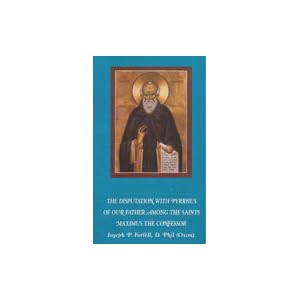
In regards to Christology, what stood out to me was a number of things. Some of which were:
201. Pyrrus: But the Fathers said this on the level of Theology and not on the level of Economy.113 Hence, no one who loveth the truth should change the appointed meaning of their statements which refer to Theology into statements that refer to the Economy, and therby introduce an absurdity.114
202. Maximus: If the Fathers say it of the Theology alone, then after the Incarnation it is not possible--so thou wouldst have us say -- to regard the Son as equally divine as the Father. And if it be not possible to regard Him as equally divine, then He hath no place in the invocation [of the Divine Name] at baptism. So both faith and preaching shall, in the last analysis, to be proven to be in vain.
203. And again, if it be not possible to regard the Son as equally divine with the Father after the Incarnation, then [how will these statements be explained]? "My Father worketh hitherto, and I work."115 Or "Whatever the Son seeth the Father doing, the Son doeth likewise"?116 Or "If ye believe not me, believe my works"?117
Or "The works which I do bear witness of me"?118 Or "For as the Father raiseth up the dead and quickeneth them, even so the Son quickeneth whom He will"?119 For all these prove that He was not only of the same essence as the Father after the Incarnation, but of the same energy as well.
204. And again, if the foreknowledge of beings be a divine energy, and if it be not only proper to the Father and the Spirit, but further, be also proper to the Son even after the Incarnation, then the Son is of the same energy after the Incarnation as the Father.
205. And again, if the miracles be a divine operation, and if we know from the miracles that He is of the same essence as the Father, then from the same energy He is shown to be of the same essence as the Father, and is to be regarded as equally divine [with Him] after the Incarnation [as He was before it].
206. And again, if the creative energy be an attribute proper to the essence of God, then the attributes of the essence are by necessity inseparable. S those who say that after then Incarnation He is not of the same energy as the Father also say that He is not of the same essence, for where the energy proper to a given nature is not found neither shall that nature be found. Conversely, those who say that He is of the same essence say that He is of the same energy as well, and regard Him to be equally divine [with the Father] after the Incarnation [as He was before it]. For wherever the natures is, there also is the energy proper to it, without diminution.
207. Pyrrhus: But we do not say "one energy" as a denial of human operation. It is said to be passable by opposition to the divine nature.120
208. Maximus: Then by the same principle those who say one nature do not say this as a denial of the humanity, but by this means oppose its passable character to the divine nature.
209. Pyrrhus: So? Did not the fathers define passibility by means of its difference from the divine operation [of impassibility]?
210. Maximus: God forbid! For no [father], ever defined an existence by comparison to its opposite or found the one to be the cause of the other. For if human passion is caused in such a manner by the divine energy, then doubtless human imperfection existeth because of the goodness of the divine nature. And the exact opposite may also then be stated: that through the passable human motion the divine energy existeth, and that because the human nature is evil, the divine nature is good. But enough of this! For such[conceptions are quite perverse.121
211. Pyrrhus: Why? Did the Fathers not designate passion as the human motion?
212. Maximus: Yes, but the spoke in various ways about these same propositions and conceptions.
213. Pyrrhus: How canst thou say this?
214. Maximus: They referred to the same thing as power, energy, distinctions, motion, property, quality, and passion, but not by opposition to the divine [energy]. Power they defined as that which maintaineth immutability, energy as that which characterizeth the same forms by indistinquishable productions, distinction as that which defineth a thing, motion as that which manifesteth, property as a component attributed only to one thing and not to another, quality as that which imparteth form, and passion as that which is moved. For all things that are from God and after God change by motion, for they are not self-moved beings of omnipotent power.122 Therefore, they cannot be defined by opposition, but only by means of the rational principle created and placed into them, which are the established causes in each thing.123
So[the human] energy is designated at the same time as the divine, for what else can one make of the expression "He operateth in the form of each of the two by the communion of each of the two"? Or "after He continued also for forty days fasting, He hungered, for He granted to nature when He so willed to enact those things proper to it?" Or of those who say either that there is a distinction of energy, or of those who say there are two energies, one, and another one?
___________________________________________________________
113 This would seem to explain why Pyrrhus persists in the literary spirit of St. Cyril of Alexandria, using physis in Theology and Economy differently, whereas St. Maximus, firmly within the Cyrillic Chalcedonian tradition, uses a consistent terminology, where the meanings of hypostasis and nature remain the same, whether referring to Triadology(i.e., Theology) or Christology(i.e., Economy).
114 Pyrrhus seems to object to the whole enterprise of Cyrillic Chalcedonianism itself, and to its (eventually successful) effort to use technical terms such as hypostasis and nature univocally in both Theology and Economy.
120 Pyrrhus' argument is dependent upon the Neoplatonic and Plotinian paradigm, which would define all distinctions by means of a dialectical opposition. cf. EnneadsIII:2:16,17:
"The All is in accordance with its rational formative pattern, and it is necessary that this one formative pattern should be one pattern made out of opposites, since it is opposition of this kind which gives it its structure, and, we might say, its existence..........distinction is opposition......the more it is differentiated the more opposed will it make the things it makes."(trans. A.H. Armstrong, Loeb Classical Library, No. 442, p.99)
121 Once again, St. Maximus' response is upon the implication of Pyrrhus' Neoplatonic dialectic which underwrites Monotheletism.
122 That is, created beings are self-moved, but not in the manner of God, with complete omnipotence, independence, and autonomy. In this sense, they are not "autonomous", which would be dualism, nor merely passive automatons in the face of an irresistible divine energy, which would be fatalism, nor are they mere emanations of the divine essence, which would be pantheism. rather, they are "semi-autonomous", i.e., precisely created, and therefore a uniquely different kind of being, with a different kind of free choice and activity, which nevertheless depended at all times on the divine will for their existence and activity.
123 That is, the nature of created beings is not defined by dialectical oppositions between them or between God, but by the distinguishing logoi in them.
pages 68 - 72 from the book The Disputation with Pyrrhus of our Father Among The Saints Maximus The Confessor. Translated from the greek by Joseph P. Farrel
Subscribe to:
Posts (Atom)
POPULAR POSTS
-
Have you ever noticed how Protestantism demonizes (divides) between things which no sane, God-fearing person would ever dare to tear asunder...
-
I am Augustine, thy Father: Thou shalt have no other Fathers before me .
-
It's because of stuff like this floating around online: Calvinism Declared By The Church Fathers . TOTAL DEPRAVITY Barnabas (A.D. 70 ):...
-
Audio Confronting the Doctrine of Sola Scriptura , by Fr. Jon Braun. (This one is mostly about what some Protestants call Solo Scriptura , o...
-
 St. Polycarp of Smyrna was a disciple of St. John the Apostle and a friend of both Sts. Papias of Hierapolis and Ignatius of Antioch, who we...

LORD JESUS CHRIST,
SON OF GOD,
HAVE MERCY ON US,
THE SINNERS.

Subscribe To


 Posts
All Comments
Posts
All Comments