Thursday, July 26, 2012
Love and Hate in Romans chapter 9
As seen from the Energetic Procession blog:
To read the rest please visit Energetic Procession.
Quote
In regard to Romans 9, there are three things on should note: the matter of the love of God, the question of Providence in working out Salvation, and lastly, what is specifically meant by “predestination.” First, the matter of God’s love and God’s opprobrium. God’s love, as everyone will confess, is eternal, for after all, God is love. But His hatred is not, not unless, that is, you have fallen into what has been termed the Origenistic problematic. Origen, the brilliant second/third-century father was influenced by middle-Platonism, and was a contemporary of the founder of NeoPlatonism, Plotinus. He and Plotinus had the same teacher in Alexandria, Ammonius Saccas. The starting point for both Origen and Plotinus was the ineffable singular unity of God (for Plotinus, “The One,” in Greek, to hen, which is neuter in form). For Origen, the eternality and unity of God was primary, and all that God was, he was eternally. Thus He was both Eternally Father with the eternally-begotten Son. (He was the first theologian to use the term “the eternal generation of the Son.”) But this comes at a cost: if God is creator, He is eternally so, and creation becomes eternal. Origen, moreover, was hard pressed to distinguish the eternal act of creation from the eternal act of begetting, for were we to begin with the unity of God, how can we distinguish acts (though Origen did seek to do so). In respect to the love of God, it would seem, hate becomes systemic of the divine nature as well. Origen reasoned that for God to be all-powerful, there must be something against which his power stood; for him to be infinite, His infinity must be opposed to finitude. We can see in this a dialectic of opposition, which would then entail that his love, while having an eternal object of love (and for Christians love is an energy within the Trinity and ultimately among us creatures), this same must be true of his hate. Origen really doesn’t comment on this, and later theologians have seen that God’s hate is but the disposition of God toward that which is not of Him, namely, sin. (Origen’s thoughts on all of this is in his On first principles.)
But Origen’s theology in these matters was condemned by the Church. God’s hate, such as it is, is not eternal (and neither is creation), but a response of his justice and love toward the corruption of His creation. This can be seen at the beginning of Dante’s Divine Comedy, for when Dante enters Hell he reads “eternal love created me.” Thus the love and hate of Jacob and Esau cannot be linked to the eternal purposes of God, in that the hate of God, like God’s creation, are acts of God in His relationship to time.
To read the rest please visit Energetic Procession.
Christology and Recapitulation
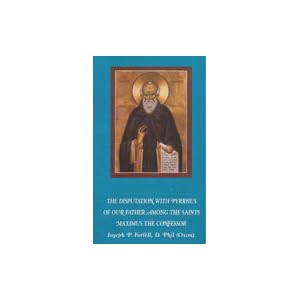
from pages iii-x
Quote:
"At the center of St. Maximus' theological and christological universe is the doctrine of Recapitulation. It is this doctrine which forms the basis of all that the New Testament and the Fathers have to say in connection with the Incarnation. While the term "recapitulation" itself appears only twice in the New Testament, the concept itself occurs repeatedly; one has only to recognize its principles of operation in order to know when it is being applied. These may be categorized as fellows: 1) preeminence 2) repetition and recontextualization, 3) reversal, and 4) fulfillment.
The Confessor elegantly summarizes this doctrine and its principles of operation in compact sentence: "The One Logos is the many logoi, and the many logoi are the One Logos." In other words, in His Incarnation and enhominization, Jesus Christ possesses and is all the fulness of the universals common both to deity and humanity. In terms of the four principles enumerated above, then, this works itself out in a multitude of ways. In terms of preeminence, it means that Christ is both the presupposition, the method, the paradigm, and the summit of whatever might be said either about God or about man. God is truly, uniquely, ultimately and finally revealed in The Word Incarnate. And man, perfect humanity, is also only understood properly in its union with the Word. In Scriptural terms, Jesus Christ is the Alpha and Omega of all that can be said of God and man, and thus has the preeminence "in all things". Being thus preeminent in all things, Christ becomes the final context, the ultimate and perfect "recontextualization" and repetition, of the logoi, understood here as both the words of the Old Testament Scripture and the principles of nature: of creation as a whole and of man in particular. That is, not only are the typological themes of Scripture repeated in His Incarnate Economy from His conception to His Second Advent, but He also repeats all of the natural stages of humanity itself; Christ recapitulates and summarizes not only sacred history but the history of all of humanity as a whole, and the stages of life of each individual human being in particular. In doing so, He reverses the effects of the Fall. As the Second Adam, the entire drama of the Fall is replayed, this time to an opposite conclusion. Instead of a Fall into passions and corruption, mankind in Christ is raised and exalted. Deification and the spiritual life, in other words, are integral components and implications of the doctrine of Recapitulation. By thus repeating, and in some cases reversing, the typological themes of Holy Scripture and the natural laws and stages of humanity, Christ is not only preeminent in all things, but fulfills all Old Testament prophecy and expectation concerning His Coming, there being nothing more that canbe said about them outside of and without reference to Christ.
Consequently, the doctrine of the Recapitulation in Christ bears implications not only for the exegesis and interpretation of Scripture and the understanding of the Incarnation, but implies also a general basis on which to interpret human history and the whole created order and their principles of activity.
At this point, it would be helpful to survey how this doctrine is employed by other Fathers prior to St. Maximus before proceeding to his own use of it. The word 'recapitulation' means 'to collect several different things together under one head', or simply 'to summarize'. It occurs only twice in the New Testament, in Ephesians 1:10--"That in the dispensation of the fulness of times he might gather together in one all things in Christ, both which are in heaven, and which are on earth, even in him"--and in Romans 13:9 -- "if there be any other commandment, it is briefly comprehended in this saying, namely, Thou shalt love thy neighbor as thyself." It is significent that St. Paul uses this word so sparingly, and then only in contexts having to do either with christological affirmation or with counsels on living a Christian life. In other words, the doctrinal affirmations of Christology and the principles of the spiritual life go hand in hand, they cannot be divorced fromeach other. The doctrinal principles of Christology are not mere intellectual constructs which have no force or bearing on the conduct of life, nor are the counsels of a virtuous life in love ever fully apprehended apart from Christ. Love, the union of God and man in Christ and the love of man for God and his neighbor, are the essence of the doctrine. This union was to play an important role in St. Maximus' own theology, as we shall see.
St. Irenaeus of Lyons is the name most often associated with recapitulation. For him, the two natures of Christ along with their various properties, establish His preeminence in both heavenly and earthly things and thus Christ fulfills them in Himself, ie., fills them with Himself:
"He was invisible and became visible; incomprehensible and made comprehensible; impassible and made passible; the Word, and made man; consummating all things in himself. That, as in things above the heavens and in the spiritual and invisible world the Word of God is supreme, so in the visible and physical realm he may have pre-eminence, taking to himself the primacy and appointment himself the head of the Church, that he may 'draw all things to himself' (St. John 12:32) in due time.
Here not only is Christ's recapitulation taken to refer to His preeminence in deity and humanity, but, since His divine nature is spiritual and invisible, it also includes "the spiritual and invisible world", the world of the angels and also of man's soul and mind. And by the same token, for St. Irenaeus the fact that Christ's humanity is physical and part of the physical creation, all of "the physical realm" is also effected by His Incarnation. Thus, the "one Christ Jesus our Lord" came "in fulfillment of God's comprehensive design and consummates all things in himself." In other terms, as the Word Himself in conjunction with His everlasting Father created "all things visible and invisible", so His Incarnation effects all things visible and invisible.
The double entendre of the word 'effects' is intentional, for Christ's Incarnate Economy affects all invisible and visible things both in the sense of accomplishing and even causing them to be, as well as in the sense of influencing them. The Recapitulation consequently effects the very design of time and history itself, since it pertains to "the mystery which hath been hid from the generations" of the "Lamb slain from the foundation of the world." Recapitulation is the christological basis, then, of a proper understanding of the history of creation and of humanity from its inception to its consummation:
He was incarnate and made Man; and then he summed up in himself the long line of the human race, procuring for us a comprehensive salvation, that we might recover in Christ what in Adam we lost, namely, the state of being in the image and likeness of God.
This constitutes the allegorical or typological basis on which Irenaeus and other Fathers read the Old Testament. On the basis of the Pauline precedent of the parallelism between them: Adam is fashioned of virgin untilled earth, Christ is born of the Virgin Mary. As the Fall occurred through a (fallen) angel, and the disobedience of Eve and Adam, so the restoration is effected not only by a repetition of these elements in the Annunciation by an angel, but by a reversal of disobedience by the obedience of Christ the Second Adam and Mary the Second Eve.
(This is) the back-reference from Mary to Eve, because what is joined together could not otherwise be put asunder than by inversion of the process by which those bonds of union had arisen; so that the former ties be cancelled by the latter, that the latter may set the former again liberty.
That is, in order for there to be a fulfillment of the Old Testament, their must be a repetition and recontextualization of its themes in the Life of Christ, and where necessary, a reversal of them. This presupposes certain principles in order for typological exegesis to take place. Types are like leitmotifs in music; they are repeated, and with each repetition, recontextualized, reaching their fulfillment in Christ.
Not only does this repetitional fulfillment of types occur in reference to the events of the Old Testament, but also in reference to the principles stages of human life itself, i.e., in reference to the observed phenomena of nature:
Therefore he passed through every stage of life, restoring to each age fellowship with God.......He sanctified each stage of life by [making possible] a likeness to himself. He came to save all through his own person: all, that is, who through him are re-born to God: infants, children, boys, young men and old.
Therefore he passed through every stage of life. He was made an infant for infants, sanctifying infancy; a child among children, sanctifying childhood, and setting an example of filial affection, of righteousness and of obedience; a young man among young men, becoming an example to them, and sanctifying them to the Lord.....And thus he came even to death, that he might be 'the first-born from the dead, having the pre-eminence among all [or in all things].'
But this recapitulation of humanity is not merely by repetition of its laws and stages, as the reference to Holy Baptism suggests. There is an ecclesiological and sacramental dimension in which it takes place.
With these principles of the doctrine in mind -- the preeminence of Christ in all things pertaining to deity and to humanity, and to the invisible and visible worlds, the repetition and fulfillment in His Incarnate Economy of the laws of human history, collective and individual, as well as of the repeated typology of the Old Testament -- we may now see how they operate in two other Fathers writing in entirely different times and for different purpose: St. Athanasius the Great of Alexandria, and St. Ambrose of Milan.
For St. Athanasius as for St. Irenaeus the Incarnation recapitulates all of humanity:
Through this union of the immortal Son of God with our human nature, all men were clothed with incorruption in the promise of the resurrection. For the solidarity of mankind is such that, by virtue of the Word's indwelling in a single human body, the corruption which goes with death has lost its power over all.
That is, in His human nature which is consubstantial with all men, the Son and Word effectively bestows incorruption, with a certain irresistible determination, on all of humanity.
In the rest of the created order, St. Athanasius like St. Irenaeus sees that the salient events of the Incarnation life of Christ have the result of effecting and filling all of Creation, being above by virtue of His coming down from heaven and His bodily Ascension and return there, being present in this world in virtue of His Incarnation in it, and below it in virtue of His Descent into Hades prior to the Resurrection:" The Self-revealing of the word is in every dimension--above, in creation; below, in the Incarnation; in the depth, in Hades; in the breath, throughout the world. All things have been filled with the knowledge of God." Thus thus the sensible world itself, in virtue of the Word becoming man, has been made the vehicle of the knowledge of the Word, because "He, as Man," centers "their senses on Himself."
.
from pages iii - x in the book "The Disputation with Pyrrhus of our Father among the Saints Maximus the Confessor: Translated from the Greek by Joseph P. Farrell
Friday, February 17, 2012
Redemption or Deification?
Why Did God Become Man? The Unconditionality of the Divine Incarnation by Panagiotes Nellas (†1986)
. quote:
"4. The View of the Mystery of the Incarnation in Relation to
the Fall, and Its Significance.
Man’s temporal Fall, however, created two other impediments,
which in a tragically real way obstruct the outpouring of the Spirit and the full realization of salvation (or completion, recapitulation,
deification, or whatever we may call it). And these real impediments,
which exist within time, need to be dealt with in a way which is
equally real and temporal.
This is why the Son of Man comes
as a giant to run the course of our... nature and through
suffering to make His way to death, and to bind the strong
man and plunder his goods... and lead the erring sheep
back to the heavenly land,
as St. John of Damascus writes poetically.13
And, as the Divine Cabasilas says,
This is what happens, then. God makes His own the
struggle on behalf of men, for He is man. Man, being pure
from all sin, overcomes sin, for he is God (513B).
Thus we arrive at the postlapsarian, historical view of the mystery of the Divine Incarnation, and the postlapsarian application of
the passage of Cabasilas which we quoted at the beginning of the
theological section of our study.
We shall not concern ourselves in detail here with this postlapsarian view of the mystery of the Divine Incarnation—not because it does not bear on our subject, but for the sole reason that
space is limited.
For it is a truth just as fundamental as that previously stated that
man, broken, degraded, and enslaved to sin, the Devil, and death on
account of the Fall is in need of redemption. And he cannot achieve
redemption on his own. Man was obliged to “retrieve his defeat,”
Cabasilas says. But he was unable to win the battle.
Indeed, no human wisdom, strength, virtue, or righteousness
could overcome death, a boundary which, by historical standards, is
fundamental and decisive. On the other hand, God, Who could have destroyed sin, the
Devil, and death by a single thought did not do so, because that
would have been unjust; it was man, and not God, who had been
defeated, and man had to retrieve the situation.
It is at this point that Cabasilas sums up the second aspect of
the mystery of the Incarnation, that “God makes His own the struggle
on behalf of men, for He is man,” and its corollary: “Man, being pure
from all sin, overcomes sin, for he is God.”
Cabasilas dwells at length on this postlapsarian aspect of the
mystery, and in my book Ἡ περὶ δικαιώσεως τοῦ ἀνθρώπου
διδασκαλία τοῦ Καβάσιλα [Cabasilas’ teaching on the justification of man] I expounded it in detail.
It would truly be a grave spiritual, pastoral, and also theological
error to ascribe a secondary importance to the reality of sin and the
need for redemption. From this standpoint, we would not have had
the right to treat the subject as we do here if we had not previously written an entire book on the Sin-Redemption dimension. Yet it
would be an equally grave error to limit salvation, that is, deification,
to redemption alone.
In the first case, Christianity would be transformed into an unrealistic mysticism; in the second, it would be degraded to a legalistic ethical system.
As a true theologian of the Catholic Church, Cabasilas took into
account both of these truths; and, in contrast to Anselm, who restricted Christianity and man to the Fall-Redemption polarity, he
gave this polarity the attention that it merits and, at the same time,
placed it in its proper context, at the same stroke giving man his
true scope.
After this crucially important observation, to which we ask the
reader to pay special attention, it is time to return to studying more
directly the problem that we posed at the outset, that of narrowing
the axis of the Divine Œconomy from Creation-Deification to FallRedemption.III. The Significance of Cabasil.
Quote:
"4. Overcoming the Fear of Sin as the Central Motive of Spiritual Life. Christ, the Beginning, Middle, and End of Spiritual
Life.
BUT Cabasilas’ correct answer to “Cur Deus homo?” also brings
the liberation of man from evil and sin. No matter how terrifying
evil may be, since it, and not Christ, is merely an episode and an
event, it proves, in the final analysis, insignificant. The understanding of man—of salvation, spiritual life, and so forth—is disjoined
from evil and joined to Christ.
Ascesis, charity, etc. are not the “good works” that will counterbalance our sins before God’s justice and in that way offer Him satisfaction.
God is not a “sadistic father” who takes satisfaction in torturing
his children. Ascesis is a vigorous struggle against evil. And man can
throw himself into this struggle much more easily, with hope and
joy, if his aim is to develop the seeds of godlikeness that he has within him, a longing for all the elements of his being to be united with
Christ, and not simply fear of sin.
The real sin, for Cabasilas, is for man to remain outside Christ,
to consider that he is sufficient on his own, i.e., autonomy. Adam’s
greatest sin, the sin that engendered all of the others, was that he
wanted to live with the life of his nature, to exist independently of
God. This led him to death.
Cabasilas is unambiguous on this point. If man is not alive with
the life of Christ, he is dead, even if he is a fine and good person socially or religiously, even if he formally observes the prescriptions
of the law. On the axis of Fall-Redemption, justice and law are
dominant. On the axis of Creation-Deification, sin consists in making oneself autonomous, in self-sufficiency. And this, according to
the ascetic Fathers, was the greatest danger lurking even for the redeemed. The dominant figure on this axis is Christ.
Therefore, the ethos of Orthodox believers is not legalistic, but
theocentric. Any virtue in man has value to the extent that it is a
virtue of Christ, says Cabasilas. For only what is incorporated in
Christ and, consequently, spiritual (“born from above”) is able to sur-mount the biological boundaries of corruption and death. “In this
way the Saints are blessed, because of the blessed One Who is with them”
(613A).
The holiness of the saints is due to the fact that they have united
their will to the will of Christ. The wisdom of the truly wise, those
who uncover the truth by Divine inspiration, is due to their having
united their mind with the mind of Christ. “From themselves and
from human nature and effort there is nothing whatever... Rather, they
are holy because of the Holy One, righteous and wise because of the righteous and wise One Who abides with them” (613A).
For this reason, Cabasilas advises, “be merciful” not in a human
way “but as your Father is merciful.”
The faithful are called to love “in the love with which Paul ‘yearned
with the affection of Jesus Christ’” (Philippians 1:8), and to have the
love “with which the Son loved the Father,” and the peace that is not
human, but of Christ. For, as the birth is “Divine and preternatural,”
so also “the new life, its regime and philosophy, and all these things are
new and spiritual” (616A).
This Pauline Christocentricity which places Christ as the beginning, middle, and end of the world and of history is the core of Cabasilas’ work. This is the basis on which he gave a correct answer to
the question, “Cur Deus homo?,” confined the Fall-Redemption
axis to its proper bounds and revealed the true breadth of the Divine Œconomy, which begins from Creation and reaches to Deification, that extension without end of created man within the uncreated God.
As has become evident from the few examples that we have been
able to give within the scope of this study, Cabasilas placed on this
axis all the realities of faith, spiritual life, and the Church, and revealed their true nature and their extraordinary transformative dynamism."
Subscribe to:
Posts (Atom)
POPULAR POSTS
-
Have you ever noticed how Protestantism demonizes (divides) between things which no sane, God-fearing person would ever dare to tear asunder...
-
I am Augustine, thy Father: Thou shalt have no other Fathers before me .
-
It's because of stuff like this floating around online: Calvinism Declared By The Church Fathers . TOTAL DEPRAVITY Barnabas (A.D. 70 ):...
-
Audio Confronting the Doctrine of Sola Scriptura , by Fr. Jon Braun. (This one is mostly about what some Protestants call Solo Scriptura , o...
-
 St. Polycarp of Smyrna was a disciple of St. John the Apostle and a friend of both Sts. Papias of Hierapolis and Ignatius of Antioch, who we...

LORD JESUS CHRIST,
SON OF GOD,
HAVE MERCY ON US,
THE SINNERS.

Subscribe To


 Posts
All Comments
Posts
All Comments