Monday, November 11, 2013
Christological issues: Who is who? Some of the various camps
As seen from holytrinitymission.org (The Christological Issue)
Although most of the Monophysites were ready to anathematize Eutyches as well as the idea that Christ’s humanity was "confused" with His divinity, they held steadfastly to the theology and terminology of Cyril of Alexandria. Just as the "old Nicaeans" in the fourth century had refused to accept the formula of the three hypostasis introduced by the Cappadocian Fathers because Athanasius had not used it, so the leaders of fifth- and sixth-century Monophysitism — Dioscoros of Alexandria, Philoxenus of Mabbugh, and the great Sever us of Antioch — rejected the Council of Chalcedon and the Christological formula of "one hypostasis in two natures" because Cyril had never used it and because they interpreted it as a return to Nestorianism. The danger of Eutychianism that they claimed was not serious enough to justify the Chalcedonian departure from Cyril’s terminology. They objected most violently — and this objection may be the real serious difference between their Christology and Chalcedonian orthodoxy — to the idea that the two natures after the union "retain in full their proper characteristics."The strict Dyophysites were Chalcedonians, which still rigidly maintained the Antiochian Christology and objected to some of Cyril’s propositions such as the Theopaschite formula: "One of the Holy Trinity suffered in the flesh." For them, the subject of suffering is Jesus, the son of Mary, not the divine Logos. But, one may ask, is there not then a duality of subjects in Christ? The existence of this party in the Chalcedonian camp and the influence exercised by its representatives — Theodoret of Cyrus until his death around year 466, Gennadios of Constantinople (458-471), his successor Macedonios (495-511), and others — provided the Monophysites with their main arguments for rejecting Chalcedon as a Nestorian council and as a disavowal of Cyril.The Cyrillian Chalcedonians, who were obviously the majority at the council itself, never admitted that there was a contradiction between Cyril and Chalcedon. Neither terminology was considered an end in itself but only the appropriate way of opposing Nestorianism and Eutychianism respectively. The position of the Cyrillian Chalcedonians as distinct from the strict Dyophysite position is symbolized by the acceptance of the Theopaschite Cyrillian formula. The representatives of this tendency — the "Scythian monk" John Maxentios, John the Grammarian, Ephraem of Antioch, Leontius of Jerusalem, Anastasius of Antioch, Eulogius of Alexandria, Theodore of Raithu — dominated Byzantine theology in the sixth century and won the support of Justinian I. Recent historians (Joseph Lebon and Charles Moeller among them) often designate this tendency as "neo-Chalcedonian," implying that the strict Dyophysite understanding of Chalcedon is the only correct one and that Antiochian Christology is preferable to Cyrillian. The implications of the debate on this point are very broad in both Christological and anthropological fields, for it questions the very notion of "deification."The Origenists involved in violent controversies but influential at the court in the beginning of Justinian’s reign offered their own solution based upon the quite heretical Christology of Evagrius Ponticus. For them, Jesus is not the Logos but an "intellect" not involved in the original Fall and thus united hypostatically and essentially with the Logos. The writings of Leontius of Byzantium, the chief representative of Origenist Christology in Constantinople, were included in the pro-Chalcedonian polemical arsenal however and his notion of the enhypostaton was adopted by Maximus the Confessor and John of Damascus, who, of course, rejected the crypto-Origenistic context in which it originally appeared.The Fifth Ecumenical Council (553) convoked by Justinian in order to give formal ecclesiastical approval to his attempts at making Chalcedon acceptable to the Monophysites was a triumph of Cyrillian Chalcedonianism. It approved Justinian’s earlier posthumous condemnation of the Three Chapters, and, though Theodore was personally condemned as a heretic and the teacher of Nestorius, Ibas and Theodoret, whom the Council of Chalcedon had officially accepted as orthodox, were spared as persons; their writings directed against Cyril however fell under the anathemas of 553. Thus, the authority of Chalcedon was formally preserved, but the strict Dyophysite interpretation of its decisions was formally rejected. The council very strongly reaffirmed the unity of subject in Christ (anathemas 2, 3, 4, 5) and, hence, formally legitimized the Theopaschite formula (anathema 10). This formula was henceforth chanted at every liturgy in the hymn "The Only-Begotten Son of God," which has been attributed to Justinian himself. Though anathema 13 gave formal approval to the Twelve Chapters of Cyril against Nestorius, anathema 8 specified that if one should use the Cyrillian formula "one nature incarnated," the word "nature" would stand for hypostasis. Thus, in joining the Orthodox Church, the Monophysites were not required to reject anything of Cyrillian theology but only to admit that Chalcedon was not a Nestorian council.Unfortunately, by 553, the schism was too deeply rooted in Egypt and Syria, and the conciliar decision had no practical effect. The decision represents however a necessary pre-condition for any future attempts at reunion and an interesting precedent of a reformulation of an article of faith and already defined by a council for the sake of "separated" brethren who misunderstand the previous formulation.
To read the entire article please go to holytrinitymission.org
Friday, August 9, 2013
It's not necessary for me to give a response
To Drake's 68 Theses Against Jnorm's Eastern Orthodox Theology Proper: Case Studies in Ad Hoc Reasoning.
I saw his response as insufficient, and error filled (most of what I said still stands). And not only that, he recently changed his mind again on some things (he has a tendency to change his mind a lot) and he doesn't seem to notice that it's in conflict with some of his past responses to us. And so he is (once again) the black knight.
I saw his response as insufficient, and error filled (most of what I said still stands). And not only that, he recently changed his mind again on some things (he has a tendency to change his mind a lot) and he doesn't seem to notice that it's in conflict with some of his past responses to us. And so he is (once again) the black knight.
Wednesday, August 7, 2013
The Orthodox Church
Written by Rev. Antonios Alevizopoulos, Th.D., Ph.D, and translated by Rev. Stephen Avramides
The link:
THE ORTHODOX CHURCH Its Faith, Worship and Life
Expiation and the Atonement
The link:
Expiation, Blood & Atonement
by Fr. Patrick Henry Reardon
To read the rest please visit the link
Expiation, Blood & Atonement
by Fr. Patrick Henry Reardon
Third, the word hilasterion, which I have translated as the substantive “expiatory,” seems to have in Paul’s mind a more technical significance. In Hebrews 9:5, the only other place where the word appears in the New Testament, hilasterion designates the top, the cover, of the Ark of the Covenant, where the Almighty is said to throne between and above the Cherubim. In this context, the term is often translated as “mercy seat,” and it seems reasonable to think that this is the image that Paul too has in mind.
On Yom Kippur, the annual Atonement Day, the high priest sprinkled sacrificial blood on that hilasterion,
“because of the uncleanness of the children of Israel, and because of their transgressions of all their sins” (Leviticus 16:16).
Therefore, by saying that God “set forth” (proetheto) Jesus as the expiatory, or “instrument of expiation,” for our sins, Paul asserts that the shedding of Jesus’ blood on the Cross fulfilled the prophetic meaning and promise of that ancient liturgical institution of Israel, reconciling mankind by the removal of the uncleanness,
“their transgressions of all their sins.”
The Cross was the supreme altar, and Good Friday was preeminently the Day of the Atonement. The removal of sins was not accomplished by a juridical act, but a liturgical act performed in great love:
“Christ also has loved us and given Himself for us, an offering and a sacrifice to God for a sweet-smelling aroma” (Ephesians 5:2).
Loving both the Father and ourselves, Jesus brought the Father and ourselves together by what He accomplished in His own body, reconciling us through the blood of His Cross.
In the Bible,
“the life of the flesh is in the blood” (Leviticus 17:11).
The victim slain in sacrifice was not the vicarious recipient of a punishment, but the symbol of the loving dedication of the life of the person making the sacrifice.
This sacrificial dedication of life is the means by which the sinner is made “at one” with God.
To read the rest please visit the link
The Patristic concept of the person
More about the idea of Person, and what it means.
The link:
The contribution of the Cappadocian fathers – The Patristic concept of the person
by Rev. John Zizioulas
The link:
The contribution of the Cappadocian fathers – The Patristic concept of the person
by Rev. John Zizioulas
The Road to Nicea
The link:
The Road to Nicea
by John Anthony Mcguckin
Creed and Catchword
The origin of these "confessional acclamations" of Christ ("God from God, Light from Light" etc.) was Alexander's party, but since it had become clear in years of wrangling that even their opponents could accept Christ's title as "god from God" (as meaning a nominal, inferior deity from the superior, absolute deity), many of the Alexandrians demanded a firmer test of faith. It was possibly Ossius [see Saints and Heretics], the theological adviser of the emperor, who suggested that the magic word to nail the Arian party would be homoousios.
The term meant "of the same substance as," and when applied to the Logos it proclaimed that the Logos was divine in the same way as God the Father was divine (not in an inferior, different, or nominal sense). In short, if the Logos was homoousios with the Father, he was truly God alongside the Father. The word pleased Constantine, who seems to have seen it as an ideal way to bring all the bishops back on board for a common vote. It was broad enough to suggest a vote for the traditional Christian belief that Christ was divine, it was vague enough to mean that Christ was of the "same stuff" as God (no further debate necessary), and it was bland enough to be a reasonable basis for a majority vote. It had everything going for it as far as the politically savvy Constantine was concerned, but for the die-hard Arian party, it was a word too far. They saw that it gave the Son equality with the Father without explaining how this relationship worked. (In fact, it would be another 60 years before anyone successfully articulated the doctrine of the Trinity) Therefore they attacked it for undermining the biblical sense of the Son's obedient mission. The intellectuals among the group (chiefly Eusebius of Nicomedia) also attacked it for its crassness—it attributed "substance" (or material stuff) to God, who was beyond all materiality. Moreover, the term was unsuitable because it was "not found in the Holy Scriptures," and indeed this did disturb many of the bishops present for the occasion.
The great majority of bishops still endorsed the idea, however, and so with Constantine pressing for a consensus vote the word entered into the creed they published. It was not that the bishops at Nicaea were themselves simply looking for a convenient consensus in the synod's vote. Many synods had been held before this extraordinarily large one at Nicaea, and ancient bishops predominantly worked on the premise that decisions of the Church's leadership required unanimity. Their task was to proclaim the ancient Christian faith against all attacks, and this was not something they felt they had to seek out or worry over—they simply had to state among themselves a common and clear heritage, one that could be proclaimed by universal acclamation. They believed that they were the direct continuance of the first apostolic gathering at Jerusalem, when the Holy Spirit led all the apostles to the realization of the gospel truth. Because of this, when a few bishops dissented and refused their vote, the remaining bishops excommunicated and deposed them, accusing them of having refused to be part of the family of faith. Among this group was Eusebius of Nicomedia. All of the deposed bishops received harsh sentences from the emperor (although Eusebius was confident he could wiggle out of his disgrace, as soon he did).
To read the rest please visit the link
Mary's Role in the economy of salvation
From the book Mary and the Fathers of the Church: The Blessed Virgin Mary in Patristic Thought by Luigi Gambero
pages 53 to 55 from the book Mary and the Fathers of the Church: The Blessed Virgin Mary in Patristic Thought by Luigi Gambero

Mary's Role in the Economy of Salvation
It is in this context of the doctrine of recapitulation of all things in Christ that Irenaeus explains the role of the Blessed Virgin in the divine plan of salvation, referring to the Eve-Mary parallel. While Justin, as we have seen, had touched on this theme casually, Irenaeus produces a more developed and profound theological reflection:
Even though Eve had Adam for a husband, she was still a virgin... By disobeying, she became the cause of death for herself and for the whole human race. In the same way, Mary, though she also had a husband, was still a virgin, and by obeying, she became the cause of salvation for herself and for the whole human race....The knot of Eve's disobedience was untied by Mary's obedience. What Eve bound through her unbelief, Mary loosed by her faith.
Irenaeus clearly establishes a perfect parallel between the two women, in terms of both convergence and divergence, just as the apostle Paul had done with Adam and Christ. Eve and Mary, though both were married, were still virgins. But while Eve disobeyed, causing ruin and death for herself and the human race, Mary by obeying became the cause of salvation. Eve's disobedience imposed the bonds of spiritual slavery upon the human race; Mary's obedience is the fruit of her faith. In another passage, where the Eve-Mary comparison is discussed in parallel with the Pauline comparison between Adam and Christ, Irenaeus attributes to the Virgin the title "advocate of Eve":
Eve was seduced by the word of the [fallen] angel and transgressed God's word, so that she fled from him. In the same way, [Mary] was evangelized by the word of an angel and obeyed God's word, so that she carried him [within her]. And while the former was seduced into disobeying God, the latter was persuaded to obey God, so that the Virgin Mary became the advocate (advocata) of the virgin Eve.
And just as the human race was bound to death because of a virgin, so it was free from death by a Virgin, since the disobedience of one virgin was counterbalanced by a Virgin's obedience.
If, then, the first-made man's sin was mended by the right conduct of the firstborn Son [of God], and if the serpent's cunning was bested by the simplicity of the dove [Mary], and if the chains that held us bound to death have been broken, then the heretics are fools; they are ignorant of God's economy, and they are unaware of his economy for [the salvation of] man.
These texts clearly show that Irenaeus not only attributes to Mary a role within the work of redemption; he specifies that this role is strictly connected to the Savior's action, in the same fashion that Eve had a role, albeit negative, with regard to the first Adam. Finally, the holy Virgin is not limited to carrying out her role on her own separate plane, parallel to that of Eve. She does something more: she interferes with Eve's historical plane because, by her simplicity, she destroys the pride and cleverness of the serpent, the author of the evil that befell Eve.
But Irenaeus goes even farther. In his Proof of the Apostolic Preaching, he expressly states that, just as Adam was recapitulated in Christ, even so Eve has been recapitulated in Mary:
Adam had to be recapitulated in Christ, so that death might be swallowed up in immortality, and Eve [had to be recapitulated] in Mary, so that the Virgin, having become another virgin's advocate, might destroy and abolish one virgin's disobedience by the obedience of another virgin.
We have cited these three texts in chronological order, and it is easy to observe a certain progressive development. The principle of recapitulation is integrated with the principle of "recirculation", which introduces a note of salvation history into the the theology of Irenaeus. While the principle of recapitulation affirms that humanity (fallen because of its first head, Adam) had to be brought back to God by another man - Christ- who would be its second head, the principle of recirculation affirms that this process of restoration accomplished by the Savior had to correspond step by step, but in an opposite way, to the story of the fall. Mary enters this process as the antitype of Eve.
pages 53 to 55 from the book Mary and the Fathers of the Church: The Blessed Virgin Mary in Patristic Thought by Luigi Gambero

Friday, August 2, 2013
Who is the Theotokos?
This is a series of lectures by Fr. Thomas Hopko on the topic "The Theotokos".
As seen from the website:
"A 3 part lecture delivered at the Northern California Antiochian Diocesan Women's Retreat Nov 9-11 2007 at the San Damiano Retreat Center in Danville, CA. We provide the 3 lectures in increments of approximately 30 minutes each."
The Audio Lectures:
Father Thomas Hopko - Who is the Theotokos - Lecture 1.1
Father Thomas Hopko - Who is the Theotokos - Lecture 1.2
Father Thomas Hopko - Who is the Theotokos - Lecture 2.1
Father Thomas Hopko - Who is the Theotokos - Lecture 2.2
Father Thomas Hopko - Who is the Theotokos - Lecture 2.3
Father Thomas Hopko - Who is the Theotokos - Lecture 2.4
Father Thomas Hopko - Who is the Theotokos - Lecture 3.1
Father Thomas Hopko - Who is the Theotokos - Lecture 3.2
Father Thomas Hopko - Who is the Theotokos - Lecture 3.3
Father Thomas Hopko - Who is the Theotokos - Lecture 3.4
.
As seen from the website:
"A 3 part lecture delivered at the Northern California Antiochian Diocesan Women's Retreat Nov 9-11 2007 at the San Damiano Retreat Center in Danville, CA. We provide the 3 lectures in increments of approximately 30 minutes each."
The Audio Lectures:
Father Thomas Hopko - Who is the Theotokos - Lecture 1.1
Father Thomas Hopko - Who is the Theotokos - Lecture 1.2
Father Thomas Hopko - Who is the Theotokos - Lecture 2.1
Father Thomas Hopko - Who is the Theotokos - Lecture 2.2
Father Thomas Hopko - Who is the Theotokos - Lecture 2.3
Father Thomas Hopko - Who is the Theotokos - Lecture 2.4
Father Thomas Hopko - Who is the Theotokos - Lecture 3.1
Father Thomas Hopko - Who is the Theotokos - Lecture 3.2
Father Thomas Hopko - Who is the Theotokos - Lecture 3.3
Father Thomas Hopko - Who is the Theotokos - Lecture 3.4
.
Tuesday, July 30, 2013
What is a Person?
Written by Dr. Peter Gilbert
http://bekkos.wordpress.com/what-is-a-person/
To read the rest please visit the link
http://bekkos.wordpress.com/what-is-a-person/
quote:
"Latin-speaking theologians had considerable difficulty getting used to the terms “ousia” and “hypostasis,” since they were both translated into Latin by the one word “substantia,” substance. In Latin theology “substantia” was used to signify the one Godhead while the Father, Son, and Holy Ghost were called “personae,” persons. The use of personae for the three and substantia for the one first occurs in a treatise by Tertullian, Adversus Praxean (Against Praxeas), written sometime about the turn of the third century. There it seems to be applied on the basis of two analogies. The first is to persona as the legal status of one who own property (substantia): the property in this case is the divine monarchy or empire which, like the Roman Empire, remains one though administered by several persons: as the Roman emperor can delegate imperial authority to his son, while the empire remains their one undivided property, so God should be understood to confer the authority of Godhead upon His Son and Holy Spirit, while the Godhead itself remains one and indivisible (Adv. Prax., ch. 3). The second analogy made is to persona in the sense of the three grammatical persons which point out the relations between speaker, person addressed, and thing spoken of. Tertullian cites passages from the Old Testament and gives them in turn the interpretations of Father speaking of Son (as, My heart hath disgorged a good Word; Ps. 45:1), of Father speaking to the Son (as, Thou art my Son, this day have I begotten Thee; Ps. 2:7), of the Son speaking of the Father (as, The Spirit of the Lord God is upon me; because the Lord hath anointed me to preach good tidings unto the meek; Isa. 61:1), and to the Father, of Himself (as, O God, Thou hast taught me from my youth, and hitherto have I declared Thy wondrous works; Ps. 71:17), finally, of the Spirit speaking (through the prophets) of the Father and the Son (as, The Lord said unto my Lord, Sit thou at my right hand, until I make thine enemies thy footstool; Ps. 110:1). The divine persons are here shown to be distinguished and ordered on the basis or pattern of relations of grammatical persons. As Tertullian says, “he who speaks, and he of whom he speaks, and he to whom he speaks cannot possibly be one and the same” (non posse unum atque eundem videri qui loquitur et de quo loquitur et ad quem loquitur; Adv. Prax. ch. 11. Cf. Varro, de Lingua Latina, 8.20: “cum personarum natura triplex esset, qui loqueretur, ad quem, de quo.”)."
To read the rest please visit the link
Tuesday, July 23, 2013
Eastern Christology: Hellenistic?
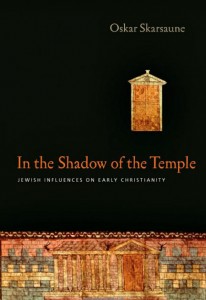
This is from the book "In the Shadow of the Temple: Jewish Influences on Early Christianity"
by Oskar Skarsaune

[1] pages 322-325 from the book In the Shadow of the Temple: Jewish Influences on Early Christianity by Oskar Skarsaune
by Oskar Skarsaune
""Jewish scholars in antiquity, the Middle Ages and modern times have almost unanimously claimed that the idea that Jesus is the incarnate Word of God is un-Jewish, a product of Christianity's transplantation from a Jewish milieu to a Gentile-Hellenistic milieu. Liberal Christian scholars in modern times have said much the same thing, as for example, the great historian of dogma, Adolf von Harnack. His saying has become famous: "The Christological dogma.....is a product of the spirit of Hellenism on the soil of the Gospel."
Now, as Harnack was well aware, there is no way of holding the eastern creed to be basically Greek and un-Jewish, while at the same time holding John the Evangelist, or for that matter Paul, to be un-Greek and Jewish in their Christology. Therefore, according to many critical scholars, the process of "Hellenizing" Christianity must have begun very early, underway already in Paul, and seems to have reached a first climax in John 1:1-18 (the so-called Johannine Prologue).
In our time, the Jewish writer Pinchas Lapide has tried to understand this "Hellenization" in Christology as a conscious cultural adaptation. He says about Paul:
He brought the message of the Jewish Messiah to the pagan world with a commitment of complete faith.....He was successful in being a Greek for the Greeks and a Jew for the Jews. He possessed courage to display religious imagination. He knew that he would be rejected if he came either to Corinth or Rome and preached about an anointed Jewish Messiah who David's son. They would not understand what he was talking about. But for Greek and Roman ears, he would fare extremely well talking about an incarnate Son of God and a Logos, a divine Word who had descended in order to redeem the world. On the other hand, this made no sense to Galilean fishermen and shepherds. That was why Paul appeared in Jerusalem as a devout, faithful Jew proclaiming a Jewish Messiah, while for Greeks he spoke of a savior who was the Son of God.(7)
So this is the challenge we face in this chapter: Are Harnack, Lapide and a score of other experts correct in their evaluation of eastern Christology as utterly Hellenistic and un-Jewish?
Let us begin with an observation on the typical Hellenistic reaction to the dogma of the incarnate Son of God. Lapide would have us believe that this was something Gentile Hellenists would really appreciate, something they craved for, something they would embrace enthusiastically. But we have several authentic reports on the Gentile Hellenistic reaction, and it does not correspond to this picture at all. The available evidence shows, on the contrary, that most Hellenists reacted with disgust and contempt at the very idea of a divine incarnation, and with charges of blasphemy when they heard that the incarnate Son of God had suffered the uttermost shame of crucifixion. We will let one Gentile author speak for all. He is Celsus, a Platonist philosopher writing a polemic book against Christianity ca A.D. 175
God is good and beautiful and happy, and exists in the most beautiful state. If then he comes down to men, he must undergo change, a change from good to bad, from beautiful to shameful, from happiness to misfortune, and from what is best to what is most wicked. Who would choose a change like this? It is the nature only of a mortal being to undergo change and remolding, whereas it is the nature of an immortal being to remain the same without alteration. Accordingly, God could not be capable of undergoing this change..... Either God does change, as the Christians say, into a mortal body; and it has already been said that this is an impossibility. Or he does not change, but makes those who see him think that he does so, and leads them astray, and tells lies...Dear Jews and Christians, no God or child of God has either come down or would want to come down (from heaven)!
Tertullian once made a point of this difficulty, the offensiveness of the fact of the incarnation. It is as if he were striving to express the basic intuition that the offensiveness of the Christological dogma is precisely what makes it ring true. Nobody would have dreamt of inventing anything so offensive! Besides, Tertullian reminds us, Paul has warned us that in the gospel we meet the foolishness of God. But, he says to Marcion, if you eliminate the birth and the suffering of the divine Son from the gospel, there is no foolishness left.
Which is more unworthy of God, which is more likely to raise a blush of shame, that God should be borne, or that he should die? That he should bear the flesh, or the cross? be circumcised, or be crucified, be cradled or be coffined, be laidin a manger, or in a tomb?
The Son of God was crucified. I am not ashamed of it, because it seems shameful. And the Son of God dies, it is by all means to be believed, because it is absurd. And He was buried, and rose again; the fact is certain, precisely because it is impossible. (De carne Christi 5.1, 4) (9)
Thus, according to Tertullian, the very offensiveness of the Christological confession carries the conviction of its truth. This is not something we have made up.
So Celsus and Tertullian have made us aware of the true response to the concept of incarnation in the Hellenistic world. And that means that the Christian doctrine of the incarnation can hardly be the product of a milieu- the Hellenistic- that regarded this doctrine as a philosophical and theological monstrosity. Nor can it be the brilliant idea of someone trying to speak the way Hellenists liked." [1]
[1] pages 322-325 from the book In the Shadow of the Temple: Jewish Influences on Early Christianity by Oskar Skarsaune
Thursday, July 18, 2013
An Orthodox Priest talks about the protestant view of Salvation by Faith Alone
Wednesday, July 17, 2013
What the pagans thought about some of our Christian practices
This is from the book The Cult of the Saints: Its Rise and Function in Latin Christianity by Peter Brown (this is from the Kindle edition)
""Nothing could be more misleading than to assume that, by the middle of the fourth century, some insensible tide of religious sentiment had washed away the barriers by which Mediterranean pagans had sought for so long to mark off the human dead from the living. Far from it: on this point, the rise of Christianity in the pagan world was met by deep religious anger. We can chart the rise to prominence of the Christian church most faithfully by listening to pagan reactions to the cult of martyrs.
For the progress of this cult spelled out for the pagans a slow and horrid crumbling of ancient barriers which presaged the final spreading again over the earth of that “darkness spoken of in the old myths” in which all ancient landmarks would be blotted out.27 In attacking the cult of saints, Julian the Apostate mentions the cult as a novelty for which there was no warrant in the gospels; but the full weight of his religious abhorrence comes to bear on the relation between the living and the corpses of the dead that was implied in the Christian practice:
“You keep adding many corpses newly dead to the corpse of long ago. You have filled the the whole world with tombs and sepulchres.”28
He turned against the cult practiced at the tombs of the saints all the repugnance expressed by the Old Testament prophets for those who haunted tombs and burial caves for sinister purposes of sorcery and divination.29 As an emperor, Julian could give voice to his own profound distaste by reiterating the traditional Roman legislation that kept the dead in their proper place. How could men tolerate such things as Christian processions with relics? …The carrying of the corpses of the dead through a great assembly of people, in the midst of dense crowds, staining the eyesight of all with ill-omened sights of the dead. What day so touched with death could be lucky? How, after being present at such ceremonies, could anyone approach the gods and their temples?30
In an account of the end of paganism in Egypt, by Eunapius of Sardis, we catch the full charnel horror of the rise of Christianity
: For they collected the bones and skulls of criminals who had been put to death for numerous crimes…made them out to be gods, and thought that they became better by defiling themselves at their graves. “Martyrs” the dead men were called, and ministers of a sort, and ambassadors with the gods to carry men’s prayers.31
In the course of the late fourth and fifth centuries, the growth of the cult of martyrs caused a visible shift in the balance of importance accorded to the areas of the living and the areas of the dead in most late-antique towns. Great architecture mushroomed in the cemeteries. To take only one example: at the beginning of the fifth century, the north African city of Tebessa came to be flanked by an enormous pilgrimage site, built in the cemetery area, presumably around the grave of Saint Crispina. The shrine was in the full-blooded, public style associated with the Theodosian renaissance. Its pilgrim’s way, 150 meters long, passed under great triumphal arches and along arcaded courtyards, echoing, among the tombs outside Tebessa, the porticoes and streets of a classical city.32 In the same years Paulinus of Nola could congratulate himself on having built around the grave of Saint Felix, in a peripheral cemetery area still called Cimitile, “the cemetery,” a complex so impressive that the traveler might take it for another town.33""
Brown, Peter (2009-02-15). The Cult of the Saints: Its Rise and Function in Latin Christianity (Haskell Lectures on History of Religions) (pp. 7-8). University of Chicago Press. Kindle Edition.

The Unity of God
From the book Being as Communion: Studies in Personhood and the Church by John D. Zizioulas
>
""As is known, the final formulation of the doctrine of the Holy Trinity speaks of "one substance, three persons" (μία ουσία τρία άτομα). One would therefore have said that the unity of God, the "ontology" of God, consists in the substance of God. This would bring us back to the ancient Greek ontology: God first is God (His substance or nature, His being), and then exists as Trinity, that is, as persons. This interpretation in fact prevailed in Western theology and unfortunately entered into modern Orthodox dogmatics with the arrangement in the dogmatic handbooks of the headings "On the One God" followed by "On the Trinity." The significance of this interpretation lies in the assumption that the ontological "principle" of God is not found in the person but in the substance, that is, in the "being" itself of God. Indeed the idea took shape in Western theology that that which constitutes the unity of God is the one divine substance, the one divinity; this is, as it were, the ontological "principle" of God.
But this interpretation represents a misinterpretation of the Patristic theology of the Trinity. Among the Greek Fathers the unity of God, the one God, and the ontological "principle" or "cause" of the being and life of God does not consist in the one substance of God but in the hypostasis, that is, the person of the Father. The one God is not the one substance but the Father, who is the "cause" both of the generation of the Son and of the procession of the Spirit. Consequently, the ontological "principle" of God is traced back, once again, to the person. Thus when we say that God "is," we do not bind the personal freedom of God - the being of God is not an ontological "necessity" or a simple "reality" for God - but we ascribe the being of God to His personal freedom.
In a more analytical way this means that God, as Father and not as substance, perpetually confirms through "being" His free will to exist. And it is precisely His Trinitarian existence that constitutes this confirmation: the Father out of love - that is, freely - begets the Son and brings forth the Spirit. If God exists, He exists because the Father exists, that is, He who out of love freely begets the Son and brings forth the Spirit. Thus God as person - as the hypostasis of the Father - makes the one divine substance to be that which it is: the one God. This point is absolutely crucial. For it is precisely with this point that the new philosophical position of the Cappadocian Fathers, and of St. Basil in particular, is directly connected. That is to say, the substance never exists in a "naked" state, that is, without hypostasis, without "a mode of existence." And the one divine substance is consequently the being of God only because it has these three modes of existence, which it owes not to the substance but to one person, the Father. Outside the Trinity there is no God, that is, no divine substance, because the ontological "principle" of God is the Father. The personal existence of God (the Father) constitutes His substance, makes it hypostases. The being of God is identified with the person.
3. What therefore is important in Trinitarian theology is that God "exists" on account of a person, the Father, and not on account of a substance. Because it's significance is not simply theoretical or academic but profoundly existential, ..........................."" [1]
"The manner in which God exercises His ontological freedom, that precisely which makes Him ontologically free, is the way in which He transcends and abolishes the ontological necessity of the substance by being God as Father, that is, as He who "begets" the Son and "brings forth" the Spirit. This ecstatic character of God, the fact that His being is identical with an act of communion, ensures the transcendence of the ontological necessity which His substance would have demanded - if the substance were the primary ontological predicate of God - and replaces this necessity with the free self-affirmation of divine existence. For this communion is a product of freedom as a result not of the substance of God but of a person, the Father - observe why this doctrinal detail is so important - who is Trinity not because the divine nature is ecstatic but because the Father as a person freely wills this communion." [2]<>
[1] pages 40-42 from the book Being as Communion: Studies in Personhood and the Church by John D. Zizioulas
[2] page 44 from the book Being as Communion: Studies in Personhood and the Church by John D. Zizioulas

Tuesday, July 16, 2013
An early prayer to the Theotokos

http://theoblogoumena.blogspot.com/2007/08/john-rylands-papyrus-470.html
This papyrus fragment is a prayer to the Theotokos written about 250 A.D., per papyrologists who have examined the handwriting style. (Theotokos means "God-bearer," a term for Mary that was formally affirmed at the Third Ecumenical Council held at Ephesus in 431.) Some initially placed the papyrus in the fourth or fifth century (the John Rylands Library description below lists it as 3rd - 4th century), perhaps because they didn't think that Christians would have been praying to the Theotokos that early. If the early dating is correct, this prayer must have already been part of the Church's services or prayers, showing that petitions and prayers to the Theotokos and the Saints go back to the early days of the Church, perhaps to the second century.
1 ΥΠΟ ΤΗΝ CΗΝ2 ΕΥCΠΛΑΓΧΝΙΑΝ3 ΚΑΤΑΦΕΥΓΟΜΕΝ4 ΘΕΟΤΟΚΕ ΤΑC ΗΜΩΝ5 ΙΚΕCΙΑC ΜΗ ΠΑ6 ΡΙΔΗC ΕM ΠΕΡΙCΤΑCΕΙ7 ΑΛΛ' ΕΚ ΚΙΝΔΥΝΟΥ8 ΡΥCΑΙ ΗΜΑC9 ΜΟΝΗ ΑΓΝΗ, ΜΟΝ10 Η ΕΥΛΟΓΗΜΕΝΗ
1 Beneath your
2 compassion
3 we take refuge
4 Theotokos Our
5 petitions do not de-
6 spise in time of trouble
7 but from danger
8 rescue us
9 Only Holy On-
10 ly Blessed
http://catholic-concepts.com/2013/07/09/250-a-d-christian-prayer-to-mary/
Subscribe to:
Posts (Atom)
POPULAR POSTS
-
Have you ever noticed how Protestantism demonizes (divides) between things which no sane, God-fearing person would ever dare to tear asunder...
-
Audio Confronting the Doctrine of Sola Scriptura , by Fr. Jon Braun. (This one is mostly about what some Protestants call Solo Scriptura , o...
-
It's because of stuff like this floating around online: Calvinism Declared By The Church Fathers . TOTAL DEPRAVITY Barnabas (A.D. 70 ):...
-
 Unfortunately, not a whole lot is known about St. Melito of Sardis. He wrote around the year AD 170. If the lists of books attributed to him...
 -
This text is one of the most critical texts for defending the Protestant doctrine of Sola Fide , that is, salvation by grace, through faith,...

LORD JESUS CHRIST,
SON OF GOD,
HAVE MERCY ON US,
THE SINNERS.

Subscribe To


 Posts
All Comments
Posts
All Comments